

Yiddish Musical Theater in the United States

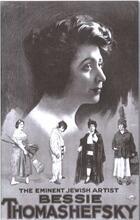
Jewish women on stage in America took on a variety of musical roles and performed all kinds of songs, including religious hymns and liturgical chants. Female performers were regularly featured on Yiddish theater posters and commercial sheet music, reflecting the preponderance of central female characters in the Yiddish stage repertoire. In its heyday, the Yiddish stage mirrored American Jewish life. Family matters had particular importance in that area of immigrant accommodation and acculturation to American life, and the nobility of motherhood was celebrated in legions of stories and songs. An amazing range of women’s woes were highlighted, discussed, and often resolved across the footlights, presenting the reality that immigrant women faced to an extent not paralleled in the English-language theatrical world during those years.
European Antecedents
From 1876 to the early 1880s, operettas, plays that combined spoken dialogue, music, songs, and dances on a light topic or theme, became popular in Jewish communities in Russia, Romania, Austria, and Poland. Beginning with some of his earliest productions, Avrom Goldfaden, the self-styled “father” of Yiddish theater, devised operettas for his troupes of singer-actors and instrumentalists. As this new genre of theater became more popular, it gradually began to feature women playing the female roles instead of young boys. By the 1880s, as the center of gravity for Yiddish theater shifted westward, Yiddish operettas and their artists began to immigrate to America.
Migration to America
 view larger
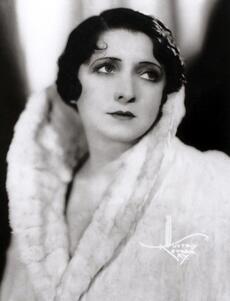
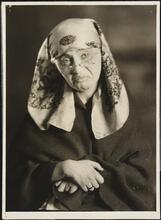
Opera singer Sophie Braslau.
Institution: Library of Congress
 view larger
Courtesy of the American Jewish Historical Society. view details
 view larger
Courtesy of a private collection. view details
 view larger
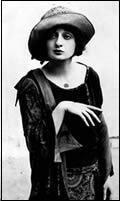
Actress and theater director, Celia Adler (1889-1979).
view detailsfield_section_text_value
field_section_text_value
field_section_text_value
field_section_text_value
Mirroring American Jewish Life on Stage
-
 view largerActress Jennie Goldstein.
Courtesy of the American Jewish Historical Society. view details -
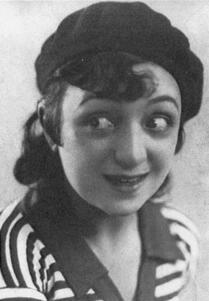 view larger
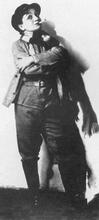
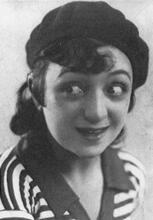
For more than eighty years Molly Picon charmed the public and helped keep the Yiddish theater alive. Best known for her potrayals of "the adorable waif" (often a boy) in Yiddish plays, she also acted, sang and danced her way through English plays, and appeared on film, television and on Broadway.
Institution: American Jewish Historical Society
view details


field_section_text_value
field_section_text_value
field_section_text_value
Green, Stanley. Encyclopaedia of the Musical Theatre. New York: Dodd Mead, 1976.
Heskes, Irene. The Music of Abraham Goldfaden: Father of the Yiddish Theater. New York: Tara Publications, 1990.
Heskes, Irene. Passport to Jewish Music: Its History, Traditions, and Culture. New York: Tara Publications, 1994.
Heskes, Irene. Yiddish American Popular Songs, 1895 to 1950. Washington, DC: Library of Congress, 1992.
Landis, Joseph C., ed. Memoirs of the Yiddish Stage. Flushing, NY: Queens College Press, 1984.
Lifson, David S., trans. and ed. Epic and Folk Plays of the Yiddish Theatre. Rutherford, NJ: Fairleigh Dickinson University Press, 1975.
Sanders, Ronald. The Downtown Jews: Portraits of an Immigrant Generation. New York: Harper & Row, 1969.
Sandrow, Nahma. Vagabond Stars: A World History of Yiddish Theater. New York: Harper & Row, 1977.
Rosenfeld, Lulla Adler. Bright Star of Exile: Jacob Adler and the Yiddish Theatre. New York: Thomas Y. Crowell Company, 1977. Rev. ed., The Yiddish Theatre and Jacob P. Adler. New York: Shapolsky Publishers, 1988.
Slobin, Mark. Tenement Songs: The Popular Music of the Jewish Immigrants. Urbana, IL: University of Illinois Press, 1982.
More Like This

Double your impact to amplify Jewish women’s stories—
All gifts matched up to $35,000
Before you close this article, please consider supporting the Jewish Women’s Archive and uplifting Jewish women’s voices.
At JWA, we preserve the voices of Jewish women and gender-expansive people past and present, share them freely with millions online, and empower a new generation of Jewish feminists to lead with courage, creativity, and conviction.
But none of this happens without you. JWA is an independent nonprofit— we rely on people, like you, who believe that history belongs to all of us and that the voices of Jewish women must remain powerful, and heard.
This month, a generous JWA board member will match every gift dollar for dollar—up to $35,000—through June 30. Your contribution goes twice as far right now.
Every contribution—no matter the size—helps us document, teach, and inspire through Jewish women’s stories.
It takes less than a minute to make a difference.
Thank you for being a part of the JWA community,
Judith Rosenbaum, CEO

