

Yiddish Theater in the United States

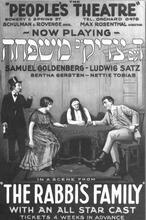
Women have always been important as both Yiddish theater audiences and actors. The Golubok company, with star Madame Sara Krantsfeld, was the first to arrive in the United States, in 1882, at the start of the great wave of Jewish immigration. For a decade and more, most American Yiddish actors were immigrants, as were their audiences. Many female actors married men in the theater community and their names have remained linked in pairs with their husbands’. Often families played in the same company, such as the famous Adler family. Women were also connected with professional Yiddish theater in creative capacities other than performing, including composition, playwriting, and scholarly work. Now, as Yiddish theater has become attenuated, the loyalties and memories of women are important for its survival.
During the Middle Ages and for most of the centuries since then, Ashkenazim—the Yiddish-speaking Jews of central and Eastern Europe—produced virtually no theater at all. Since ancient times, rabbinic Jewish tradition had disapproved of theater, for men and women alike. Moreover, it was specifically considered immodest for women to perform for men. Men were prohibited from hearing women’s voices singing, and women were prohibited from dressing as men. Finally, unlike other Western cultures, in many of whose theaters men played women’s roles up into early modern times, Jewish men were permitted to dress as women only as part of the topsy-turvy merrymaking of the Holiday held on the 14th day of the Hebrew month of Adar (on the 15th day in Jerusalem) to commemorate the deliverance of the Jewish people in the Persian empire from a plot to eradicate them.Purim holiday. For that reason, it was only during Purim, in early spring, that lively amateur entertainments were produced, and even then women participated only as spectators. Professional Yiddish theater did not exist until 1876. Until then there were only groups of wandering acrobats, among whom, however, two women’s names are recorded: Ruza and Feygele.
Nineteenth-Century Yiddish Theater
During the late-nineteenth-century Jewish Enlightenment; European movement during the 1770sHaskalah [Enlightenment] period, when Eastern European Ashkenazi culture was becoming more modern and cosmopolitan, some Yiddish plays were written to be read at home as sophisticated literary entertainment. The first recorded actual performance of one of these plays was organized in 1862 by Madame Slonimsky, wife of the new headmaster of the Zhitomer Academy for boys in Zhitomer, Poland. Her husband’s students played all the roles. The play was Serkele, by Shlomo Etenger. The title role, a strong-willed female character, was played by a boy named Avrom [Abraham] Goldfaden, who grew up to establish the first professional Yiddish troupe.
Goldfaden’s troupe, formed in Jassy, Romania, in 1876, was one manifestation of a general loosening of governmental restrictions on Jewish culture from the outside, as well as a loosening of traditional rabbinic restrictions from inside. The first company consisted of Goldfaden plus one actor. He soon hired a second actor, Sakher Goldstein, to play women’s roles as well as men’s. Goldfaden’s wife, Paulina, served the enterprise as the translator of French and German popular plays into Yiddish.
Probably the first woman to perform on the Yiddish stage was Sara Segal, a sixteen-year-old seamstress with dark eyes and a sweet soprano voice. However, her mother refused permission until Goldstein, being the only unmarried company member, married her and took her along on their wandering life. She changed her name to the European-sounding Sophie, becoming Sophie Goldstein. Later, in New York, she married another actor, making her name Sophie Goldstein-Karp, or Sophia Karp. Karp was the first woman whose profession was Yiddish theater, and she was typical of the many hundreds who followed. She was an actor, known for glamour and charm. She occasionally participated in a venture as producer or even director as well as star. (Karp is said to have died of a theatrical dispute. In an effort to prove her claim on a certain theater, she refused to leave the building, even sleeping on the unheated stage, until she caught pneumonia and died.) But this was minor, and in fact women in Yiddish theater were primarily performers.
The Golubok company was the first to arrive in the United States, in 1882, at the start of the great wave of Jewish immigration. Their prima donna was a Madame Sara Krantsfeld. Sophie Karp and many other actors came shortly afterward. For a decade and more, most American Yiddish actors were immigrants, as were their audiences, but Yiddish theater was so new that many who were born in Europe made their debuts in the new land. Others started careers in the Old Country and then immigrated; by 1900, talent scouts were aggressively importing actors whose reputations had arrived at Ellis Island along with other news from home.
Most of the qualities associated with Yiddish actors were already clear in the 1880s. Theatergoers favored fiery temperament and emotionalism in drama, and “quicksilver” energy in comedy, for female and male actors alike. As the theater acquired serious playwrights and discriminating audiences, truthfulness and sensitivity became highly valued. Types, in the styles of the period, included queenly lovers, strong heroines, glamorous villainesses, saucy soubrettes, and devoted mammas. And since music was interpolated in most shows, even including serious straight dramas, a good singing voice was also important.
From the beginning, many female actors married men in the theater community, and their names were and have remained linked in pairs with their husbands’. Eventually there came to be many actors’ daughters as well. Often families played in the same company. Companies generally formed for a season, or for a tour, and touring companies moved not only around the United States but also back and forth to Eastern Europe and Russia. It was also not unusual to visit Western Europe, South America, or South Africa. On tour many actors took along their children, who soon learned to perform. The American capital of Yiddish theater was New York City, where at times as many as fourteen theaters were filled simultaneously, not counting vaudeville and cabaret. But there were also professional theaters in other cities around the country, such as Philadelphia, Detroit, and Providence.
Because the Yiddish public was passionate about theater, they generally were aware of actors’ private lives, including romances, which were matters of comment in theater columns and critiques in the press. Although respectable families were not pleased if their daughters went on the stage, actors committed to intellectual or political ideals were highly respected by the intelligentsia, and for the community at large the presence of actors lent dash and style to café life. Actors, like other performers, customarily contracted for one night a season to be played for their own benefit. In this practice, not unique to Yiddish theater, the performer picked and cast the play. On these benefit nights, the house might be filled with an actor’s enthusiastic fans, and the box office take came to a significant yearly bonus. She might also receive gifts in addition to money profits.
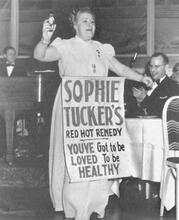
Popular Stars of the Yiddish Stage
field_section_text_value
Yiddish Theater in the Later Twentieth Century
field_section_text_value
Female Professionals in Yiddish Theater
field_section_text_value
Conclusion
Women have always been important as Yiddish theater audiences. In the early sweatshop days, working girls spent hard-earned pennies for tickets. Girls went to the theater in friendly groups or on dates. It was the custom for fraternal organizations to buy out a performance and sell tickets to raise money, and women often went to such performances in order to meet people from back home in the Old Country. Mothers could bring along their children, with picnic lunches to keep them fed during long matinees. Dramas of life in America provided them with ways to learn about the new country and try out, vicariously, new ways to cope. Translations of world classics or of Broadway hits were glimpses of the outside world. Escapist operettas and comedies offered relief from the hardships of immigration and poverty. And women’s tastes influenced the theater world. Actors whom women found handsome played leading roles; there are many tales of women swooning in the aisles and running after Adler or Thomashefsky. Actors whom women admired, whose styles they copied, became stars and remained stars long past their youth. Now, as Yiddish theater is attenuated, the loyalties and memories of women are important for its survival.
For a detailed overview of Yiddish theater see Vagabond Stars: A World History of Yiddish Theater, by Nahma Sandrow (1977). The volume includes an extensive bibliography of sources in both Yiddish and English.
More Like This

Double your impact to amplify Jewish women’s stories—
All gifts matched up to $35,000
Before you close this article, please consider supporting the Jewish Women’s Archive and uplifting Jewish women’s voices.
At JWA, we preserve the voices of Jewish women and gender-expansive people past and present, share them freely with millions online, and empower a new generation of Jewish feminists to lead with courage, creativity, and conviction.
But none of this happens without you. JWA is an independent nonprofit— we rely on people, like you, who believe that history belongs to all of us and that the voices of Jewish women must remain powerful, and heard.
This month, a generous JWA board member will match every gift dollar for dollar—up to $35,000—through June 30. Your contribution goes twice as far right now.
Every contribution—no matter the size—helps us document, teach, and inspire through Jewish women’s stories.
It takes less than a minute to make a difference.
Thank you for being a part of the JWA community,

Judith Rosenbaum, CEO