

Women, Music, and Judaism in America

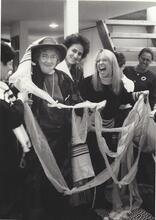
First Women Cantors’ Network Conference, Congregation Beth El
Norwalk, CT, May 1982. Left to Right: First row: Deborah Katchko (Norwalk, CT), Linda Shivers (Highland Park, NJ), Doris Cohen (Flushing, NY), Rochelle Helzner (Washington, D.C.), Jane Myers (Philadelphia, PA), Elaine Shapiro (W.Palm Beach, FL), Ruth Devorah (New York, NY). Second row: Sue Roemer (Silver Spring, MD.), Tzippy Bronstein, (Brooklyn, NY), Sheyne Mueller (New York, NY). Third row: Rita Glassman (New York, NY). Courtesy of the Women Cantors’ Network.
American Jewish women’s music has for more than a century been discussed in limiting terms; restrictive categories of musical genre, narratives of women’s “emergence” into male-coded spaces, and inherited wisdom about “Jewish music” have together concealed the diversity and cultural influence American Jewish women’s music. Rather than classifying the music American Jewish women created into these often limiting (and often male-coded) categories, this article discusses Jewish-identifying women’s broader musical activities in both religious and non-religious settings. The article highlights women’s contributions to amateur music-making in the home, music scholarship, liturgical music, Yiddish music, professionally recorded music, and more to illustrate the diverse modes of American Jewish women’s musical choices.
Introduction
Fully understanding the prolific history of women, Judaism, and music in America requires cutting through more than a century of inherited wisdom about the content and practice of “Jewish music.” Women have been deeply involved in Jewish communal, civic, and concert musical life from the earliest days. However, nineteenth-century efforts by (mainly male) scholars and cantors coded “Jewish music” as a male-dominated activity, with the synagogue and cantor at its center. Reinforced by rabbinical concerns over women’s voices, colloquially known as “Kol Isha,” this self-interested scholarship generally marginalized the musical activities of women as exceptions, auxiliaries to tradition, or liberal breakthroughs. (To cite one example: advocates of Jewish reform, while noted for their inclusion of women, also established the cantor as a normatively male figure in mixed-gender congregations.) More recent generations of researchers are rethinking these assumptions.
This article emphasizes American Jewish women’s multivalent musical choices rather than narratives of “emergence” into male-coded American Jewish music spaces. In doing so, it acknowledges that mainstream Jewish liturgical, educational, art, and “popular” music histories often exclude or minimize women’s participation—emphasizing “famous” cantors, composers, and performers, for example, while largely ignoring the many women who served as choir directors, organists, choristers, and local musicians in small- and medium-sized communities. It also acknowledges that the term “Jewish music” itself has long skewed male. Consequently, this article focuses on Jewish-identifying women’s activities in both religious and non-religious settings, rather than seeking to classify the music they create.
Jewish Women and Musical Leadership

Photo from A Woman of the Century: Fourteen Hundred-Seventy Biographical Sketches Accompanied by Portraits of Leading American Women in All Walks of Life, Frances E. Willard and Mary A. Livermore, eds. (Buffalo: Charles Wells Mouton,1893), 1812.

Courtesy of the Jacob Rader Marcus Center of the American Jewish Archives, Cincinnati, OH, www.americanjewisharchives.org and the National Federation of Temple Sisterhoods.
field_section_text_value
Fostering American Jewish Music Scholarship

"No thunder sounded. No lightening struck," recalled Judith Kaplan Eisenstein of her history-making 1922 Bat Mitzvah ceremony, the first in America. She is pictured here at her second Bat Mitzvah ceremony, where she was honored by a number of prominent Jewish women, including Betty Friedan and Letty Cottin Pogrebin.
Institution: The Ira and Judith Kaplan Eisenstein Reconstructionist Archives, Reconstructionist Rabbinical College
field_section_text_value
Postwar Liturgical Leadership

field_section_text_value
Yiddish Music

field_section_text_value
Women and Music in American Sephardi Populations

field_section_text_value
American Art Music

field_section_text_value
Negotiating Musical Spaces and Genres


field_section_text_value
Reconsidering the Past and Looking Forward
field_section_text_value
Adelstein, Rachel. “Braided Voices: Women Cantors in Non-Orthodox Judaism,” PhD Thesis, University of Chicago (2013).
Block, Adrienne Fried, and Carol Neuls-Bates. Women in American Music: A Bibliography of Music and Literature. Westport, CT: Greenwood Press, 1979.
Gordon, Dale. “A New Song: Feminism, Music, and Voice in Partnership Minyanim,” MA Thesis, Tufts University (2012).
Cohen, Judah M. “Professionalizing the Cantorate—and Masculinizing It?: The Female Prayer Leader and Her Erasure from Jewish Musical Tradition.” Musical Quarterly 101.4 (2018).
Heskes, Irene. The Music of Abraham Goldfaden: Father of the Yiddish Theater. Cedarhurst, NY: Tara Publications, 1990.
Heskes, Irene. Passport to Jewish Music: Its History, Traditions, and Culture. Cedarhurst, NY: Tara Publications, 1994.
Heskes, Irene. Yiddish American Popular Songs, 1895 to 1950. Washington, DC: Library of Congress, 1992.
Hetko, Adah R. “Lineage, Language, and Community Commitment: Contemporary Yiddish Women Singers and their Development of Yiddish Identity.” MA Thesis, Indiana University (2018).
"Nuptials at the Jewish Synagogue.” Alexandria Gazette and Advertiser LVIII, #101 (1857), 2.
Pendle, Karin, ed. Women and Music: A History. Bloomington, IN: Indiana University Press, 1991.
Koskoff, Ellen. Music in Lubavitcher Life. Urbana, IL: University of Illinois Press, 2001.
Rosenfeld, Lulla Adler. Bright Star of Exile: Jacob Adler and the Yiddish Theatre. New York: Shapolsky Publishers, 1986.
Ross, Sarah M. A Season of Singing: Creating Feminist Music in the United States. Waltham, MA: Brandeis University Press, 2016.
Rotem, Tamar. “Morality Plays.” Haaretz, January 7, 2005.
Salmon, Simone. “Emily Sene’s Sephardic Mixtape.” In 100 Years of Sephardic Los Angeles, edited by Sarah Abrevaya Stein and Caroline Luce. Los Angeles: UCLA Leve Center for Jewish Studies, 2020. https://sephardiclosangeles.org/portfolios/emily-senes-sephardic-mixtap….
Sandrow, Nahma. Vagabond Stars: A World History of Yiddish Theater. New York: Harper & Row, 1977.
Shelemay, Kay “The Power of Silent Voices: Women in the Syrian Musical Tradition.” In Music and the Play of Power in the Middle East, North Africa and Central Asia. edited by Laudan Nooshin. New York: Routledge, 2009.
Slobin, Mark. Tenement Songs: The Popular Music of the Jewish Immigrants. Urbana, IL: University of Illinois Press, 1982.
Tick, Judith. “Women in Music.” In The New Grove Dictionary of American Music, Vol. 4, edited by H. Wiley Hitchcock and Stanley Sadie. London: Macmillan, 1986.
Vaisman, Ester-Basya (Asya). “‘Hold On Tightly To Tradition’: Generational Differences in Yiddish Song Repertoires Among Contemporary Hasidic Women.” In Choosing Yiddish, edited by Lara Rabinovitch, Shiri Goren, and Hannah Pressman. Detroit, MI: Wayne State University Press, 2013
Wise, Isaac Mayer, “Does the Canon Law Permit Ladies to Sing in the Synagogue?” The Israelite II, 5-6 (1855).
More Like This



Double your impact to amplify Jewish women’s stories—
All gifts matched up to $35,000
Before you close this article, please consider supporting the Jewish Women’s Archive and uplifting Jewish women’s voices.
At JWA, we preserve the voices of Jewish women and gender-expansive people past and present, share them freely with millions online, and empower a new generation of Jewish feminists to lead with courage, creativity, and conviction.
But none of this happens without you. JWA is an independent nonprofit— we rely on people, like you, who believe that history belongs to all of us and that the voices of Jewish women must remain powerful, and heard.
This month, a generous JWA board member will match every gift dollar for dollar—up to $35,000—through June 30. Your contribution goes twice as far right now.
Every contribution—no matter the size—helps us document, teach, and inspire through Jewish women’s stories.
It takes less than a minute to make a difference.
Thank you for being a part of the JWA community,
Judith Rosenbaum, CEO

