
Theater in the United States

Since the 1860s, Jewish women have been involved in the American theater as writers, actors, directors, designers, dramaturgs, critics, and scholars. A number of women played important roles in the Yiddish theater that thrived in the late nineteenth and early twentieth centuries, leaving a rich legacy that is still carried on today. In the twentieth century, actors from Sophie Tucker and Fanny Brice to Barbra Streisand and Bette Midler shaped American theater, while writers contributed to both musical and nonmusical theater. In the last decades of the century, figures such as Judith Malina and Liz Swados rocked the foundations of the theater establishment. In the twenty-first century, an increasing number of Jewish women artists have embraced activism, confronted social issues, and explored personal history as part of the work of theater.
field_section_text_value
The Nineteenth Century
 view larger
"Accused" of sounding "like a Jew," French actress Sarah Bernhardt (1844-1923) wrote, "I am a daughter of the great Jewish race, and my somewhat uncultivated language is the outcome of our enforced wanderings." Indeed, she took her own theater company around the world, transforming herself, a member of the wandering race, into an object of worldwide welcome and acclaim. The great French actress appears here in 1880.
Institution: U.S. Library of Congress.
view details view larger
Courtesy of the American Jewish Historical Society. view details
 view larger
Courtesy of the American Jewish Historical Society. view details
 view larger
Theda Bara in Carmen, 1915.
view detailsfield_section_text_value
The Twentieth Century
-
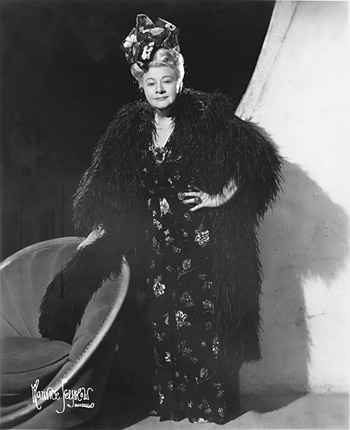
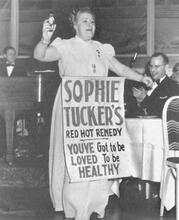
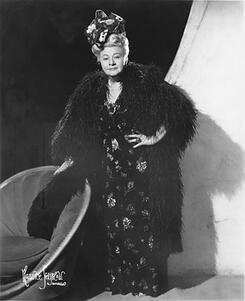 view largerSinger and comedian Sophie Tucker.
Courtesy of the Jacob Rader Marcus Center of the American Jewish Archives, Cincinnati, OH view details -
 view larger
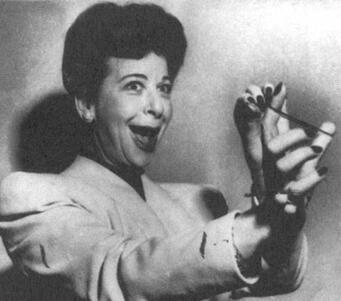
Actress, comedian, and singer, Fanny Brice (1891 – 1951) turned to show business to fulfill her version of the American dream— and for over forty years, this "clown with the Yiddish-accent" delighted audiences throughout the country.
Institution: Private collection.
view details -
 view larger
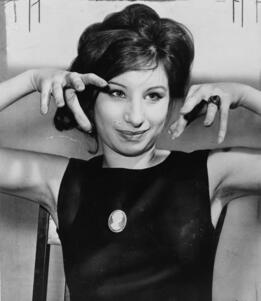
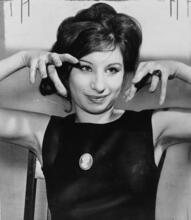
Actress, singer, film director/producer, and founder of the Streisand Foundation, Barbra Streisand in 1962.
Photo from Wikimedia Commons.
view details -
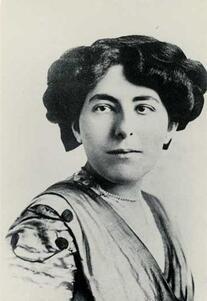 view larger
Edna Ferber (1885–1968) was a Pulitzer Prize winning novelist and playwright. This image is a portrait of Ferber taken after she won the state oratory contest and graduated from high school.
view details -
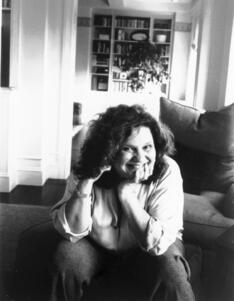 view largerWendy Wasserstein.
Courtesy of Jill Krementz, Lincoln Center Theater. view details -
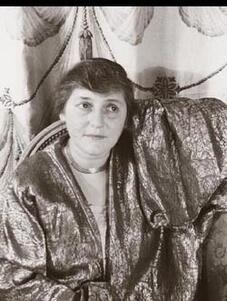 view larger
A photograph of theatrical designer and writer Aline Bernstein taken by Carl Van Vechten on February 26, 1933.
Courtesy of Van Vechten Trust.
view details -
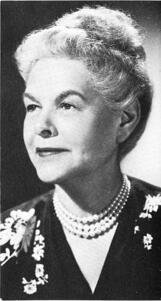 view larger
Theresa Helburn in 1919.
view details
Courtesy of Lawrence Langner's G. B. S. and the Lunatic published in 1963.


field_section_text_value
The Twenty-First Century


field_section_text_value
Contemporary Challenges
The question of defining what constitutes “Jewish” or “Jewishness,” particularly onstage, continues to challenge Jewish theater. Many of the artists referenced here are profoundly secular, of mixed heritage, and do not always create specifically Jewish theater. Many artists continue to grapple with the Holocaust, as the last survivors pass away and audiences face modern reminders of genocide. Conflicts about Zionism and Israeli/Palestinian theater have also proved difficult to navigate, and the political climate in the United States often makes collegiality difficult to maintain. As a result of the #MeToo movement, a number of Jewish men in the theater industry have been exposed as sexually and emotionally abusive.
Antisemitic acts and violence on the arts have also been profoundly discouraging. For example, at the Oregon Shakespeare Festival, Shana Cooper’s production of Indecent went into rehearsal just a few months after the murders of Jews in Poway and Pittsburgh. This production of Indecent was also the first to include Jews of color (Rebecca S’Manga Frank and Bill DeMerritt), who faced racism from the audience, including from white Jews, who questioned their Jewishness. Indeed, many portrayals of Jews on stage remain based on a white, “Ashkenormative” idea of Jewishness, even though it has been 25 years since Wasserstein’s An American Daughter featured an observant Black Jew, Dr. Judith Kaufman. Today, reflecting the demographic changes in America and the American Jewish community, a growing number of performers garnering acclaim are Jews of color including Frank, Demerritt, Nicolette Robinson, and Daveed Diggs of Hamilton (And “I Want a Puppy for Hanukkah”) fame. But questions about representation of Jews on stage and screen continue, especially about who gets to be Jewish on stage. Indecent’s success created more opportunity for Jews to be Jews in theater. Indeed, many involved in productions of Vogel’s play remark that it was the first time they got to be Jewish for a play; for Jews of color, this is even more significant.
Newer companies like the Jewish Plays Project, a competition and development initiative, and theatre dybbuk, a company committed to Jewish performance and education, have begun to offer more opportunities for Jewish artists to make positive change in the theater. HowlRound and American Theatre magazine have recently published articles on Jewish themes and questions. There are also new spaces for observant Jews to be able to practice their art, such as 24/6, a theater that honors Shabbat, and the training program Kol Neshema, founded by Robin Garbose, which invites girls and women to study theater and film with a Torah perspective.
Stella Adler’s question of almost a century ago—how artists can practice their craft in ways that will do less harm to themselves and others—continues to resurface. Intimacy Direction has emerged as a new field within theater, and Jewish women including Sarah Lozoff, Rachel Flesher, and Maya Herbsman are rising in prominence as this new collaborative role committed to physical and emotional safety becomes more common.
Questions about how Jewish American artists work have risen to the forefront as people emerge from the forced shutdown of the COVID-19 pandemic and the cries for justice and equality that reverberated so profoundly after the murder of George Floyd and many other people of color. During the pandemic shutdown, many institutions reckoned with a powerful document issued in 2020 by a collective of theater artists entitled We See You, White American Theater. Among the signers are a few Jews of color. It has been a time of difficult conversations and anti-racist work, which sits alongside the work to improve conditions and increase opportunities for women. Rachel Chavkin’s impassioned 2019 Tony speech captured the feeling of many artists: “There are so many women who are ready to go. There are so many artists of color who are ready to go. And we need to see that racial diversity and gender diversity reflected in our critical establishment, too. This is not a pipeline issue. It is a failure of imagination by a field whose job is to imagine the way the world could be.”
No one article can encompass the entire history of Jewish American women’s contribution to theater in the United States. For example, trans artists, stage managers, and agents and managers are not included, and certainly many actors, writers, directors, designers, and more have been missed. Despite great progress, many women have had no choice but to hide their Jewishness, and even today some feel that stinging tradition lingers. Theater, though, has provided space to so many Jewish women, who have contributed their many talents, pushing the art of the theater to greater heights and giving strength and depth to its intellectual and creative foundations. They have written great plays. They have performed onstage with skill, strength, and sensitivity. They have been innovators in lighting, costume, and scenic design. They have directed productions. They have challenged and inspired with their critical writing. They have founded and run their own theater companies. And they have nurtured talent as teachers. Jewish women have been there from the beginning, they have performed with distinction, and they will continue to do so.
Adler, Stella. The Technique of Acting (1990)
Bigsby, C.W.E. A Critical Introduction to Twentieth Century Drama (1985)
Bordman, Gerald, ed. Oxford Companion to American Theatre (1992)
Brock, Pope. “Stella Adler: The Fiery First Lady of American Acting.” People Weekly 32, no. 3 (July 17, 1989): 66
Brustein, Robert. Making Scenes: A Personal History of the Turbulent Years at Yale, 1966–1979 (1984), and The Third Theatre (1970)
Chinoy, Helen Krich, and Linda Walsh Jenkins, eds. Women in American Theatre (1987)
Clurman, Harold. The Fervent Years: The Story of the Group Theatre and the Thirties (1957)
Cohen, Sarah Blacher, ed. From Hester Street to Hollywood: The Jewish-American Stage and Screen (1986)
Croyden, Margaret. Lunatics, Lovers and Poets: The Contemporary Experimental Theatre (1974)
Goldman, William. The Season (1970)
Guernsey, Otis L. Curtain Times: The New York Theatre, 1965–1987 (1987)
Hewes, Henry. Saturday Review (December 30, 1967): 18
Lifson, David S. The Yiddish Theatre in America (1965)
Lynes, Russell. The Lively Audience: A Social History of the Visual and Performing Arts in America, 1890–1950 (1985)
Malin, Ella A. “The Season around the United States with a Directory of Professional Regional Theatres.” The Best Plays of 1965–1966 (1966): 42
Malina, Judith. The Diaries of Judith Malina, 1947–1957 (1984)
Neff, Renfreu. The Living Theatre: USA (1970)
Picon, Molly, and Jean Bergantini Grillo. Molly! (1980)
Sandrow, Nahma. Vagabond Stars: A World History of Yiddish Theater (1977)
Schiff, Ellen. Awake and Singing: Seven Classic Plays from the American Jewish Repertoire (1995), and Fruitful and Multiplying: Nine Contemporary Plays from the American Jewish Repertoire (1996)
Sherin, Edwin. “In the Words of Edwin Sherin.” Cue (May 24, 1969): 15
Theatre Profiles 9 (1990)
Wilmeth, Don B., and Tice L. Miller. Cambridge Guide to American Theatre (1996)
Zeigler, Joseph Wesley. Regional Theatre: The Revolutionary Stage (1973).
More Like This


Double your impact to amplify Jewish women’s stories—
All gifts matched up to $35,000
Before you close this article, please consider supporting the Jewish Women’s Archive and uplifting Jewish women’s voices.
At JWA, we preserve the voices of Jewish women and gender-expansive people past and present, share them freely with millions online, and empower a new generation of Jewish feminists to lead with courage, creativity, and conviction.
But none of this happens without you. JWA is an independent nonprofit— we rely on people, like you, who believe that history belongs to all of us and that the voices of Jewish women must remain powerful, and heard.
This month, a generous JWA board member will match every gift dollar for dollar—up to $35,000—through June 30. Your contribution goes twice as far right now.
Every contribution—no matter the size—helps us document, teach, and inspire through Jewish women’s stories.
It takes less than a minute to make a difference.
Thank you for being a part of the JWA community,

Judith Rosenbaum, CEO