Writing

Content type
Collection
Leaf spine

Exploring My Latin Jewish Roots Through the The Jews of the Americas Fellowship

Deborah Leipziger

Brandeis University's Jews of the America's Fellowship has prepared me to explore themes of migration, the environment, and the arrival of my Italian and German grandparents to Brazil.

Joelle Maxx Milman

Meet Joelle Maxx Milman, Author of 'Repartings: Poems of Haftara'

Sarah Biskowitz

Joelle Maxx Milman is a writer, artist, activist, and translator whose new book, Repartings: Poems of Haftara, includes original translations of prophetic texts alongside her own poetic responses.

Topics: Poetry, Bible

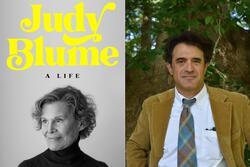
Episode 141: The Quiet Radicalism of Judy Blume

For generations of readers, Judy Blume's novels made growing up feel less lonely. In this episode, Judith Rosenbaum talks with Mark Oppenheimer, author of a new biography of Blume, about their favorite Blume titles, what’s Jewish about her work, and why her novels are radical in ways people often overlook. Throughout the episode, listeners share what Judy Blume's books mean to them.

Gella Sänger

Gella Sänger (née Hirsch) was a Neo-Orthodox author, editor, and bookseller living in Fürth in Bayern, Germany. She was the first woman affiliated with (Neo-)Orthodoxy to write a guide to Jewish law and practice for women and girls. 

Song of the Blue Bird

Review: 'The Song of the Blue Bird'

Zia Saylor

The remarkable gift of this biblical trilogy, carefully crafted by Goldenberg, centers on its applicability and relevance to present struggles.

'All Of A Kind Family' Books

One Hundred Years and Worlds Apart: The Enduring Power of 'All-of-a-Kind Family'

Naomi Granek-Brown

When I first read All-of-a-Kind Family, I fell in love with its depiction of Jewish culture integrated into normal life.

Topics: Fiction
Meet the Fellows Thumbnail

Reflecting on JWA's First Pomegranate Fellowship Cohort

Marcella White Campbell

As their writing continues to be published this spring and beyond, look out for the work of Rachel, Anjelica, Sai, Emily, and Hannah, and the many other Jewish writers of color whose work is already changing the world.

Topics: Writing

Paula Brown Doress-Worters

Working with Paula was always a joy. She was witty, hard-working, playful, and always so thoughtful. I continue to admire how she helped so many better understand the injustices we all face by drawing from her own and others’ lived experiences. 

Micaela Feldman/Mika Etchebehere

Micaela Feldman, known primarily as “Mika Etchebehere/Etchebéhère,” was a Spanish-language writer who also published in French, bearing witness to several major political events and intellectual debates of the twentieth century in Argentina and Europe. In particular, she played a prominent role in the Spanish Civil War as the captain of a revolutionary militia fighting against Francisco Franco’s and the Falange’s fascism. She rose to wider fame in 1976 with the publication of her autofiction Ma guerre d’Espagne à moi/Mi guerra de España.

Amy Levy, January 1889

Who Owns a Story? Uncovering the Archives of Amy Levy

Zia Saylor

In November 2025, the University of Cambridge purchased and promptly unsealed the previously private papers of Anglo-Jewish author Amy Levy.

Galinka Ehrenfest

Galinka Ehrenfest, born in Estonia but raised in the Netherlands, was the chief originator, designer, and illustrator behind “ El Pintor,” a collective that created beautiful and imaginative children’s books published in the Netherlands during World War II. 

Alicia Partnoy

Alicia Partnoy, a survivor of Argentina’s so-called “Dirty War” (1976-1983), is an Argentine author, activist, and scholar who lives in Los Angeles, California. Her best known work is The Little School: Tales of Disappearance and Survival, which was introduced as evidence in the trials against the perpetrators in charge of the secret detention camps in her hometown and in the South of the country. 

Marie Curie Nobel Prize Award

Jewish Women Nobel Prize Winners And Almosts You Should Know

Zia Saylor

These Nobel Prize recipients, including a few women not honored for their work, are role models of brave work and brilliant thinking. 

Rebecca Gratz Civil War Letter to Anna Maria Boswell Shelby Gratz—September 12, 1861.

From the Archive: A Letter from Rebecca Gratz During the Civil War

Nina Warnke
Rachael Davis

Over 800 pieces of Rebecca Gratz’s personal correspondence are reunified on Gratz College’s Grayzel Digital Platform. 

Topics: Writing
Persephone Bookstore in Bath, UK

Persephone Books is Keeping Twentieth Century Women's Stories Alive

Zia Saylor

Based on the Greek mythology of Persephone, this bookstore focuses on bringing previously hidden stories back into the light.

Topics: Publishing, Feminism
Miriam Borgenicht

Learning Reconciliation from My Great-Grandmother’s Poetry

Susannah Abel-Zucker

Having arguments with people you love and still being able to go on loving them is a necessary skill for effective activism.

Topics: Poetry, Activism
Headshot of Mia Sherin

7 Questions for Sex and Dating Writer Mia Sherin

Sarah Groustra

JWA sat down with sex and relationship writer Mia Sherin.

Topics: Feminism, Writing

Episode 131: Together in Manzanar: A Japanese Jewish American Story

In the spring of 1942, at the height of World War II, Elaine Buchman Yoneda became the only Jewish woman on record to be imprisoned in an American concentration camp. Manzanar was one of the detention centers—commonly known as Japanese internment camps—where the US government imprisoned 120,000 people of Japanese descent, the majority of whom were American citizens, during the war. Elaine spent ten months in Manzanar, along with her Japanese-American husband, Karl, and their 3-year-old son, Tommy. In this episode of Can We Talk?, Tracy Slater, author of Together in Manzanar, describes the bleak living conditions in the camp, the tensions that festered among the prisoners, and how the Yonedas became targets of violence. She also talks about how the anti-immigrant and racist policies of the time tore families apart, and how those same forces are reemerging today.
Helen Hull Jacobs

Winner of numerous championship victories, including the triple crown, Helen Hull Jacobs was a force to be reckoned with on the tennis court in the 1920s and 1930s. Her love for the court was only rivaled by her passion for writing, to which she dedicated the second half of her life, writing over 21 books, many about tennis.

Episode 130: Molly Goldberg, America's First TV Mom

From 1929 until the mid 1950s, Molly Goldberg was America’s favorite Jewish mother. Her character was written, acted, and embodied by Gertrude Berg, the first female showrunner and the first woman to win an Emmy for television. First on radio, then on television, The Goldbergs was a hit show and the first family sitcom. In this episode of Can We Talk?, New Yorker staff writer Emily Nussbaum introduces us to Gertrude Berg and her lovable character Molly Goldberg. We talk about how Molly remade the image of the Jewish mother, how McCarthy-era persecution led to the show’s downfall, and how the show still resonates today.

Bertha Klausner

Bertha Klausner was an influential literary agent in New York and Los Angeles. One of the earliest female literary agents, she represented major writers and cultural figures throughout the twentieth century.

Gabriele Tergit

Rising to prominence as a journalist in Weimar-era Berlin, Gabriele Tergit, née Elise Hirschmann (1893–1982), was an important chronicler of German-Jewish life. In her journalistic writings and novels, Tergit wrote biting social satires, sweeping panoramic novels, and lucid, hard-hitting commentaries on current events. A liberal whose writings reveal her strong commitments to social justice, women’s rights, and humanism, Tergit was forced to flee Germany in 1933 and settled permanently in London in 1938.

Selina Solomons

Selina Solomons was a turn-of-the-twentieth-century activist and writer, best known for her leadership role in the 1911 suffrage campaign that granted California women the right to vote. Solomons belonged to a prominent Jewish American family and spent her life in the San Francisco Bay Area. She employed multiple genres in advocacy of women’s rights, including speeches, poetry, drama, short fiction, and a manual-cum-suffrage history titled How We Won the Vote in California

Donate

Help us elevate the voices of Jewish women.

donate now

Get JWA in your inbox

Read the latest from JWA from your inbox.

sign up now