
Yiddish Film in the United States

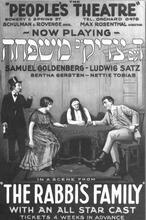
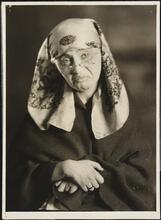
Courtesy of the American Jewish Historical Society.
American Yiddish films captured the language, lifestyle, values, dreams, and myths of Yiddish culture, creating a haven for immigrant communities in New York City. Emerging in the early twentieth century, Yiddish film reached its “Golden Age” between 1936 and 1939, when more than two dozen films opened. Women played a significant role in Yiddish films, both as actors and characters depicted on screen. The most prevalent image of Jewish women to be presented in Yiddish films is the immigrant woman struggling to overcome the adversities. Celia Adler, Jennie Goldstein, Lili Liliana, and Berta Gersten were just a few of the women who became influential actors on the Yiddish screen. The height of Yiddish film was curtailed abruptly by the onset of World War II.
The Emergence of Yiddish Film
field_section_text_value
Women in Yiddish Films
field_section_text_value
Selected Yiddish Actors and Films
Prepared by Miriam Saul Krant
Abarbanel, Judith
Uncle Moses, 1932; The Cantor’s Son, 1937; Americaner Schadchen, 1940.
Adler, Celia
Where Is My Child, 1937.
Appel, Anna
Broken Hearts, 1926; The Eternal Prayer, 1929; The Holy Oath, 1937; Green Fields, 1937; The Singing Blacksmith, 1938.
Beverly, Helen
The Cantor’s Son, 1937; Green Fields, 1937; The Light Ahead, 1939; Overture to Glory, 1940.
Drute, Dina
Green Fields, 1937.
Gersten, Berta
Mirele Efros, 1939; God, Man and Devil, 1949.
Goldstein, Jennie
Two Sisters, 1938.
Halpern, Dina
The Dybbuk, 1937; The Vow, 1938.
Kressyn, Miriam
Sailor’s Sweetheart, 1930; Purimsphiler, 1937.
Liliana, Lili
The Dybbuk, 1937; Kol Nidre, 1939; Mazel Tov Yidden, 1941.
Picon, Molly
Das Judenmadel [The Jewish Girl], 1921; East and West, 1923; Yiddle with His Fiddle, 1936; Mamele, 1938.
Riselle, Miriam
Tevye, 1939; The Singing Blacksmith, 1938.
Weintraub, Rebecca
Tevye, 1939.
Weiss, Florence
The Cantor’s Son, 1937; The Singing Blacksmith, 1938; Overture to Glory, 1940.
Zwerling, Yetta
I Want to Be a Mother, 1937; I Want to Be a Boarder, 1937; Living Orphan, 1939; Kol Nidre, 1939; The Great Advisor, 1940; Motl the Operator, 1940; Jewish Melody, 1940; Her Second Mother, 1941; Mazel Tov Yidden, 1941
Hoberman, J. Bridge of Light: Yiddish Film Between Two Worlds (1995).
National Center for Jewish Film. Films, videotapes and files. Brandeis University, Waltham, Mass.
More Like This

Double your impact to amplify Jewish women’s stories—
All gifts matched up to $35,000
Before you close this article, please consider supporting the Jewish Women’s Archive and uplifting Jewish women’s voices.
At JWA, we preserve the voices of Jewish women and gender-expansive people past and present, share them freely with millions online, and empower a new generation of Jewish feminists to lead with courage, creativity, and conviction.
But none of this happens without you. JWA is an independent nonprofit— we rely on people, like you, who believe that history belongs to all of us and that the voices of Jewish women must remain powerful, and heard.
This month, a generous JWA board member will match every gift dollar for dollar—up to $35,000—through June 30. Your contribution goes twice as far right now.
Every contribution—no matter the size—helps us document, teach, and inspire through Jewish women’s stories.
It takes less than a minute to make a difference.
Thank you for being a part of the JWA community,
Judith Rosenbaum, CEO