
Celia Adler

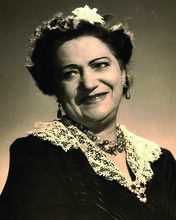
Celia Adler won acclaim in the Yiddish theater world as a founding member of the Jewish Art Theater. Born to a family of Yiddish actors, Adler was acting by age four. In 1918, she joined Maurice Schwartz’s Yiddish Art Theater. In 1919, Adler, Jacob Ben Ami, and others left to found the Jewish Art Theater. Their troupe was hailed by Theatre Magazine as the high point of Yiddish theater. Adler continued to perform both serious and melodramatic roles on stage and screen. After World War II, she entertained American troops in Yiddish and English. At age 57, she performed in A Flag is Born with Marlon Brando, a play scheduled for a month that instead ran for thirty weeks. Her last film was Naked City, in 1948.
Celia Adler’s popularity as a Yiddish actor made her a force in the Yiddish art theater movement, where she succeeded despite her lack of a powerful male protector. She was acclaimed for her ability to combine pathos and charm, and those who witnessed her performances especially remember her talent for comedy.
Early Life
field_section_text_value
Performance Career
field_section_text_value
Later Life and Career
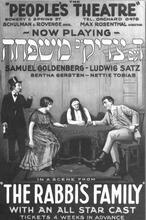
Adler appeared in two films: Abe’s Imported Wife and the 1937 production Vu Iz Mayn Kind? [Where Is My Child?], a reprise of the melodramatic tearjerkers of her earlier years. In 1938 she joined the Yiddish Dramatic Players, together with the new star of the Yiddish stage, Joseph Buloff.
In the 1920s and 1930s, Yiddish-language theater played out the dramatic transition from Old Country to new and the traumatic process of immigrant adjustment. Out of the emotional turmoil of the flight from Europe, trans-Atlantic migration, and translation to new world poverty, there arose the inventive, re-creative power of Yiddish theater. Through its medium, Jewish immigrants were able to reimagine their previous lives, their present poverty, and their dreams of a better life. But as the immigrants improved their economic status and moved away from the old centers of Jewish life, the troupes lost their earlier base of support in the Jewish neighborhoods. Inevitably, they broke up for lack of funds. While art theaters always have financial problems, the Yiddish art theaters suffered as well from the dispersal of their audience and the decrease in the number of Yiddish-speaking people. Adler made her loyalties clear.
When she accepted a contract to appear in an English-language production of David Pinski’s The Treasure at the Garrick Theater in New York, she wrote a letter to her fans via the Yiddish World explaining that her departure was temporary and promising to return to the Yiddish stage. Spanning the immigrant and “Yankee” generations, Adler was in the rear guard of Yiddish theater.
In the aftermath of World War II, Adler was contracted by the Jewish Welfare Board to entertain troops in American military camps. She presented a program of English and Yiddish songs, and later continued these concert appearances for civilian audiences off-Broadway. But Yiddish theater was dead by that time, not only in the United States but in Russia and Poland as well, where it was literally killed off by communist regimes. At age fifty-seven, Adler was called back to the stage by Ben Hecht, who cast her opposite Paul Muni (an old friend from Yiddish theater days) in his English-language play A Flag Is Born. Members of the cast included Marlon Brando, Quentin Reynolds, and Luther Adler. Scheduled to run four weeks, the play actually went thirty weeks. Later, Adler played a part in the film Naked City (1948). After that contract, she writes, she was happy to sit back and enjoy her career as Bobe Tsili to her grandchildren, daughters of “my son the doctor” Selwyn (Zelig) Freed.
At the time of her death on January 31, 1979, Adler was married to Nathan Forman.
Adler, Celia. Tsili Adler Dertseylt (1959).
AJYB 24:113.
EJ.
EJ necrology (1973–1982).
Lifson, David S. The Yiddish Theatre in America (1965).
Rosenfeld, Lulla Adler. The Yiddish Theatre and Jacob P. Adler (1988).
Sandrow, Nahma. Vagabond Stars (1977).
UJE.
WWIAJ (1938).
Zylbercweig, Zalmen. Leksikon fun Yidishn Teater (1931).
More on Celia Adler
Double your impact to amplify Jewish women’s stories—
All gifts matched up to $35,000
Before you close this article, please consider supporting the Jewish Women’s Archive and uplifting Jewish women’s voices.
At JWA, we preserve the voices of Jewish women and gender-expansive people past and present, share them freely with millions online, and empower a new generation of Jewish feminists to lead with courage, creativity, and conviction.
But none of this happens without you. JWA is an independent nonprofit— we rely on people, like you, who believe that history belongs to all of us and that the voices of Jewish women must remain powerful, and heard.
This month, a generous JWA board member will match every gift dollar for dollar—up to $35,000—through June 30. Your contribution goes twice as far right now.
Every contribution—no matter the size—helps us document, teach, and inspire through Jewish women’s stories.
It takes less than a minute to make a difference.
Thank you for being a part of the JWA community,

Judith Rosenbaum, CEO