

Molly Picon

A lively comic actress, Molly Picon brought Yiddish theater to a wider American audience. Picon began her acting career in vaudeville before her director/producer husband drew her to Yiddish theater. He created roles for which she was best-loved: mischievous girls dressed as boys. Picon also branched into radio and film. She acted in the first Yiddish play ever performed on Broadway and insisted on performing in Yiddish on a 1932 tour of Palestine. Filming on location in Poland, on the eve of World War II, Picon captured a view of shtetl life soon to be erased by the Holocaust. Towards the end of her career, her role in the film version of “Fiddler on the Roof” helped introduce Yiddish culture to a new generation.
Introduction
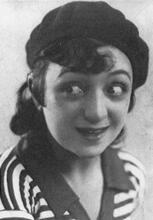
A drunk’s dare to a five-year-old on a trolley car initiated the career of Molly Picon, the petite darling of the Yiddish musical theater. Later, with her geneyvishe oygen [mischievous eyes], dark bob, and endearing acrobatics, she won hearts on tours across the United States, Europe, Palestine and Israel, South Africa, and Australia. In over eighty years of performing, “Our Molly” would also delight audiences in radio, film, and television. Despite being told by an English director not to use her hands too much, as it was “too Jewish,” Picon used every one of her fifty-eight inches to convey the humor, poignancy, and passion for performance that glowed beneath her physical pranks. For much of her career, her forte was the adorable waif, often a motherless boy, who, with naive gumption, a charming display of tears, laughter, somersaults, splits, songs, cartwheels, and musical instruments, accompanied by an occasional farm animal and good luck, managed to make it in the adult world.
Hers was a limber, adaptable sekhl [smarts]: versatile, gallant, indomitable. She seemed simultaneously all-American in her winsome tomboy persona, the irresistible scamp whose good sense and unabashed virtue led to fame and fortune, and entirely Jewish in her devotion to Yiddish and efforts on behalf of Jewish refugees and the State of Israel. A staunch Roosevelt supporter, she was a candle to the world’s conscience during and after World War II. Wherever she performed, as well as in her own home, she gave solace through awareness, fun, and compassion. To her audiences, she brought both laughter and tears; to her foster children she offered a haimish [homey] present and the vision of a humane future.
Early Life and Family
She was born Margaret Pyekoon on Broome Street on the Lower East Side of Manhattan on February 28, 1898. Her grandmother, who cherished a fantasy romance of her own, claimed that Molly’s birthday was a sweltering first of June, allowing Molly, who never seemed to age onstage, to celebrate two birthdays a year. Molly’s mother, Clara Ostrovsky (later Ostrow), had left Rizshishtchov (“a little town that looks like a sneeze and sounds it”) near Kiev, Russia, in 1890, just ahead of the pogroms, with her brothers and sisters (eleven, eventually); her father, Aaron, a wheat grower; her mother, Sarah; a featherbed; and a samovar. Molly’s father, Louis (or Lewis) Pyekoon (later Picon), had studied for the rabbinate in Warsaw, where he married his first wife, whom he neglected to divorce before emigrating. Louis was unhappy that his first child, his “Molly Dolly,” was a girl. He came and went; after his second daughter, Helen, was born, he left for good. Molly, Helen, Clara, and Clara’s mother, Sarah, moved to Philadelphia, where Clara was a seamstress at Kessler’s Theater and took in boarders, reputable and otherwise.
In 1903, Clara took five-year-old Margaret, dressed in red and sporting an elegant fake-fur muff, to the Bijou Theater for a contest. A drunk on the trolley demanded that she do her act then and there. She consented, concluding with an imitation of the drunk himself. Impressed, he collected pennies for her from the other passengers. At the contest, she would add to them the first-prize five-dollar gold piece and the loose change that her first legitimate audience had spontaneously tossed onstage. Molly Picon had begun her theatrical career.
Early Career and Marriage
Molly studied piano with Fanny Thomashefsky. (She would continue to acquire skills throughout her life, including improvisation from Commedia Dell’Arte and, in her thirties, rope-climbing from an Arab acrobatic troupe.) She performed with Michael Thomashefsky’s Yiddish repertory troupe at the Arch Street Theater (including, at age fifteen, Uncle Tom’s Cabin, with alternate performances in Yiddish and English) and in cabaret from 1912 to 1915. She left William Penn High School before graduation. In 1918 she was cast as Winter in a touring English-language vaudeville act, The Four Seasons. A flu epidemic in 1919 in Boston closed the theaters, leaving Molly stranded. Only a Yiddish theater the authorities had apparently overlooked, the Boston Grand Opera House, managed by Jacob Kalich, remained open.
Molly Picon answered his advertisement for a flaam feierdig soubrettin [lively ingenue]. He cast her. Within a year, after his proposals in five fluent languages and broken English, Picon and Kalich announced their engagement onstage. They married on June 29, 1919, in the back of a Philadelphia grocery store, the bride in a dress stitched by Mama Clara from a theater curtain.
On Friday, August 13, 1920, Picon gave birth to a stillborn baby girl. “Peculiar that a perfect love should bear dead fruit,” she wrote. Pelvic disease left her unable to bear more children.
Yonkel, as Picon called Kalich, took her to Europe for two years, “to perfect my Yiddish, to get my star legs, and not to be inhibited by working with people who knew me” and to enhance her reputation in America. Kalich brought Picon to the great theaters of Europe, the Vilna Troupe, and many non-Jewish companies. He directed Picon in his adaptation of Tzipke, in which she played a plucky ragamuffin much like Yankele, her signature role (performed, she hyperbolized, “3,000 times”).
Performances in New York and Europe
Thrown out of Romania because of antisemitism and competition with the Romanian National Theater, Picon and Kalich returned to New York, where they teamed with composer Joseph Rumshinsky to create operettas scripted and directed by Kalich with lyrics often by Picon. From 1922 to 1925, Picon appeared on Second Avenue in Yankele and more, including Mamale, Raizele, Oy Is Dus a Meydl [Oh, what a girl], and The Circus Girl, in which Picon dangled by one foot from a rope. D.W. Griffith, calling her “the most interesting actress in America,” tried but failed to raise money for a film for Picon, The Yiddisher Baby.
Her first films were made in Europe. She debuted in Das Judenmadel by Otto Freister, filmed in Austria in 1921, followed by Hutet Eure Tochter, which had no Jewish content, in 1922. In Kalich’s Yiddish film Ost und West (1923) [East and West, also known as Mizrech un Mayrev], Picon is an American girl who, when not disguised as a Hasidic boy, mistakenly marries a Talmudist, played by Kalich, eventually happily secularized. A censored version was shown in America; in 1932, viewing a restored version with Yiddish dubbing and sound effects added, a critic opined that “it breathes Jewish character, but does not satisfy ... thank God ... high literary expectations.” In 1925, Yidn Fun Sibir, a reworking of existing films, linked Clara Young, glamorous star of Eastern European operetta, with Picon. In 1929’s Little Girl with Big Ideas, her talkie debut, Picon acted in English with a put-on heavy Yiddish accent. For Yidl Mitn Fidl (1937), directed by Joseph Green with songs by Ellstein and Itsik Manger, Picon, playing a girl who dresses as a boy at her father’s bidding, was paid ten thousand dollars, the highest salary for a Yiddish movie; dubbed into English in 1961, it was retitled Castles in the Air. In Mamele (1938), a comic melodrama from a play by Meyer Schwartz, Picon, over forty, played Khavtski, an energetic twelve-year-old gamin who cares for her widowed father and six siblings. This was the last Jewish film made in Poland before the Nazi onslaught.
World Tours and Radio Show
field_section_text_value
Post-War Performance Career
field_section_text_value
Performances in the 1960s
A surprising revival of Yiddish theater in 1959 was Kalich’s The Term used for ritually untainted food according to the laws of Kashrut (Jewish dietary laws).kosher (kasher) Widow, their first completely dramatic play, which she called “the biggest thing since the Zionist movement.” Picon assumed two roles, wife and sweetheart.
Soon thereafter, Picon first refused then accepted the role of an Italian mother whose sons live in the fast lane, in the film version of Neil Simon’s Come Blow Your Horn, for which she was nominated for an Academy Award for “best supporting actress” in 1964. She appeared on television in A Family Affair, The Jack Paar Show, Car 54, Where Are You? (in which she sang Warshawsky’s “Der Alef Bays”), and Dr. Kildare. After a bout with appendicitis on tour, Picon wrote her “mish-mosh” family biography, So Laugh a Little, with Ethel Rosenberg.
The role of the genteel widow Clara Weiss in Milk and Honey (originally Shalom), somersaulting with sheep and goats at age sixty-four, was her only original Broadway success. “Thank God for Molly,” wrote critic Phil Adler. Picon then chose uncharacteristic stage roles: a nagging mother-in-law in Madame Moussez, The Rubiyat of Sophie Klein, and the lead in Chu Chem, which a critic called “The King and Oy,” an absurd piece about a search for Jews in China.
After The Six-Day War and more bond sales for Israel, Picon accepted the role of Yente the Matchmaker in Norman Jewison’s movie Fiddler on the Roof, in which Kalich had a small role. How to Be a Jewish Mother, a revue in which she appeared with Godfrey Cambridge, was considered insulting by many blacks and ill-conceived by many whites. Picon, who had twice been the only white performer in Harlem, was stunned.
Picon performed Solid Gold Cadillac in Chicago in 1969 without Kalich, whose health had begun to deteriorate, but at a gala hosted by the Hebrew Actors Union at the Commodore Hotel in New York, they celebrated their fiftieth wedding anniversary together. On Broadway, in an apt coincidence, Picon took over Helen Hayes’s role in The Front Page and was received with cheers. On the other hand, Will It Last, later called Paris Is Out, closed after a hundred uncomfortable performances.
Later Life, Honors, and Legacy
Picon was honored in 1975 at the Hundredth Anniversary of the Yiddish Theater at the Museum of the City of New York; the museum maintains a collection of her costumes, pictures, programs, and scripts. On October 12, 1975, she performed at Carnegie Hall before a background of slides of her life.
In 1976, a year after Kalich’s death, Picon sold Chez Schmendrick, giving pictures, plaques, and books to YIVO, and rented a house in Cortland. She performed her one-woman show Hello Molly in 1979, selected Jean Grillo Benjamin as coauthor for her autobiography Molly!, and moved near Lincoln Center with her widowed sister Helen Silverblatt, who had also been a child actor. They vowed to speak only Yiddish to each other for the rest of their lives.
The Philadelphia Public Library presented a major exhibit on her work while she was performing Milk and Honey there. On June 28, 1980, Picon received the Creative Achievement Award of the Performing Arts Unit of B’nai B’rith. For her lifetime contribution to Jewish performing arts, in 1985 the Congress of Jewish Culture awarded her a Goldie, named for the “father” of the Yiddish theater, Abraham Goldfaden. She accepted wearing a tuxedo in homage to the boy’s hand-me-downs she had worn in her early films.
Molly Picon, “the girl who gets older every year and younger every day,” remained zestful until Alzheimer’s disease gripped her final few years. She died on April 6, 1992. Throughout her career, she had lived up to her beloved Yonkel’s admonition: “Molly, that’s our job. Make them laugh.”
Molly Picon is featured in Making Trouble, the JWA documentary film about women comedians.
BEOAJ.
EJ.
Hoffman, Warren.The Passing Game: Queering Jewish American Culture Judaic Traditions in Literature, Music, and Art. Syracuse: Syracuse University Press, 2009.
Power, Sharon. "Yiddish Theatre Actresses and American Jewish Identity." Shofar 30, no. 3 (2012): 84-IX.
Nahshon, Edna, Ed. New York's Yiddish Theater: From the Bowery to Broadway. In conjunction with the Museum of the City of New York. New York: Columbia University Press, 2016.
Slater, Elinor, and Richard Slater. Great Jewish Women (1994).
UJE.
WWIAJ (1926, 1928, 1938).
More on Molly Picon
Double your impact to amplify Jewish women’s stories—
All gifts matched up to $35,000
Before you close this article, please consider supporting the Jewish Women’s Archive and uplifting Jewish women’s voices.
At JWA, we preserve the voices of Jewish women and gender-expansive people past and present, share them freely with millions online, and empower a new generation of Jewish feminists to lead with courage, creativity, and conviction.
But none of this happens without you. JWA is an independent nonprofit— we rely on people, like you, who believe that history belongs to all of us and that the voices of Jewish women must remain powerful, and heard.
This month, a generous JWA board member will match every gift dollar for dollar—up to $35,000—through June 30. Your contribution goes twice as far right now.
Every contribution—no matter the size—helps us document, teach, and inspire through Jewish women’s stories.
It takes less than a minute to make a difference.
Thank you for being a part of the JWA community,

Judith Rosenbaum, CEO

