Meet Joelle Maxx Milman, Author of 'Repartings: Poems of Haftara'


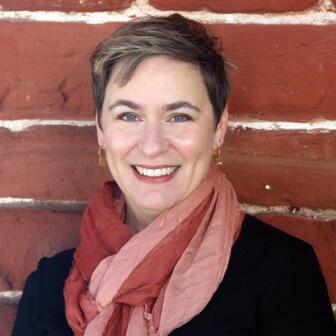
Joelle Maxx Milman is a writer, artist, activist, and translator of Modern and Biblical Hebrew. Her new book, Repartings: Poems of Haftara, from Ben Yehuda Press, includes original translations of prophetic texts alongside her own poetic responses. Joelle has a BA from Barnard College and an MA in English literature from Hebrew University, where she studied the mystic element in Mina Loy’s late poetic work. She currently splits her time between Brooklyn and the Blue Ridge Mountains, and has previously lived in Los Angeles, New Jersey, Tel Aviv, and Jerusalem. JWA recently sat down with Joelle to discuss her reflections on feminist biblical translations and poetry.
Sarah Biskowitz: Repartings: Poems of Haftara comes out this April. What inspired you to begin this project?
Joelle Maxx Milman: This project actually came to me fully formed—I joined along for the ride and channeled the words into text. The project began when I was living in Tel Aviv, doing lots of activism in the West Bank, and finishing my master’s at Hebrew University. My activism sent me on a multi-year political journey that introduced me to all sorts of cultural worlds I hadn’t previously been exposed to. One of them was Der Nister, a hidden Yiddish bookstore in downtown Los Angeles. I struck up a friendship with Rabbi Zach Golden, who leads the congregation there. He asked me to write a weekly poem on the haftora. From there, everything clicked into place. The poems were born.
SB: How did you choose which texts to include?
JMM: God chose. Which is to say: I wrote a weekly response to the Haftora portions as they were read aloud in synagogue each week. The structure was freeing, as my work wasn’t to choose which text to feature: my role as a writer was to respond to what was given. While I skipped a week here and there, the 22 final poems were mostly written in chronological order. The funny part is that the reasoning behind why each haftora is connected to the weekly parsha is equal parts obscure, esoteric, and random. Something I love about this strange weekly ordering is that it made for a unique collection of texts in my work: thus, the poems and translations in Repartings, similar to the authorless texts of Talmud, became their own strange redaction.
SB: In what ways did your feminist principles influence how you approached the prophetic texts?
JMM: Feminism has been the bedrock of my understanding of the world since I was a child. However, my understanding of what feminism means has shifted over time, as the world changed and I grew up. To me, feminism asks me to question the power dynamics that lie at the heart of the relationships that structure our world and ask if we need those dynamics to begin with. Be it between man and woman, woman and god, person and person, feminism wants to know if there’s a better way to be in relationship to the world around us—a value system that has quite a bit in common with Judaism itself.
Thus, I approached these ancient Jewish texts with these questions in mind and found all sorts of answers. In Repartings, connection with god is obvious; gender is not. In the book, women enter the sacred space of prophetic imperative as a matter of course, and the realities of the body are always part of the story. The central poet, prophet speaker in the book is asking a specifically feminist question of the texts: What is this text really trying to say? Who do the images belong to? What does god want? What do people want?
SB: In many ways, the prophets were the social justice advocates of their time. Which of their lessons resonate most with you today?
JMM: Each prophet has their own special way of prophesying. Some are kinky, some are kind; some are devastated, and some sit in judgment under the fig tree. Most of them stood in some degree of opposition to the priestly establishment. All of the prophets—no matter who and how and where—struggle with the burden of having to speak the truth God gives them. All of the prophets speak from within their commitment to peoplehood, even if some get exiled for using their voice.
In our own time period filled with war, antisemitism, and unprecedented power within our communities, the prophets were an invaluable read for me. They reminded me that we have been here before; we’ve made mistakes, refused to listen, and we’ve hurt ourselves and others. Reading Jeremiah specifically, I was saddened to see how prophets often weren’t taken seriously in their time, and how their visions of destruction were then proven true.
Reading the prophets taught me how to witness the cycle of destruction and how, eventually, it becomes healing. Rupture and repair. To read their words is to look into the dark and honest heart of our people. We should all read them more. It is helpful to see where we have been - and to listen to the calls to do things differently, this time around, if we have the strength to do so.
SB: The prophets used striking imagery to convey their messages. Have any of these images stuck with you?
JMM: My goodness, yes. After writing this book, I became entranced and obsessed with the book of Ezekiel. The text of Ezekiel is incredibly rich with imagery, esoterica, and divine violence—a trio of feelings that possessed me in the aftermath of October 7th. The book opens with the “merkava” imagery, the divine chariot that god rides around the world after she is kicked out of the temple in Jerusalem, when it became profaned. This image became core to kabbalah, and some rabbis say you aren’t meant to read it alone or out loud (although, funnily enough, we actually read it in synagogues on Shavuot). God is cruel to Ezekiel: he ties him up, drags him by the hair, kills his loved ones, and exiles him far from the land of Israel. The book of Ezekiel cackles with raw electricity, and it can feel genuinely dangerous to read. Those haunting images truly possessed me, especially as I moved from Tel Aviv back to the USA.
That said, Ezekiel has many lessons to teach us. He is the first prophet of exile. He is a prophet of diaspora and individuality, laying the roadmap to peoplehood beyond the tribal call of nationhood. And while the first two-thirds of Ezekiel are filled with these destructive prophecies, the end of the book gives us a balm—a vision of the third temple, an exact map with rooms for all, and a flowing spring at the center from which every tree will bloom. After the haunting early images of the book, this creek moved into my brain and soothed me.
SB: You’ve worked as a translator for peace-building organizations like Breaking the Silence. How did these previous experiences of translation inform your work?
JMM: Translation, at its most honest, is an act of absorbing someone else’s voice into your body and spitting it back out through your own tongue. Breaking the Silence is an incredible and controversial organization, and they do noble work in their attempt to look at some of the darkest realities of our time and use their voice to share an alternate narrative. They publish collections of testimonies, anonymous redactions of collected storytelling from former IDF soldiers who want to understand their service in a different light than the collective. Translating these testimonies was, in many ways, similar in process to translating these lesser-known parts of the Nevi’im—where honesty is tantamount, pain is obvious, and the work of speaking up matters at scale.
SB: This book was your first time working with Biblical Hebrew as opposed to Modern Hebrew. How did translating Biblical Hebrew present new challenges for you?
JMM: As a kid in Jewish day school, I learned biblical Hebrew before anything else—when I first moved to Israel, Israelis would laugh at me for speaking in biblical sentences, like someone speaking Shakespearean English. I eventually got the modern Hebrew thing down and worked as a professional Hebrew-English translator for many years. During that time, I translated quite a bit of modern Hebrew poetry, which required me to know the grammatical structure of Hebrew to the core. When it came time to translate these biblical selections, it felt like a return.
SB: The God of your translation is non-binary, and many of the passages you translate discuss women. Can you tell us about your choices related to gender in your translation?
I always resonated with the idea that god has 70 faces, that god is one, and that oneness manifests in so many facets of life. The children’s song that goes, “Hashem is here, Hashem is there, Hashem is truly everywhere” means that god is this table, god is this laptop, god is the tulips, and god is I and Thou. Thus, it never made sense to me that god was only a he—how limiting! God is nonbinary in essence if god is anything at all.
SB: Do you have any advice for other people interested in creating new art based on Jewish texts?
JMM: Torah is alive in every generation because, in every life, we re-approach the text and make it ours. If you are thinking about writing from the depths of our communal books, I’d say go forth: Tanach is for you. Stroke the shell, crack it wide, the pearl is yours to hold and wear and honor. Tanach is a hungry text, rich and alive, and spending time with it will always be rewarding. As a Hebrew speaker and a woman not bound by time-bound mitzvot, I felt like I had the key to the castle and the ability to go into any room I wanted. To anyone curious about biblical texts—especially women and non-binary folk—I want to say that the text is for us. It’s waiting for you, it’s itching for you, it wants to be shaped and played with and re-read and changed. Give it love and integrity, and it will give you some back. This is the work of today.
Double your impact to amplify Jewish women’s stories—
All gifts matched up to $35,000
Before you close this article, please consider supporting the Jewish Women’s Archive and uplifting Jewish women’s voices.
At JWA, we preserve the voices of Jewish women and gender-expansive people past and present, share them freely with millions online, and empower a new generation of Jewish feminists to lead with courage, creativity, and conviction.
But none of this happens without you. JWA is an independent nonprofit— we rely on people, like you, who believe that history belongs to all of us and that the voices of Jewish women must remain powerful, and heard.
This month, a generous JWA board member will match every gift dollar for dollar—up to $35,000—through June 30. Your contribution goes twice as far right now.
Every contribution—no matter the size—helps us document, teach, and inspire through Jewish women’s stories.
It takes less than a minute to make a difference.
Thank you for being a part of the JWA community,
Judith Rosenbaum, CEO