

Galinka Ehrenfest

Children’s book author and illustrator Galinka Ehrenfest (right), with Albert Einstein and her brother Paul Ehrenfest Jr. Via Wikimedia Commons.
Galinka Ehrenfest, born in Estonia but raised in the Netherlands, was the chief originator, designer, and illustrator behind “ El Pintor,” a collective that created beautiful and imaginative children’s books published in the Netherlands during World War II. Many of the contributors to El Pintor lived in hiding during the war, and Ehrenfest and her husband Jaap Kloot used the proceeds of their books not only to pay their contributors but also to find hiding places, cover the living expenses of those in hiding, and distribute ration coupons and food. In 1943, Kloot was betrayed, arrested, and murdered in Sobibor. Ehrenfest survived the war but could not bear to continue to produce El Pintor books without Kloot. After the war she focused on developing play-work areas for street children.
In the early years of the Second World War in the Netherlands, the stuffy world of moralistic children’s books changed as if by magic when a book by “El Pintor” (“The Painter” in Spanish) appeared on the market. A second followed, surprisingly different in form and content from the first. Then a third appeared, with beautiful pop-up illustrations: cut-out games with cards and jokes in handsome folders designed to instruct; an oblong fold-out book with photo collages; a complete theater and booklets with stories about far-off lands. All were beautifully illustrated and each had content that surprised, encouraged children to think, and inspired them to use their imagination.


One of the finest publications was Come Inside the House of El Pintor, where readers could climb, jump, swim, feast, paint, skate, make a mess, cook, slide, fly, fish, sail. No one knew who El Pintor was, but in this book he invited children to come inside and play. In the story, the door of a large Amsterdam canal house swings open and two children set off on an exploration. They enter a hall full of trees and mirrored walls in which they see themselves many times over, pass through a mirrored door, and arrive in a huge swimming pool with funny water creatures and a boat. On another floor is a large studio with paints and crayons ready for use—but no paper: visitors are allowed to draw on the white walls (strictly forbidden at home). On every new page readers can have a different adventure. The visit ends in a large library and, as the children say goodbye, they are given a gift: Come Inside the House of El Pintor, where you may climb, jump, swim, feast, paint, skate, make a mess, cook, slide, fly, fish, sail.
A Huge Success
The El Pintor titles were an immediate hit. Demand for distraction and beautiful books grew enormously during the war, and print runs often rose to more than 10,000 copies, partly thanks to purchases of translations in Germany. Nevertheless, the book sold out in no time and went through several reprints. An announcement “a new book by El Pintor” guaranteed sales in advance.
Most of the children’s books and games by El Pintor had to be published under increasingly difficult conditions. Without the German occupiers’ permission and the required stamps, paper was almost impossible to obtain. There was also the problem of printing the books in an unusually large number of colors: today’s children’s books typically use a maximum of four basic colors, which can be mixed as desired, but El Pintor’s books used twice that number, plus mixed colors. Few reliable printers were capable of producing these colors, and as the war progressed, more and more people were arrested and put out of action. Various tricks also had to be employed to evade censorship. Although they had no explicit political message, El Pintor’s books encouraged cheerful disobedience, and the protagonists of the booklets about far-off lands were poor, Black, or Muslim. Everything was inspected, and the creator’s identity had to remain secret.
El Pintor quickly became a mark of quality, a brand name, a concept, and a source of inspiration for the modern children’s book—yet no one knew exactly who the creator was.
Who was El Pintor?

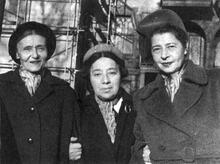
Children’s book author and illustrator Galinka Ehrenfest with her mother Tatiana Afanassjeva, Leiden, 1916. Via Wikimedia Commons.
Godfried Bomans, a well-known Dutch writer who collaborated with El Pintor on several books, described El Pintor as “a magician of our time, a modern gnome; he looks just like many other people, and he lives, without a pointed hat and without a beard, in an ordinary house on the Keizersgracht. But beware! Late at night, when darkness falls, he takes scissors and a pot of glue in hand and makes magic books for children, each one more beautiful than the last.”
The chief originator, designer, and illustrator of the El Pintor books was Galinka Ehrenfest. Her husband, Jacob (Jaap) Kloot (1919-1943) ran the publishing house Corunda in Amsterdam and began publishing the books. Together, they were the driving force behind El Pintor.
Anna Galinka Ehrenfest was born on July 23, 1910, in Kanuka, Estonia, the second daughter of the Jewish-Austrian physicist Paul Ehrenfest and the Russian mathematician Tatiana Afanassjeva. She had an older sister, Tanya, and two younger brothers, Paul and Wassili. She grew up in Leiden, in the Netherlands, after her father was appointed professor there in 1912. The Ehrenfests built their own house, designed by Tatiana, where over the years they received hundreds of students, friends, and scientists for debates in German, Dutch, English, and Russian, and to make music. Paul Ehrenfest was a fine pianist and played duets with his best friend Albert Einstein on violin. Galinka played both instruments, could draw well, was creative and imaginative in many fields, and especially loved children.
At seventeen, having qualified as a kindergarten teacher, Galinka Ehrenfest began working in a children’s clinic in Jena, where her youngest brother Wassili, who was intellectually disabled, had been placed. Back in Leiden the following year, she succeeded in teaching a child born deaf to read and write, an unusual accomplishment at the time, and was offered an important position in the first Dutch children’s clinic. There she gained experiences that proved decisive for her later career as a designer of illustrated children’s books and games.
Around the age of twenty, Ehrenfest set off—entirely on her own—for the United States, where she worked as a fruit picker, nanny, music teacher, illustrator, and doll maker for the famous Yale Puppeteers. She won a scholarship to the Chouinard Art Institute in California and wrote delightful letters full of humorous drawings to her family about her adventures. She travelled widely with her father when he gave guest lectures in America and once dragged Einstein to a performance by the Puppeteers, who had made an Einstein marionette, with which Albert obligingly posed.
In 1933, Ehrenfest returned to Leiden, not long before her father’s death. After Hitler’s rise to power, he had fallen into ever deeper depression; he felt unable to keep up with the rapid developments in physics, recognized the resurgence of antisemitism all too well from his youth, and worried about the future of Wassili, who by then was living in the Netherlands. In September he visited his son, shot him, and then took his own life. Galinka Ehrenfest stayed with her mother for some time to support her, then moved to Amsterdam, where she met her future husband (they married on June 11, 1941) and El Pintor took shape.
Jaap Kloot came from a modest, large Jewish family that had to scrape by financially. His father worked in the vegetable section of Amsterdam’s market halls; he himself slept with his brothers in the basement of the house, among rats and mice, and was something of a loner in the family due to his artistic talent. He became a pupil of Paul Citroen at the “New Art School” in Amsterdam, inspired by the Bauhaus, where he served as a kind of secretary. Little is known about him besides the fact that he was enterprising and highly organized; almost none of his drawings have survived.
Ehrenfest and Kloot met at the New Art School in 1935. Ehrenfest had long wanted to create children’s books and had an abundance of ideas and concepts, but she only began publishing after she met Kloot.
El Pintor Becomes a Group


To meet the great demand for new El Pintor publications, Ehrenfest and Kloot soon needed additional staff. They sought out reliable people among their friends and involved them in various ways in production. Some of these collaborators were in danger because of their Jewish origins, their political beliefs, or their involvement in the resistance and could no longer earn their own living. Photographers, writers, and illustrators contributed, sometimes from their hiding places. Thus, El Pintor became a loose collective under Kloot’s organizational leadership and Ehrenfest’s artistic direction.
Ehrenfest and Kloot used the proceeds from book sales not only to pay their contributors but also to find hiding places, cover the living expenses of those in hiding, and distribute ration coupons and food. Ehrenfest in particular crisscrossed the city and countryside on these missions.
The End of El Pintor
Despite all the danger, Ehrenfest and Kloot remained optimistic about the future. Ehrenfest was pregnant, some twenty new titles were ready for publication, and they were in the process of buying a large property to live in and to house Corunda and a children's theater when Kloot was betrayed around May 30, 1943. He was arrested in Leiden, imprisoned in Scheveningen, and transferred to Westerbork transit camp. From there he was almost immediately deported to Sobibor, where he was murdered shortly after arrival on July 2, 1943.
For Ehrenfest, a nightmarish time began when Kloot was arrested. She suffered severely from malnutrition, lost her unborn child, and must have feared the worst for Jaap. Nevertheless, she worked twice as hard; she took over the running of Corunda as best she could and continued caring for those in hiding without support. In 1944, under increasingly difficult conditions, she published the first volumes of a planned series El Pintor’s Travels, with text by Jef Last. She also printed advertising leaflets and painted shawls and fabrics for sale. Only well after the liberation did she receive confirmation of Kloot’s death.
In 1946 Ehrenfest published one last game, El Pintor’s Animal Paradise. Thereafter, El Pintor faded away and Corunda was dismantled. Ehrenfest could not bear to continue the work without Kloot. With great determination, she devoted herself to developing play-work areas for street children, in which they could play, build, and garden, and designing furniture and homes and built her own house in the south of the Netherlands, in Limburg. In 1949, she remarried a math teacher; although they never lived together, they had a daughter, Tamara, born in 1949.
In the final years of her life, Ehrenfest fought for greater independence for childcare providers, writing a detailed plan to improve their financial wellbeing. Although the plan was never implemented, it was cited as a model for many years after her death in Gronsveld on August 12, 1979.
Horn, Linda. Galinka Ehrenfest en El Pintor. Vraag Einstein of hij mijn viool meeneemt (Ask Einstein to Bring My Violin: Galinka Ehrenfest and El Pintor). De Buitenkant: Amsterdam, 2019.
More Like This
![Fink, Ida - still image [media]](/sites/default/files/styles/medium/public/mediaobjects/Fink-Ida.jpg?itok=dcqYYaRT "Fink, Ida - still image [media]")
Double your impact to amplify Jewish women’s stories—
All gifts matched up to $35,000
Before you close this article, please consider supporting the Jewish Women’s Archive and uplifting Jewish women’s voices.
At JWA, we preserve the voices of Jewish women and gender-expansive people past and present, share them freely with millions online, and empower a new generation of Jewish feminists to lead with courage, creativity, and conviction.
But none of this happens without you. JWA is an independent nonprofit— we rely on people, like you, who believe that history belongs to all of us and that the voices of Jewish women must remain powerful, and heard.
This month, a generous JWA board member will match every gift dollar for dollar—up to $35,000—through June 30. Your contribution goes twice as far right now.
Every contribution—no matter the size—helps us document, teach, and inspire through Jewish women’s stories.
It takes less than a minute to make a difference.
Thank you for being a part of the JWA community,

Judith Rosenbaum, CEO



