

Cantors: American Jewish Women

Women’s vocal leadership in synagogue practice began when educated women served as zogerin (women’s prayer leader). In America, the idea of Jewish women singing religious songs became refracted into dramatic productions on the Yiddish stage. Starting in the nineteenth century, women participated in mixed choral and community singing, and some opera singers were called upon to act as cantors in important Reform congregations. Subsequently, new technologies allowed women “khazntes” to produce recordings or sing hazzanut (cantorial singing) on the radio. Although not considered professional cantors, some women began to lead worship services in synagogues. The Reform (1975) and Conservative (1987) movements began formally investing women as cantors, opening the floodgates of participation. Today a plurality of cantors in liberal movements are women.
Historical Antecedents
field_section_text_value
Traditional (Male) Cantorial Training
During the nineteenth century, there was no formal system of training for cantors in America. Those who became cantors learned through an apprenticeship system. They studied with a mentor or from a senior synagogue cantor. Not until the twentieth century, following World War II, did the American Jewish community began to establish institutions of Jewish learning for cantors. These schools were all originally exclusively for men. Among those were the School of Sacred Music at the Hebrew Union College–Jewish Institute of Religion (now the Debbie Friedman School of Sacred Music, DFSSM at HUC-JIR, founded1948), the Cantors Institute and College of Liturgical Music of the Jewish Theological Seminary of America (now the H. L. Miller Cantorial School and College of Jewish Music, founded 1952), and the Cantorial Training Institute at Yeshiva University (now the Philip and Sarah Belz School of Jewish Music, founded 1964). Along with these three schools for cantorial studies, three professional denominational cantorial associations were also formed: the Reform-based American Conference of Certified Cantors (now the American Conference of Cantors, ACC, 1952); the Conservative-based Cantors Assembly of America (CA, 1947); and the Orthodox-based Cantorial Council of America (CCA, 1960). Additionally, the Jewish Ministers Cantors Association of America and Canada (also known as the Chazzanim Farband), founded in 1897, continued to serve as a type of cantor’s union and support organization.
Women Serving as Cantors
field_section_text_value
Official Recognition

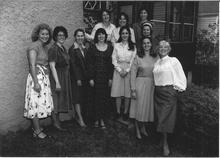
First Women Cantors’ Network Conference, Congregation Beth El
Norwalk, CT, May 1982. Left to Right: First row: Deborah Katchko (Norwalk, CT), Linda Shivers (Highland Park, NJ), Doris Cohen (Flushing, NY), Rochelle Helzner (Washington, D.C.), Jane Myers (Philadelphia, PA), Elaine Shapiro (W.Palm Beach, FL), Ruth Devorah (New York, NY). Second row: Sue Roemer (Silver Spring, MD.), Tzippy Bronstein, (Brooklyn, NY), Sheyne Mueller (New York, NY). Third row: Rita Glassman (New York, NY). Courtesy of the Women Cantors’ Network.
“Voice of Miriam”: First All-Female Cantorial Concert, Great Neck, NY, 1980.
field_section_text_value
Supporting Organizations
The Women Cantors’ Network organization, now with a membership of over 300, provides support, continuing education opportunities, and a forum for discussion of practical issues pertaining to women in the cantorate. In addition to WCN’s annual study conferences, the organization has produced a regular newsletter since 1983 and began commissioning new musical composition in 1997. In 2019, WCN published a songbook of members’ compositions called Kol Isha: Songs and Settings of Prayers.
Along with cantorial associations, affiliated organizations support women in synagogue music. Founded in 1896 as both an educational and a service organization, the American Guild of Organists has a mixed constituency of liturgical musicians, men and women, Jews and non-Jews. In 1987, the ACC established the Guild of Temple Musicians, which represented accompanists, conductors, composers, music directors and soloists.
Impact of Women Cantors on American Jewish Music
Women cantors have been part of an expanding role for cantors in America, as cantor-educators, in pastoral care, and as cantor-composers and singer-songwriters. Having attended Brandeis University and the New England Conservatory simultaneously, Sheila Cline (1941-2020) became the second woman ordained as a cantor at HUC-JIR in 1976. After years as a pulpit cantor, she took her career toward a pastoral role, becoming certified in Jewish education, gerontology, and pastoral counseling. She served many institutions as a chaplain, and her expertise expanded into community relations.
Among the most prominent of the cantor-composers is Benjie Ellen Schiller (b. 1958), who became the first full-time faculty member of the Debbie Friedman School of Sacred Music at HUC-JIR in New York in 1987, where she holds a named professorship of Liturgy, Worship and Ritual as well as serving as a professor of Cantorial Arts. Other cantors, such as Faith Steinsnyder (b. 1957), serve as role models to their fellow women cantors. Steinsnyder is the first woman to teach traditional hazzanut and cantorial repertoire at HUC-JIR, JTS, and the Academy for Jewish Religion. She is known widely for concertizing the classics of hazzanut. Deborah Katchko-Gray produced the first publication in which traditional hazzanut was made available in female-friendly vocal ranges with guitar chords.
The presence of cantors who are also singer-songwriters has increased exponentially in recent years. Along with changes in musical vocal range and timbre, women cantors have created new music celebrating life cycle events and written new liturgical texts important to women. Linda Hirshhorn (b. 1947), a singer-songwriter who sang as a teen in Zamir Chorale in New York and became leader of the ensemble Vocolot, was officially invested as a cantor and served congregations in California. Cantor/Rabbi Rachelle Nelson (b. 1956) is well known throughout the United States as a composer of Jewish music, as is Cantor Natalie Young (b. 1974), whose music can be found in numerous publications and has been performed widely at Jewish music festivals and conferences. Many, such as Rosalie Boxt (b. 1973), current Director of Worship at the URJ, marry contemporary Jewish music with community singing. Boxt is known for encouraging new compositions of Jewish worship music. In liberal movements, cantors today commonly combine song leading in worship with guitars, drums, and other instruments. Cantor Lisa Levine (b. 1960) combines cantorial arts with composition, drumming, and meditation practices. Many women cantors sing new Jewish music that blends with other American styles and genres; Beth Styles, for example, uses gospel, pop, and Jewish song blended in creative ways.
Today, there are more female cantors than male in liberal North American congregations. Some have served in some of the largest congregations in the country, such as Cantor Lori Corrsin (b. 1954), at Congregation Emanu-El in New York, and Cantor Roslyn Barak (b. 1950), who served at Temple Emanu-El in San Francisco until her retirement in 2015. In reflecting upon her chosen profession, Barbara Ostfeld, the first woman ordained as a cantor in the United States wrote, “Women cantors have altered the way in which prayer is offered, heard, and received.”
Adelstein, Rachel. “Braided Voices: Women Cantors in Non-Orthodox Judaism.” PhD diss., University of Chicago, 2013.
American Conference of Cantors. “ACC Spotlight: Cantor Rosalie Boxt: Cantor Rosalie Boxt is Director of Worship at the URJ.” American Conference of Cantors. https://www.accantors.org/cantor-spotlight/acc-spotlight-cantor-rosalie-boxt.
American Conference of Cantors. “Remembering Sheila Cline.” Accessed January 13, 2021.
Andres, Holly. “Conservative Female Cantor Fits In.” The Los Angeles Daily News, March 1, 2008.
Axe, Vicki. “Vicki Axe. Interview by Marcie Frishman.” Digital Collections, Wesleyan University, 1986.
Axe, Vicki “Oral Interviews.” Columbus Jewish Historical Society. October 23, 1996.
Baranblat, Rachel. “In Song Together: For Linda Hirschhorn, Music is a Path to Transformation.” Zeek, January 24, 2012. https://zeek.forward.com/articles/117414/
Barak, Roslyn. Personal Interview with Judith Pinnolis, November 2, 2020.
Barak, Roslyn Jhunever. "Roslyn Jhunever Barak: Song and Spirit: A Cantor’s Life Congregation Emanu-El, San Francisco, 1987-2015." Interview by Basya Petnick. 2014 and 2015. Oral History Center, The Bancroft Library, University of California, Berkeley, 2017.
Barugel, Marla Rosenfeld. “Breaking Past Barriers and Looking Ahead.” Journal of Synagogue Music 32 (2007): 36-37.
Berman, Saul. “Kol ‘isha,” in Rabbi Joseph H. Lookstein Memorial Volume, ed. Leo Landman (New York: Ktav Publishing House Inc., 1980):45-66.
Biddle, Marc. “Sour Notes Remain for Women as Cantors.” The Chicago Tribune, March 13, 1987.
Brown, Adrianne. “The Khazntes—The Life Stories of Sophie Kurtzer, Bas Sheva, Sheindele the Khaznte, Perele Feig,Goldie Malavsky, and Fraydele Oysher.” Journal of Synagogue Music 31 (2007): 51-79.
Brzozowski, Carol. “Women Cantors Find Acceptance in Male-Dominated Vocation.” The South Florida Sun-Sentinel. November 21, 1986.
Cantorial Council of America. “Cantorial Council of America,” Belz School of Jewish Music, Yeshiva University. Accessed January 13, 2021.
Cantors Assembly. “History of the CA.” Cantors Assembly. Accessed January 13, 2021.
Chandler, Russell. “Jewish Temple Names Woman Cantor.” The Los Angeles Times. July 2, 1978: C2.
Cohen, Doris. Interview by Shayna Mueller. Digital Collections, Wesleyan University. May 13,1986.
Cohen, Francis L. “Sagerin.” The Jewish Encyclopedia. 1906. Accessed January 13, 2021. http://www.jewishencyclopedia.com/articles/12991-sagerin
Cohen, Judah M. “Professionalizing the Cantorate—and Masculinizing It? The Female Prayer Leader and Her Erasure from Jewish Musical Tradition.” The Musical Quarterly 101, no. 4, (Winter 2018): 455–481.
Cook, Joan. “A Female Cantor? Two Women Who are Bucking Tradition.” The New York Times. February 22, 1971: 20.
Dart John. “Seminary Decision Opens Door for Women Cantors.” The Los Angeles Times. February 14, 1987: A5.
“Editorial Notes,” The American Hebrew. October 9, 1896: 569.
Fishman, Bob. “Rabbi Vicki Axe to step down at Shir Ami in Greenwich.” The Connecticut Jewish Ledger Online, August 15, 2018.
Goldfarb, Donna. Personal Correspondence with Judith Pinnolis. April 9, 2021.
Goldman Karla. Beyond the Synagogue Gallery: Finding a Place for Women in American Judaism. Cambridge, MA: Harvard University Press, 2000.
Graham, Nancy. “Woman Cantor Surprises Olympians.” The Los Angeles Times, August 2, 1984: A1.
Harris, Ben. “With Shruti Boxes and Drums, Practitioners Chanting Their Way into Judaism,” Jewish Telegraphic Agency, November 23, 2010.
Katchko-Gray, Deborah. Personal Interview with Judith Pinnolis. June 17, 2020.
Klepper, Jeff. “The Voice of Women” Concert Program. Temple Beth El in Great Neck, New York, April 27, 1980. In Private Collection of Jeff Klepper.
Levine, Joseph A. “The Issue of Women Cantors: Landmarks Along the Way.” Journal of Synagogue Music 32 (2007): 5-14.
“Memorial Services for Rabbi Isaac M. Wise.” The New York Times, April 30, 1900: 12.
Ostfeld, Barbara. “The Ascent of the Woman Cantor: Shira Hamaalot.” In New Jewish Feminism: Probing the Past, Forging the Future, ed. by Rabbi Elyse Goldstein, 133-143. Woodstock, VT: Jewish Lights Publishing, 2009.
Ostfeld, Barbara J. Catbird: The Ballad of Barbi Prim. Buffalo, NY: Erva Press, 2019.
Pinnolis, Judith S. “Benjie Ellen Schiller,” The Jewish Music WebCenter. March 2000.
Pinnolis, Judith S. “‘Cantor Soprano’ Julie Rosewald: The Musical Career of a Jewish American ‘New Woman.’” The American Jewish Archives Journal 72 no.2 (2010): 1-53.
Pinnolis, Judith S. "Ostfeld, Barbara Jean." In Encyclopaedia Judaica, 2nd ed., edited by Michael Berenbaum and Fred Skolnik, 507. Vol. 15. Detroit, MI: Macmillan Reference USA, 2007.
Ramos-González, A. “Daughters of Tradition: Women in Yiddish Culture in the 16th-18th Centuries.” European Journal of Women's Studies 12 no.2 (2005): 213-226.
Rivera, John. “Cantor says gender is no longer an issue Clergy: Judith K. Rowland, whose father was a Reform rabbi, decided in college to attend cantorial school. A woman leading worship in Baltimore's largest synagogue isn't a big deal now, she says.” The Baltimore Sun, August 4, 1998.
Slobin, Mark. Chosen Voices: The Story of the American Cantorate. Chicago: University of Illinois Press, 1989.
Taitz, Emily. “Firzogerin.” In Encyclopaedia Judaica, edited by Michael Berenbaum and Fred Skolnik, 2nd ed., 50-51. Vol. 7. Detroit, MI: Macmillan Reference USA, 2007.
“10,000 Singers March in Brooklyn,” The New York Times, July 1, 1900: 5.
“Woman Named Temple Cantor, Perhaps First in Jewish History: Young Mother of 4 Selected Unanimously by Board of Long Island Congregation.” The New York Times, August 3, 1955: 1.
Zeitlin, Marilyn. “A Joyful Noise.” The Los Angeles Times, September 30, 1990: WSJ5.
Zeitlin, Marilyn. “For Female Cantors, a Barrier Falls at Last.” The Los Angeles Times, September 27, 1990: VYE5A.
More Like This

Double your impact to amplify Jewish women’s stories—
All gifts matched up to $35,000
Before you close this article, please consider supporting the Jewish Women’s Archive and uplifting Jewish women’s voices.
At JWA, we preserve the voices of Jewish women and gender-expansive people past and present, share them freely with millions online, and empower a new generation of Jewish feminists to lead with courage, creativity, and conviction.
But none of this happens without you. JWA is an independent nonprofit— we rely on people, like you, who believe that history belongs to all of us and that the voices of Jewish women must remain powerful, and heard.
This month, a generous JWA board member will match every gift dollar for dollar—up to $35,000—through June 30. Your contribution goes twice as far right now.
Every contribution—no matter the size—helps us document, teach, and inspire through Jewish women’s stories.
It takes less than a minute to make a difference.
Thank you for being a part of the JWA community,

Judith Rosenbaum, CEO

