
Union of Jewish Women
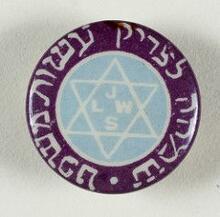
Influenced by their American counterparts, Anglo-Jewish women organized a Conference of Jewish Women in 1902. This conference led directly to the foundation of a national organization, the Union of Jewish Women. The UJW determined the social service agenda for English Jewish women until World War I. Its success was rooted in following the precedents set by Jewish women’s social service organizations abroad and gentile women’s activism in Britain, and adapting them for the specific needs of the Anglo-Jewish community. The UJW adopted the ostensibly scientific methods of social service promoted by the late Victorian “scientific philanthropy” movement. Its professional staff trained upper- and middle-class Anglo-Jewish women as volunteers for a range of educational and philanthropic organizations, serving as a direct link between charitable institutions and women who needed help.
Formation of the Union of Jewish Women
field_section_text_value
Leadership
The well-connected leadership of the UJW took care to leverage its social power as it initially vied for publicity and new members. Leaders included Julia Cohen, whose husband’s family was heavily involved in London’s Jewish Board of Guardians, and several Rothschilds and other prominent Anglo-Jewish women. The leadership also reflected the UJW’s link to the secular movement for women’s rights that was then sweeping Western Europe and America. The chair of the International Council of Women (ICW) joined the Executive Committee, initiating the process that eventually led the ICW to join the international women’s movement, drawing the UJW closer to the broader women’s movement simultaneously. The ICW was the umbrella organization for women’s social service organizations around the world and its leader’s presence on the UJW’s Executive Committee publicly identified that organization as part of the international women’s movement.
Indeed, the Union declared itself to be an “all-embracing sisterhood,” forming a “bond between Jewish women of all degrees and all shades of opinion, religious, social and intellectual.” That said, the UJW before World War I was composed primarily of upper-class women who came in contact with the working class only when providing charitable services.
Strategy
field_section_text_value
Expansion and Affiliations
field_section_text_value
Addressing Inequality in Jewish Religious and Communal Life
field_section_text_value
Gibbon, Monk. Netta. London: Routledge and Keegan Paul, 1960
Kuzmack, Linda Gordon. Woman’s Cause: Jewish Woman’s Movement in England and the United States, 1881–1933. Columbus, OH: Ohio State University press, 1990.
Lipman, V. D. Social History of the Jews in England, 1850–1950. London: Watts, 1954
London Jewish Chronicle (1902–1933).
London Jewish Guardian (1921–1926).
The Jewish World (London), (1890-1934).
Union of Jewish Women. Leaflet. London: 1914.
Union of Jewish Women. Reports 1902–1933. London: 1933.
More Like This
Double your impact to amplify Jewish women’s stories—
All gifts matched up to $35,000
Before you close this article, please consider supporting the Jewish Women’s Archive and uplifting Jewish women’s voices.
At JWA, we preserve the voices of Jewish women and gender-expansive people past and present, share them freely with millions online, and empower a new generation of Jewish feminists to lead with courage, creativity, and conviction.
But none of this happens without you. JWA is an independent nonprofit— we rely on people, like you, who believe that history belongs to all of us and that the voices of Jewish women must remain powerful, and heard.
This month, a generous JWA board member will match every gift dollar for dollar—up to $35,000—through June 30. Your contribution goes twice as far right now.
Every contribution—no matter the size—helps us document, teach, and inspire through Jewish women’s stories.
It takes less than a minute to make a difference.
Thank you for being a part of the JWA community,
Judith Rosenbaum, CEO