

Constance Rothschild, Lady Battersea

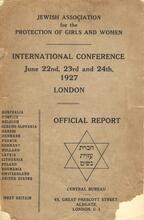
A member the aristocratic Rothschild family, Constance Rothschild, Lady Battersea, inherited her mother’s strong sense of duty to the poor, an independent spirit, and social entrée to the topmost echelons of English society. Battersea was active in English philanthropy, the temperance movement, the women’s suffrage movement, and the movement for reforms of women’s prisons. She founded the Jewish Association for the Protection of Girls and Women in 1885, and in 1902 she convinced the Union of Jewish Women to ally with the National Union of Women Workers and the International Council of Jewish Women. By bringing Jewish women into the English women’s movement, Battersea helped lay the basis for the formation of a distinctively Jewish women’s movement in England.
Family and Early Life
field_section_text_value
Marriage
Although Constance’s marriage to Cyril Flower was controversial due to Flower’s gentile background, it would prove a happy, if somewhat unconventional one. Cyril Flower, Lord Battersea, generally preferred the social and romantic company of other men, and Constance was apparently aware of this situation even before a more public scandal involving Battersea and a male lover in 1902. However, Cyril’s marriage to Constance was characterized by warm friendship, shared interests, and a deep intellectual respect on both sides. Both were passionate supporters of Britain’s Liberal Party; until the 1902 scandal forced him into retirement, Cyril enjoyed a successful political career, aided by Constance’s keen social sense and strong network of powerful friends. Both aristocrats from birth, Constance and Cyril were further united by a shared interest in the welfare of the poor and working class of England, which informed their political and charitable work, including Constance’s interest in socialist-leaning organizations and her work on prison reform.
The Rothschild daughters’ marriages and strong social ties to the gentile aristocracy undoubtedly contributed to Constance’s complicated relationship with Judaism as a religion. She explored her own spirituality and religious beliefs throughout her life, attending Christian church services and considering baptism at one point (although this never materialized), but she always retained a sense of Jewish heritage and identity; even at the times in her life when she regularly attended church and professed sympathy for Christian theology, she referred to Jewish holidays in her personal diaries as “ours.” Disillusioned with Orthodoxy, Constance felt some sympathy for the new Liberal Judaism that emerged at the turn of the twentieth century, but she never joined the movement.
Social Activism
After her marriage, Battersea combined a lavish social life with charitable activities. Profoundly committed to the social concern instilled in her by her mother, she became active in English philanthropy, including royal projects, and then became engaged in the temperance movement that flourished in England and America in the mid- and late- nineteenth century. While much of the temperance movement had been started through Christian churches, the movement itself was not religious, and Battersea was inspired by the cause. Further, the temperance movement, although heavily influenced by Christian ideology, presented itself as one for the betterment of society as a whole, rather than any one group, class, or nationality. As a result, Battersea joined the British Women’s Temperance Association in the 1890s and eventually became a leader of temperance campaigns in London and the provinces. Battersea was introduced to the women’s movement in 1881 by suffragist and temperance worker Fanny Morgan, whom Battersea helped to undertake a political career that resulted in her election as mayor of Brecon.
In the mid–1890s, Battersea’s reputation for social activism, as well as her close friendship with Morgan, already an activist, led her to become active in the movement for reforms of English women’s prisons, which were chaotic, unhealthy, and often cruel. Most working-class Jews who became criminals were boys or men who were usually involved only in petty crime. Indeed, Battersea met only three Jewish female convicts during her visits to Aylesbury prison. However, her interest in prison reform stemmed not only from a Jewish perspective but also from one of social activism, and particularly women’s activism. In fact, she eventually became a government-appointed member of the board of Aylesbury Women’s Prison as part of broader reform efforts.
Jewish Association for the Protection of Girls and Women
field_section_text_value
National and International Feminism
field_section_text_value
Battersea, Lady Constance. Reminiscences. London: Macmillan, 1922.
Jewish Association for the Protection of Girls and Women. Annual Reports. 1895–1933.
Battersea Papers at the Rothschild Family Archive in the City of London.
Cohen, Lucy. Lady De Rothschild and Her Daughters. 1821–1933. London: John Murray, 1935.
Davis, Richard. The English Rothschilds. Chapel Hill, NC: University of North Carolina Press, 1983
Jewish International Conference on the Suppression of the Traffic in Girls and Women. Official Reports. 1910, 1927.
Kuzmack, Linda Gordon. Woman’s Cause: The Jewish Woman’s Movement in England and the United States, 1881–1933. Columbus, OH: Ohio State University Press, 1990.
More on Constance Rothschild, Lady Battersea
Double your impact to amplify Jewish women’s stories—
All gifts matched up to $35,000
Before you close this article, please consider supporting the Jewish Women’s Archive and uplifting Jewish women’s voices.
At JWA, we preserve the voices of Jewish women and gender-expansive people past and present, share them freely with millions online, and empower a new generation of Jewish feminists to lead with courage, creativity, and conviction.
But none of this happens without you. JWA is an independent nonprofit— we rely on people, like you, who believe that history belongs to all of us and that the voices of Jewish women must remain powerful, and heard.
This month, a generous JWA board member will match every gift dollar for dollar—up to $35,000—through June 30. Your contribution goes twice as far right now.
Every contribution—no matter the size—helps us document, teach, and inspire through Jewish women’s stories.
It takes less than a minute to make a difference.
Thank you for being a part of the JWA community,

Judith Rosenbaum, CEO

