
Assimilation in the United States: Twentieth Century

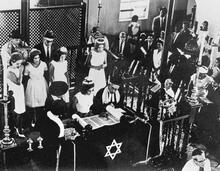
The "Yankee" Jewish women of the first half of the twentieth century created the infrastructure of American-Jewish women's organizational activities. The founding of synagogue sisterhoods began with the Reform National Federation of Temple Sisterhoods in 1913, followed by the Women's League for Conservative Judaism in 1918, and the two Orthodox sisterhoods, Mizrachi Women’s Organization of America (AMIT) in 1925 and Emunah in 1935. Pictured here is the Orthodox Congregation B'nai David Sisterhood of Detroit, Michigan, ca. 1950. Among those seated are Rebbetzin Yetta Sperka (top left), wife of the synagogue Rabbi Joshua Sperka; Mrs. Hyman Adler (top right), wife of the congregation's cantor; and Mrs. David J. Cohen (second row, center).
Institution: Ahava Rivka Sperka.
Jewish women assimilating into a changing American society across the twentieth century navigated often opposing gender roles. As they strove to achieve upward social mobility, they adapted Jewish assumptions of what women, especially married women, should do to accommodate American norms for middle-class women. Their collective accomplishments registered in political activism, organizational creativity, strong support for feminism, religious innovation, and educational achievement in the face of antisemitism, stereotypes, and denigration. Immigrant mothers and their daughters interpreted American demands for adjustment differently, leading to conflict over the right path to follow. Later generations of Jewish American women challenged both American and Jewish expectations of gender roles, rewriting the script of assimilation by the end of century.
Introduction
field_section_text_value
Coming of Age During the Progressive Era: 1900–1960
field_section_text_value
Coming of Age During Depression and War: 1930–1990
field_section_text_value
Baby Boomers: 1950–2000
field_section_text_value
Fin de siecle: 1980–2000
Raised in affluence and a security in which antisemitism was more a topic in history books than a living reality, this group of Jewish women confronted opportunities for individual and collective accomplishment unmatched in any previous cohort. Higher education became the norm and advanced degrees were common. A fluidity in gender roles in America yielded a wider array of choices than in the past. The idea of a Jewish construction of womanhood itself was contested, further expanding possibilities for this cohort largely unburdened by historical memory, whether personal, collective, or symbolic. As the United States changed, so did the character of Jewish assimilation.
Increasing numbers of Jews postponed both marriage and motherhood. Age of marriage rose rapidly as did age at the birth of a first child. Careers increasingly provided a focus of identity, rather than voluntarism. Politics remained important, but this group was not defined by its commitment to feminism as were the baby boomers. Many viewed the women’s movement as past, although they appreciated reaping its benefits. An articulate minority criticized the movement’s mistakes: its emphasis on equality with men, its reluctance to recognize lesbians, its blindness about race, its middle-class dimensions. The Holocaust continued to provide an emotional and spiritual anchor. By contrast, only those most committed to Jewishness incorporated Israel into their identity.
Unlike previous cohorts, this last generation included a significant minority of women of mixed parentage. When these women chose to identify and act as Jews, they introduced new perspectives drawn from Christianity and Buddhism, as well as other religions and cultures. For example, Angela Warnick Buchdahl became the first Asian-American woman rabbi, serving a major Reform congregation. Often what attracted them to Judaism differed from the values of third-, fourth-, and fifth-generation American Jewish women. Some brought a consciousness of race and intersectionality to Jewish communal organizations.
Over the twentieth century Jewish women followed diverse paths of assimilation in America. At times the majority society largely dictated their choices; at other times they faced an array of possibilities so that their own cultural values proved critical to the road taken. Irrespective of the receptivity of the United States to Jews and the extent of antisemitism, Jewish women have always had to confront the challenge of reconciling Jewish gender roles with American norms. Difficulties of reconciliation periodically stimulated Jewish women to challenge American gender roles, helping to fuel second wave feminism. Yet despite impressive achievements in fashioning successive versions of American Jewish womanhood, Jewish women have continued to be the butt of cruel jokes, such as those about JAPs. Such stereotyping suggests that American Jewish women differ from other women of their socioeconomic class, that they remain outsiders in cultural style despite their accomplishments, and that Jewish men do not necessarily share their understanding of desirable gender roles.
The assimilation of Jewish women during the twentieth century provides perhaps more evidence of continuity than disruption. Each cohort accepted the centrality of marriage and motherhood; child rearing and transmitting culture to the next generation remained vital tasks. Each group also understood Judaism to be a religious culture rooted in family life. A tradition of political activism similarly endured, even as the issues changed, as did a tradition of political leadership. Yet American Jewish women at the end of the twentieth century looked very different from those of a century earlier. But then, so did America.
Antler, Joyce. Jewish Radical Feminism: Voices from the Women’s Liberation Movement. New York: NYU Press, 2018.
Baum, Charlotte, Paula Hyman, and Sonya Michel. The Jewish Woman in America New York: Doubleday, 1976.
Ben-Ur, Aviva. Sephardic Jews in America: A Diasporic History.New York: New York University Press, 2009.
Fishman, Sylvia Barack. A Breath of Life: Feminism in the Jewish Community. Hanover, NH: University Press of New England, 1995.
Friedan, Betty. The Feminine Mystique. New York: W.W. Norton, 1963.
Glenn, Susan A. Daughters of the Shtetl: Life and. Labor in the Immigrant Generation. Ithaca, NY: Cornell University Press, 1990.
Hyman, Paula. Gender and Assimilation in Modern Jewish History: The Roles and Representation of Women. Seattle: Washington University Press, 1995.
Klapper, Melissa. Ballots, Babies, and Banners of Peace: American Jewish Women’s Activism 1890-1940. New York: NYU Press, 2013.
Markowitz, Ruth Jacknow. My Daughter, the Teacher: Jewish Teachers in the New York City Schools. New Brunswick, NJ: Rutgers University Press, 1993.
Nadell, Pamela S. America’s Jewish Women: A History from Colonial Times to Today. New York: W.W. Norton & Company, 2019.
Prell, Riv-Ellen. Fighting to Become Americans: Jews, Gender and the Anxiety of Assimilation. Boston: Beacon Press, 1999.
Rukeyser, Muriel. “Letter to the Front.” The Collected Poems of Muriel Rukeyser. New York: McGraw-Hill, 1979.
Schwartz, Shuly Rubin. The Rabbi’s Wife: The Rebbetzin in American Jewish Life. New York: NYU Press, 2006.
Sontag, Susan. On Photography. London: Allen Lane, Penguin Books, 1977, 1990.
More Like This
Double your impact to amplify Jewish women’s stories—
All gifts matched up to $35,000
Before you close this article, please consider supporting the Jewish Women’s Archive and uplifting Jewish women’s voices.
At JWA, we preserve the voices of Jewish women and gender-expansive people past and present, share them freely with millions online, and empower a new generation of Jewish feminists to lead with courage, creativity, and conviction.
But none of this happens without you. JWA is an independent nonprofit— we rely on people, like you, who believe that history belongs to all of us and that the voices of Jewish women must remain powerful, and heard.
This month, a generous JWA board member will match every gift dollar for dollar—up to $35,000—through June 30. Your contribution goes twice as far right now.
Every contribution—no matter the size—helps us document, teach, and inspire through Jewish women’s stories.
It takes less than a minute to make a difference.
Thank you for being a part of the JWA community,

Judith Rosenbaum, CEO