

Anna Sokolow

Anna Sokolow, the daughter of Russian Jewish immigrants to the United States, learned to dance on New York’s Lower East Side. She danced with the early Martha Graham Company and became a leading choreographer whose works reflect her intense commitment to the social, political, and human conflicts of her times. Her dances were created and shown internationally, particularly in Mexico and Israel, where she worked with the Yemenite dance company Inbal. She also collaborated with the Actor’s Studio with Elia Kazan. Her work was seen on and off Broadway and with her own company. Her most famous works include “Kaddish,” “Dreams,” and “Rooms.”
Anna Sokolow, the “rebellious spirit” of modern dance, was a member of the Martha Graham Company (1937–1940), on the faculty of the Juilliard School of Music, Dance Division (1958–1988), founder and director of La Paloma Azul Company (Mexico, 1940), the Lyric Theater (Israel, 1962), the Anna Sokolow Dance Company (1967), and the Players Project (1971), adviser to Inbal (1953), and choreographer of hundreds of dance works, plays, operas, Broadway musicals, and festivals. Her partners included musician Alex North, painter Ignacio Aguirre, and actor John Silvester White. In celebration of her 85th birthday in 1995, the dance world joined in tribute to her accomplishments and service, her pioneer work in Mexico and Israel, and, above all, her “blazing force and integrity.”
Family & Training

field_section_text_value
Choreography on Social, Political, and Human Conflicts

Institution: Jerome Robbins Dance Division, New York Public Library for the Performing Arts
field_section_text_value
International and Jewish Work


Sokolow became a pioneering teacher and choreographer when she was invited to Mexico in 1939 by Carlos Mérida. Mexico was then a land fighting an artistic and social revolution. Rita Morgenthau helped get Sokolow’s company to Mexico. Mexico City audiences accepted her dancing, although the work was neither ballet nor folk dance. Away from New York, with a different tempo and culture, her work turned toward lyricism. Her company, “La Paloma Azul” [The blue dove], received acclaim, as did her production of the “Antigone Symphony” by Carlos Chavez.
field_section_text_value
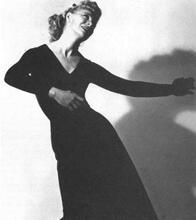
From Bullfight, a film by Shirley Clarke, 1955.
This film is the only extant recording of Anna Sokolow performing.
Courtesy of Wendy Clarke.
Theater, and in Israel, “The Treasure”(1962), a play based on a story by Isaac Leib Peretz. She staged vast festivals and fund-raising events after World War II on behalf of the Jewish National Fund and Bonds for Israel. These included the 1952 Purim Festival (with Sholom Secunda) at Madison Square Garden, the 1953 Fund-Raising for Israel Bonds: 3000th Anniversary of Jerusalem, and the 1954 Hanukkah Festival pageant (with Kim Stanley and Joseph Schildkraut). She staged opera at the New York City Center in 1956, including “Orpheus,” "La Traviata,” “The Tempest,” “L’Histoire du Soldat,” and “Carmen.”

“Rooms” (1955), Sokolow’s best-known late work, grew from sessions at the Actors Studio. It depicts the isolation of the urban dweller. Each dancer sits in a chair, reaching into space, close to one another, yet out of touch. The theme of the withdrawn sufferer appeared again in “Session ’58,” “Opus ’50,” “Opus Jazz 1958” in Israel, “Opus ’60,” and, finally, “Opus ’65” in the Joffrey Ballet Company’s repertory to Teo Macero’s jazz score.
Two works are worth special note. “Lyric Suite” (1953), choreographed to Alban Berg’s score, was premiered in Mexico and then performed at the YMHA in 1954 with such notables as Donald McKayle, Jeff Duncan, Ethel Winter, and Mary Antony. The use of Berg’s music and the emotive yet non-narrative choreography made this a landmark in modern dance work. Louis Horst said, “Anna, now you are a choreographer.” “Dreams” (1961), an “allegory of time and helplessness,” used concentration camp images. In Holland, audiences responded with the silence of recognition. On the fiftieth anniversary of the liberation, “Dreams” still had enormous impact.

field_section_text_value

Baum, Charlotte, Paula Hyman, and Sonya Michel. The Jewish Woman in America. New York: Dial Press, 1975.
Clarke, Mary, and David Vaughan. The Encyclopedia of Dance and Ballet. New York: G.P. Putnam’s Sons, 1977.
Dance Magazine (June 1956, April 1969, April 1985, April 1991).
Dance News: The Season in Review (June 1964, February 1965).
Dance Observer (November 1943, October 1946).
Denby, Edwin. Dance Writings. New York: Knopf, 1986.
Jowitt, Deborah. “Anna at Eighty-five.” Dance Magazine 64, no. 8 (August 1995).
Kosstrin, Hannah. Honest Bodies: Revolutionary Modernism in the Dances of Anna Sokolow. Oxford: Oxford University Press, 2017.
Lloyd, Margaret. The Borzoi Book of Modern Dance. New York: A.A. Knopf, 1949.
Martin, John. America Dancing. New York: Dodge Publishing Company,1936.
Margin, John. The Dance. New York: Tudor Publishing Company, 1946.
Martin, John. Book of the Dance. New York: Tudor, 1963.
McDonagh, Don. The Complete Guide to Modern Dance. New York: Doubleday, 1976.
Morgan, Barbara. Martha Graham. New York: Duelll, Sloan and Pearce, 1941.
New Dance Group. Souvenir Program, June 11, 1993.
Studies in Dance History 5, no. 1. 'Of, by, and for the People: Dancing on the Left in the 1930s. Articles by Pricket, Graff, Ocko.
Warren, Larry. Anna Sokolow: The Rebellious Spirit. Pennington, NJ: Princeton Book Company, 1991.
More on Anna Sokolow


Double your impact to amplify Jewish women’s stories—
All gifts matched up to $35,000
Before you close this article, please consider supporting the Jewish Women’s Archive and uplifting Jewish women’s voices.
At JWA, we preserve the voices of Jewish women and gender-expansive people past and present, share them freely with millions online, and empower a new generation of Jewish feminists to lead with courage, creativity, and conviction.
But none of this happens without you. JWA is an independent nonprofit— we rely on people, like you, who believe that history belongs to all of us and that the voices of Jewish women must remain powerful, and heard.
This month, a generous JWA board member will match every gift dollar for dollar—up to $35,000—through June 30. Your contribution goes twice as far right now.
Every contribution—no matter the size—helps us document, teach, and inspire through Jewish women’s stories.
It takes less than a minute to make a difference.
Thank you for being a part of the JWA community,

Judith Rosenbaum, CEO

