
Ze'eva Cohen

Yemenite-Israeli-American dancer and choreographer Ze’eva Cohen was a postmodern dance leader in New York between the 1960s and 1990s, a founding member of Dance Theater Workshop, and founding director of the dance program at Princeton University. She choreographed dances for companies all over the world, was a dynamic and dramatic solo performer, published articles on her work and history in English and Hebrew, and influenced generations of dance students. This entry details her dance training in Israel and New York, her performance in Anna Sokolow’s companies, her choreography at Dance Theater Workshop and in her solo repertory concert, her choreography with Ze’eva Cohen and Dancers and in her concert Female Mythologies, and her work in dance education at Princeton and with the International Baccalaureate Organization.
Ze’eva Cohen is a Yemenite-Israeli-American dancer and choreographer whose work over half a century in Israel and the United States redefined what it means to be a Jewish performer. She was a leader in the world of postmodern dance in New York between the 1960s and 1990s, a founding member of Dance Theater Workshop, and founding director of the dance program at Princeton University. She choreographed approximately 50 works for companies all over the world, performed in the work of many contemporary choreographers, published articles on her work and history in English and Hebrew, and influenced generations of dance students.
Family History
Cohen was born in Tel Aviv on August 15, 1940. Her parents, Bat-zion Mashat (born in 1914 in Tel Aviv) and Nissim Cohen (born in 1908 in Egypt and immigrated to Tel Aviv in 1912), were members of the Irgun movement to fight British rule in Palestine. Her father was arrested as a political prisoner for his activity with the Irgun and spent five years in a Kenyan prison. Her mother was a nurse. She has one brother, Eytan Cohen, twelve years her junior.
The Cohens were the only Yemenite family in the Ashkenazi neighborhood in North Tel Aviv where Cohen grew up. Cohen’s maternal grandparents and paternal grandmother, who were born in Yemen and spoke mostly Arabic, lived in the Neve Tzedek neighborhood in southern Tel Aviv. (Cohen’s paternal grandfather never arrived in Palestine from Egypt.) Throughout her upbringing, Cohen became aware of the cultural distinctions and social inequalities between Yemenite Jewish and Ashkenazi Jewish culture, not only in her Ashkenazi neighborhood but also as the second generation to grow up under Israeli statehood, singing patriotic songs and participating in the Scouts Youth Movement. Cohen’s earliest dance memories are improvising at home with her mother to music by composers including Brahms, Chopin, and Tchaikovsky.
Dance Training in Israel and the United States
field_section_text_value
Performance and Forays into Choreography in New York
field_section_text_value
Solo Repertory Concert, 1971–1983
 view larger
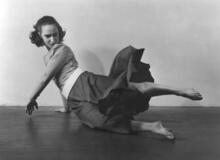
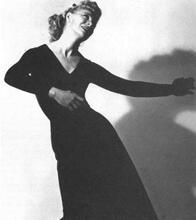
Ze’eva Cohen in 32 Variations in C Minor, 1976. Choreography by James Waring. Photographer: Jack Mitchell.
view details view larger
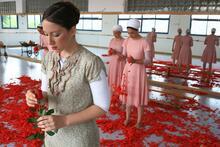
Ze’eva Cohen as Rebecca in Mothers of Israel, 1979. Choreography by Margalit Oved. Photographer: John Lindquist. © Harvard Theatre Collection, Houghton Library, Harvard University.
view details view larger
Ze’eva Cohen in The One of No Way, 1976. Choreograph by Frances Aleinikoff. Photographer: Jack Mitchell.
view detailsfield_section_text_value
Major Choreographic Works
Cohen’s choreography started circulating internationally in the late 1970s through repertory companies. Her masterwork Rainwood (1977) was inspired by the natural beauty of the mid-California coast near Santa Cruz. Cohen based the dance in movements reflecting flora and fauna, metamorphosis and migration; she set the piece against the background of unfolding environmental sounds. Cohen later staged this work, renamed Arava, Bitsot Veyaar (literally, Wilderness, Swamps, and Forest, but the piece is known in English as Rainwood), for Israel’s Batsheva Dance Company, where it was awarded the Kinor David Prize in 1980 for best choreography of the year. Since the late 1970s, Cohen’s choreography has been in the repertory of over 30 companies, including Alvin Ailey II, Batsheva, Boston Ballet, Chamber Dance San Francisco, Chicago Repertory Ensemble, Dance Kaleidoscope, Inbal Dance Theater, Kibbutz Contemporary Dance Company, and Tanzprojekt. She earned many grants and awards from the National Endowment for the Arts, the New York State Council on the Arts, the Con Edison and Edith C. Blum Foundation, and the America-Israel Cultural Foundation.
"Rainwood" Utah RDT, 2010 from Ze'eva Cohen on Vimeo.
Cohen toured her choreography with her company Ze’eva Cohen and Dancers from 1983 to 1988. Her work during New York’s 1980s “dance boom” (so called because of the influx of public funding for the arts and the resultant wide experimentation in contemporary dance performance) featured her sense of the ludic (tongue-in-cheek playfulness) as in Walkman Variations (1985), and drew upon Jewish tradition, as in Sephardic Songs (1986). Cohen’s company performed at the Joyce Theater, the leading downtown Manhattan dance venue at the time, among other venues.
"Sephardic Songs" from Ze'eva Cohen on Vimeo.
"Negotiations", Danspace Project NY, 2000 from Ze'eva Cohen on Vimeo.
In the 1990s, Cohen choreographed a program called Female Mythologies, which featured the duets Negotiations (1996) and If Eve Had a Daughter/Mother Tongue I Love You (1996). Cohen performed Negotiations with African American dancer Aleta Hayes. The dance proposes an alternate narrative for the biblical matriarchs Sarah and Hagar. Cohen positions them entering negotiations as equals, instead of Sarah casting Hagar and Ishmael into the desert, as a way to address conflict arising from cultural difference. If Eve Had a Daughter features a duet to klezmer music with Yiddish exchanges between Cohen as an immigrant mother and Jewish dancer Jill Sigman as her American-born daughter. It portrays tensions between the mother wanting to instill traditional values in her daughter, who wants to leave the old world behind.
"If Eve Had a Daughter", Danspace Project NY, 2000 from Ze'eva Cohen on Vimeo.
Contributions to Dance Education
In addition to the concert stage, Cohen made significant contributions to dance education. She started teaching at Princeton University in 1969, the first year that Princeton admitted women. Cohen founded Princeton’s dance program as a liberal arts program, teaching dance technique, composition, analysis, and writing. She directed it until her retirement as Professor Emerita in 2008. In 1999, Cohen received an award from Princeton’s President’s Standing Committee on the Status of Women for enriching the lives of women. From 2000 to 2018, Cohen was a Consultant and Senior Moderator on the subject of Dance for the International Baccalaureate Organization (IB). She worked with a team of educators to design a multi-faceted dance curriculum for high school students as part of the IB program.
Engaging New Audiences

When Cohen retired, she completed four projects to transmit her choreographic legacy for future generations: 1) she worked with the Dance Notation Bureau to notate her dances Ariadne (1985), inspired by the Hellenistic ruins at Caesarea, and Rainwood in Labanotation, a dance notation system that is conceptually similar to music notation; 2) she made a documentary, Ze’eva Cohen: Creating a Life in Dance; 3) she worked with the Dance Heritage Coalition to ready her professional materials for archival access; and 4) she made her repertory available on the video sharing platform Vimeo. These projects bring Cohen’s work to many audiences now, and make them accessible for new audiences into the future.
The majority of Cohen’s archived professional materials will be given to the Jerome Robbins Dance Division of the New York Public Library for the Performing Arts at Lincoln Center. Some of her papers are also located in the Dance Library of Israel at Beit Ariela in Tel Aviv, and a sampling of photographs, lighting plots, and notation scores from her career is located in the Israel National Library in Jerusalem.
Cohen, Ze’eva. “A Choreographer Reflects on Ariadne: From Life, to Art, to Dance Notation.” Dance Notation Bureau Library News 6, no. 1 (2011): 1–2.
Cohen, Ze’eva. Interview with the author. June 24, 2017.
Cohen, Ze’eva. “Reclaiming My Jewish Yemenite Heritage.” In The Oxford Handbook of Jewishness and Dance in Contemporary Perspective, edited by Naomi Jackson, Toni Shapiro-Phim, and Rebecca Pappas, forthcoming.
Cohen, Ze’eva .Vimeo Channel. https://vimeo.com/zeevacohen.
Cohen, Ze’eva. Website. http://www.zeevacohen.com.
Fanger, Iris M. “Ze’eva! A Close-Up.” Dance Magazine, March 1976, 40–44.
Handly, Donna. “The Pregnant Dance.” Ms., May 1975, 39–41.
Ingber, Judith Brin. “Cohen, Ze’eva: Israeli Dancer, Choreographer, and Educator.” In International Dictionary of Modern Dance, edited by Taryn Benbow-Pfalzgraf, 135–138. Detroit: St. James Press, 1998.
Personal Collection of Ze’eva Cohen.
Ze’eva Cohen: Creating a Life in Dance. Dir. Sharon Kaufman. Ze’eva Cohen Dance Foundation, Inc., and CPW Media, 2014. https://vimeo.com/198375268
More on Ze'eva Cohen

Double your impact to amplify Jewish women’s stories—
All gifts matched up to $35,000
Before you close this article, please consider supporting the Jewish Women’s Archive and uplifting Jewish women’s voices.
At JWA, we preserve the voices of Jewish women and gender-expansive people past and present, share them freely with millions online, and empower a new generation of Jewish feminists to lead with courage, creativity, and conviction.
But none of this happens without you. JWA is an independent nonprofit— we rely on people, like you, who believe that history belongs to all of us and that the voices of Jewish women must remain powerful, and heard.
This month, a generous JWA board member will match every gift dollar for dollar—up to $35,000—through June 30. Your contribution goes twice as far right now.
Every contribution—no matter the size—helps us document, teach, and inspire through Jewish women’s stories.
It takes less than a minute to make a difference.
Thank you for being a part of the JWA community,
Judith Rosenbaum, CEO