

Yael: Bible

Yael plays an important role in the story of Israel’s wars with the Canaanites, described in the Book of Judges. In the narrative about the military heroine Deborah, Deborah first sends Barak to fight the Canaanites, and when he protests that he will not go unless she goes too, she agrees to accompany him but prophesies that the victory will not be a glory for him because Sisera will fall “by the hand of a woman.” When the battle goes disastrously for Sisera, rather than die with his men on the battlefield, he flees to Yael’s tent, hoping to find refuge. Instead, Yael kills him. Yael thus fulfills Deborah’s prophecy, but she confounds many other expectations.
field_section_text_value
Place in Biblical Texts
Yael’s story is recounted in Judges 4 and in the poetic Song of Deborah in Judges 5. Many scholars have argued, based on its linguistic features, that the poetic account is earlier than the prose version, and in fact that the Song of Deborah may be one of the oldest parts of the Hebrew Bible. However, concrete dating has proven slippery. Scholars have debated the relationship between the prose account and the poem, with some arguing to treat them as two separate traditions, perhaps one an elaboration on or rewriting of the other, or perhaps both based on earlier oral traditions. An alternative analytical strategy argues for reading the chapters as they are presented: as a single story, told in two different genres, agnostic as to which came first or what their common source may have been. Each text contains details and emphasis that the other lacks, and for more than 2,000 years they have been read together.
Yael and Sisera
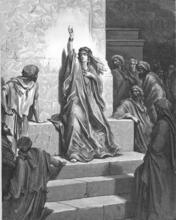
In the prose account, Deborah first sends Barak to fight the Canaanites, and, when he protests that he will not go unless she goes too, she agrees to accompany him. She prophesies that the victory would not be a glory for him, for Sisera would fall “by the hand of a woman” (4:9); that woman will be Yael. This pronouncement is meant in part to shame Barak for his apparent cowardice: because he will not readily “man up,” a woman will get the credit for taking down the enemy general.
When the battle goes disastrously for Sisera and his troops, rather than die with his men on the battlefield, Sisera flees and goes to Yael’s tent, for there is “peace” between King Jabin and Yael’s husband, Heber the Kenite (4:17). When Sisera approaches her tent, Yael goes out to greet him, invites him in, covers him with a blanket or rug (the word used here appears nowhere else in the Bible, so its meaning is uncertain), and, at his request for a little water, gives him milk. Yael is a surrogate mother for Sisera, promising him that no harm will come to him, giving him milk, and tucking him in. Some have suggested fancifully that Yael covers Sisera with her body—that is, she has intercourse with him—but this is unsupported by the text. However, even if we do not envision actual sex between the characters, Judges 4 and 5 are suffused with sexual overtones—and maternal ones. Yael’s words to Sisera (“Turn aside, my lord, turn aside to me” [4:18]), are suggestive, especially as they position her to be alone in her tent with a man. Her use of the address “my lord” may also be a bit of verbal foreplay; this address is often used in the Bible by women towards men with whom they have or will have a sexual relationship (cf. 1 Sam 25, Ruth 2:13, 1 Kgs 1).
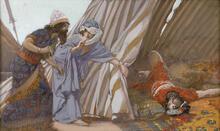
Once inside the tent, Sisera tells Yael to stand at the entrance and respond negatively to whoever asks whether anyone is inside (4:18–20). The text reads: “He said to her, “Stand at the opening of the tent, and if it happens that any man comes and asks you, ‘Is there a man here?’ say, ‘None.’” In a sense, there is no man, only a little boy, cared for by his stand-in mother. As he lies asleep, exhausted from the battle, Yael takes a tent peg and drives it through his forehead into the ground. She then shows his dead body to Barak, who has come in pursuit of the enemy general (4:21–22). Yael has accomplished what Barak could not, and Sisera has indeed been delivered into the hand of a woman.
Evaluations of Yael’s Actions
field_section_text_value
Ackerman, Susan. Warrior, Dancer, Seductress, Queen: Women in Judges and Biblical lsrael. New York: 1998.
Bal, Mieke. Murder and Difference: Genre, Gender, and Scholarship on Sisera’s Death. Bloomington, Indiana: 1988.
Conway, Colleen M. Sex and Slaughter in the Tent of Jael: A Cultural History of a Biblical Story. New York: Oxford, 2017.
Fewell, Danna Nolan, and David M. Gunn. “Controlling Perspectives: Women, Men, and the Authority of Violence in Judges 4–5.” Journal of the American Academy of Religion 58 (1990): 389–411.
Guest, Deryn. “From Gender Reversal to Genderfuck: Reading Jael through a Lesbian Lens.” In Bible Trouble: Queer Reading at the Boundaries of Biblical Scholarship, eds. Teresa J. Hornsby and Ken Stone, 9-42. Altanta: Society of Biblical Literature, 2011.
Meyers, Carol, General Editor. Women in Scripture. New York: 2000.
Niditch, Susan. “Eroticism and Death in the Tale of Jael.” In Gender and Difference in Ancient Israel, edited by Peggy L. Day, 43–57. Minneapolis: Fortress Press, 1989.
Reis, Pamela Tamarkin. “Uncovering Jael and Sisera: A New Reading.” Scandinavian Journal of the Old Testament 19 (2005): 24–47.
Sasson, Jack M. Judges 1-12. New Haven, CT: Yale, 2014.
Tamber-Rosenau, Caryn. Women in Drag: Gender and Performance in the Hebrew Bible and Early Jewish Literature. Piscataway, NJ: Gorgias, 2018.
van Wolde, Ellen. “Jael in Judges 4.” Zeitschrift für die alttestamentliche Wissenschaft 107 (1995): 240–246.
Yee, Gale A. “By the Hand of a Woman: The Metaphor of the Woman Warrior in Judges 4f.” Semeia 61 (1993): 99–132.
More Like This



Double your impact to amplify Jewish women’s stories—
All gifts matched up to $35,000
Before you close this article, please consider supporting the Jewish Women’s Archive and uplifting Jewish women’s voices.
At JWA, we preserve the voices of Jewish women and gender-expansive people past and present, share them freely with millions online, and empower a new generation of Jewish feminists to lead with courage, creativity, and conviction.
But none of this happens without you. JWA is an independent nonprofit— we rely on people, like you, who believe that history belongs to all of us and that the voices of Jewish women must remain powerful, and heard.
This month, a generous JWA board member will match every gift dollar for dollar—up to $35,000—through June 30. Your contribution goes twice as far right now.
Every contribution—no matter the size—helps us document, teach, and inspire through Jewish women’s stories.
It takes less than a minute to make a difference.
Thank you for being a part of the JWA community,


Judith Rosenbaum, CEO

