
Yael Wife of Heber The Kenite: Midrash and Aggadah

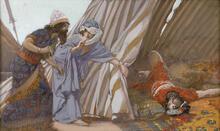
The midrash praises Yael and includes her among the devout women converts. The Rabbis expressed their positive attitude toward Yael, regardless of whether they believed that there was no sexual act between her and Sisera or that they understood that he had, in fact, lain with her. Her actions were guided by a clear goal, and even if they entailed a sin, she acted for the sake of Heaven and thereby saved Israel from annihilation. Yael’s actions helped God to realize God’s plan by punishing Sisera measure for measure for his wicked deeds, and by affording Israel a military victory over its enemies.
field_section_text_value
Yael and Sisera in the Tent
field_section_text_value
Yael the Savior
Another exegesis understands “most blessed of women in tents” as a reference either to the four Matriarchs or to the women of the wilderness generation who dwelled in tents, for without Yael’s deed, their descendants would have been lost (Gen. Rabbah 48:15). According to this interpretation, the death of Sisera, Jabin’s military commander, proved decisive in the war and resulted in Israel’s victory over the Canaanites. Thus Yael’s deed ensured the continued existence of the people of Israel. Yet another exposition comments that Yael did her husband’s bidding when she seduced Sisera, thereby meriting to be the agent of the great deliverance (Seder Eliyahu Rabbah 12).
An additional midrashic teaching that demonstrates the Rabbis’ favorable attitude to Yael’s deed declares that “whoever undertakes to perform a commandment, that commandment shall not cease from his house.” Jethro took into his home Moses, the redeemer of Israel, who had fled from the hated Pharaoh who sought to kill him, and he therefore merited that his offspring would include Yael, who would receive in her home Sisera, the foe of Israel, who had fled from Barak son of Ahinoam, the military commander and redeemer of the Israelites, and would kill this Canaanite (Ex. Rabbah 4:4). This midrash links Yael with Jethro, who is also called a Kenite (and is mentioned in Jud. 4:11). Since hospitality was especially important among nomadic tribes, it might be argued that Yael sinned by harming a guest who came to take shelter with her: instead of granting him protection, she murdered him. The midrash, however, praises her actions, regards them as equally important as Jethro’s hospitality, and presents them as a A biblical or rabbinic commandment; also, a good deed.mitzvah, a religiously commendable act.
The Rabbis categorized Sisera’s unique death as an instance of a measure-for-measure punishment. He had strongly oppressed the Israelites, and severely blasphemed and reviled [gadaf] them, and therefore died a gedufah [cursed or despicable] death, when the Lord gave him over to a woman, who (Jud. 5:26) “crushed his head, smashed and pierced his temple” (Num. Rabbah 10:2). Another midrash applies the verse from the Eshet Hayil (“Woman of Valor”) passage (Prov. 31:19): “She sets her hand to the distaff” to Yael, who did not kill Sisera with a conventional weapon, but with a tent peg, with the strength of her hands (Midrash Eshet Hayil 31:19, Batei Midrashot, vol. 2.).
All the above midrashim, taken as a whole, teach that the Rabbis expressed their positive attitude to Yael, regardless of whether they explained that there was no sexual act between her and Sisera or whether they understood that he had, in fact, lain with her. Her actions were guided by a clear goal, and even if this entailed a sin, she acted for the sake of Heaven, and thereby saved Israel from annihilation. Yael’s actions helped God to realize His plan by punishing Sisera measure for measure for his wicked deeds, and by affording Israel a military victory over their enemies.
More Like This



Double your impact to amplify Jewish women’s stories—
All gifts matched up to $35,000
Before you close this article, please consider supporting the Jewish Women’s Archive and uplifting Jewish women’s voices.
At JWA, we preserve the voices of Jewish women and gender-expansive people past and present, share them freely with millions online, and empower a new generation of Jewish feminists to lead with courage, creativity, and conviction.
But none of this happens without you. JWA is an independent nonprofit— we rely on people, like you, who believe that history belongs to all of us and that the voices of Jewish women must remain powerful, and heard.
This month, a generous JWA board member will match every gift dollar for dollar—up to $35,000—through June 30. Your contribution goes twice as far right now.
Every contribution—no matter the size—helps us document, teach, and inspire through Jewish women’s stories.
It takes less than a minute to make a difference.
Thank you for being a part of the JWA community,


Judith Rosenbaum, CEO