

Deborah: Bible

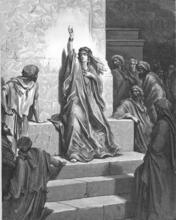
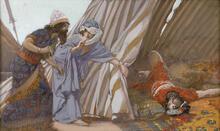
Deborah is one of the major judges (charismatic military leaders, not juridical figures) in the story of how Israel takes the land of Canaan. She is the only female judge, the only one to be called a prophet, and the only one described as performing a judicial function. Deborah summons Barak to lead the battle against the Canaanites; he agrees, but only if she accompanies him. Barak and his warriors destroy all the Canaanites except Sisera, who seeks refuge with but is killed by Jael. Later rabbis acknowledged Deborah as a prophet but, due to their discomfort with women leaders, blunted her impact by speculating about her husband, reading her self-identification in the Song of Deborah in Judges 5 as hubris, and minimizing her role as judge.
Place in Biblical Texts
field_section_text_value
Deborah’s Identity
As the story opens in Judges 4, Deborah is already a judge, settling disputes brought to her while she sits under the “palm of Deborah” in the hill country of Ephraim (4:5). She is identified as eshet lappidot (4:4), which may mean “woman of [the town] Lappidoth,” “wife of [the man] Lappidoth,” or “woman of torches” (that is, “fiery woman” or even “pyromancer”). If Lappidoth is a person, he is an otherwise unknown figure in the Hebrew Bible. Some Jewish traditions posit that Lappidoth is another name for Deborah’s general Barak, whose name means “lightning.”
Most of the judges are acknowledged as such after military victory; Deborah is called a judge before the battle, but the narrative does not include the story of how she became a judge, why she is called a “prophetess,” or the way in which God commanded her to begin the battle against Jabin, the Canaanite king of Hazor, and his general, Sisera. All other judges in the book appear to be military leaders, so we can assume Deborah is as well. The text does not describe her actually wielding weapons, though it also does not mention Barak doing so, and interpreters uniformly assume he did.
Deborah and Barak vs. Sisera
field_section_text_value
Protector of Israel
field_section_text_value
Ackerman, Susan. Warrior, Dancer, Seductress, Queen: Women in Judges and Biblical Israel. New Haven: Yale University Press, 1998.
Bal, Mieke. Death and Dissymmetry: The Politics of Coherence in the Book of Judges. Chicago: University of Chicago Press, 1988.
Bronner, Leila Leah. From Eve to Esther: Rabbinic Reconstructions of Biblical Women. Louisville, Ky.: Westminster John Knox, 1994.
Exum, J. Cheryl. “Mother in Israel: A Familiar Story Re-considered.” In Feminist Interpretation of the Bible, edited by Letty M. Russell, 73–85. Philadelphia: The Westminster Press, 1985.
Fewell, Danna Nolan, and David M. Gunn. “Controlling Perspectives: Women, Men, and the Authority of Violence in Judges 4–5.” Journal of the American Academy of Religion 58 (1990): 389–411.
Frymer-Kensky, Tikva. Victors, Victims, Virgins, and Voice: Rereading the Women of the Bible. New York: Schocken, 2002.
Gafney, Wilda C. Daughters of Miriam: Woman Prophets in Ancient Israel. Minneapolis: Fortress, 2008.
Meyers, Carol, General Editor. Women in Scripture. New York: Eerdmans, 2000.
Sasson, Jack M. “‘A Breeder or Two for Each Leader’: On Mothers in Judges 4 and 5.” In Critical Engagement: Essays on the Hebrew Bible in Honour of J. Cheryl Exum, ed. David J.A. Clines and Ellen J. van Wolde, Hebrew Bible Monographs 28, 335-340. Sheffield, England: Sheffield Phoenix, 2012.
Stager, Lawrence. “Archaeology, Ecology, and Social History: Background Themes to the Song of Deborah.” In Jerusalem Congress Volume, 1986, edited by J. A. Emerton, 221–234. Netherlands: Brill, 1988.
Stökl, Jonathan. “Deborah, Huldah, and Innibana: Constructions of Female Prophecy in the ancient Near East and the Hebrew Bible. Journal of Ancient Judaism 6:3 (2015): 320-334.
Tamber-Rosenau, Caryn. “The ‘Mothers’ Who Were Not: Motherhood Imagery and Childless Women Warriors in Early Jewish Literature.” Mothers in the Jewish Cultural Imagination. Edited by Jane L. Kanarek, Marjorie Lehman, and Simon J. Bronner. Jewish Cultural Studies 5. Oxford: The Littman Library of Jewish Civilization, 2017.
Yee, Gale A. “By the Hand of a Woman: The Metaphor of the Woman Warrior in Judges 4,” Semeia 61 (1993), 114-27.


Double your impact to amplify Jewish women’s stories—
All gifts matched up to $35,000
Before you close this article, please consider supporting the Jewish Women’s Archive and uplifting Jewish women’s voices.
At JWA, we preserve the voices of Jewish women and gender-expansive people past and present, share them freely with millions online, and empower a new generation of Jewish feminists to lead with courage, creativity, and conviction.
But none of this happens without you. JWA is an independent nonprofit— we rely on people, like you, who believe that history belongs to all of us and that the voices of Jewish women must remain powerful, and heard.
This month, a generous JWA board member will match every gift dollar for dollar—up to $35,000—through June 30. Your contribution goes twice as far right now.
Every contribution—no matter the size—helps us document, teach, and inspire through Jewish women’s stories.
It takes less than a minute to make a difference.
Thank you for being a part of the JWA community,


Judith Rosenbaum, CEO

