
Art: Representation of Biblical Women
For centuries, art has portrayed biblical women in ways that reflect society’s attitudes towards women and their role. Depictions of female biblical figures fluctuate according to historical and social perceptions. Delilah, Potiphar’s wife, and Judith are especially valued in Northern culture, where they express the theme of woman’s domination. Other figures, such as Jael, Esther, and Judith, become types in Christian reception and are therefore popular and admired female models. The moralistic medieval visualization of Lot’s daughters, Bathsheba, and Susanna became highly erotic during the Renaissance and Baroque periods. Jewish art often features heroic and worthy women who, through their courageous deeds, helped to triumph over Israel’s enemies. Hagar and Rachel are often invoked by Israeli artists to convey their attitude towards the Jewish-Arab conflict.
Introduction
field_section_text_value
Seductive
field_section_text_value
Heroic
field_section_text_value
The (Male) Gaze
field_section_text_value
Woman of Worth
field_section_text_value
Chaste, Obedient, and Devout
field_section_text_value
The Multifaceted Biblical Women
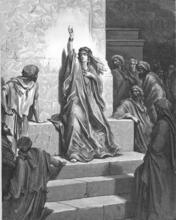
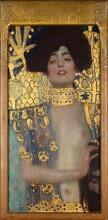
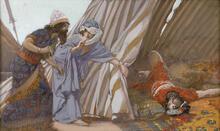
Eve is a recurrent subject throughout art history, while other female biblical figures appear intermittently; yet all images constantly fluctuate according to historical and social perceptions. Thus, Delilah, Potiphar’s wife and Judith are especially valued in Northern culture, where they serve to express the theme of woman’s domination and man’s subjugation through their charm and wily acts. Other figures such as Jael, Esther and Judith—known for their valiant deeds—become types in Christian reception and are therefore popular and admirable female models. The moralistic medieval visualization of Lot’s daughters, Bathsheba and Susanna, all implicated in sexual context, changes in Renaissance and Baroque art into a highly erotic image; featured as voluptuous, sensuous female nudes, they are intended to delight the gaze of the (mostly male) spectators. The conventionalized stereotypes of Sarah (Hagar), Rebecca and Rachel (Leah), valued in medieval thought thanks to their typological meaning, are frequently represented. In Netherlandish and German art, though retaining their Christian meaning, they also acquire a social connotation; they serve as paradigms of female virtues, incarnating chastity, obedience or marital fidelity. Jewish art prefers to turn both to heroic women who through their courageous deeds helped to triumph over Israel’s enemies (Jael, Judith, Esther), and worthy women (Miriam, Ruth). Lastly, Hagar and Rachel are undoubtedly the figures of choice of Israeli artists to convey their attitude towards the Jewish-Arab conflict.
Biblical Stories in Islamic Painting. Exhibition catalog. Israel Museum, Jerusalem, Dec. 1991–May 1992.
Bleyerveld, Yvonne. “Chaste, Obedient and Devout: Biblical Women as Patterns of Female Virtue in Netherlandish and German Graphic Art, c. 1500–1750,” Simiolus 28/4 (2000/2001): 219–236; Femmes de l’Ancien Testament.
Exhibit catalog. Musée National Message Biblique Marc Chagall, Nice, July 3–October 4, 1999.
Friedman, Mira. “The Metamorphoses of Judith.” Journal of Jewish Art, 12–13 (1986/87): 225–246.
Idem. Bilder zur Bible. Altes Testament, Bayreuth: 1985.
Garrard, Mary D. Artemisia Gentileschi. The Image of the Female Hero in Italian Baroque Art. Princeton, N.J.: 1989.
Hieatt, A. Kent. “Eve as Reason in a Tradition of Allegorical Interpretation of the Fall.” Journal of the Warburg and Courtauld Institutes 38 (1975): 221–226.
Jacob and Israel. Homeland and Identity in the Work of Jakob Steinhardt. Exhibit catalog. The Open Museum, Tefen Industrial Park, January 1998.
Kahr, Madlyn Millner. “Delilah.” The Art Bulletin 54 (1972): 282–299.
Kunoth-Leifels, Elisabeth. Über die Darstellungen der “Bathseba im Bade.” Essen: 1962.
Kunz, Hannelore. “Materialen und Beobachtungen zur Darstellung der Lotgeschichte (Genesis 19:12–26) von den Anfängen bis gegen 1500.” Ph.D. diss., Ludwig-Maximilians-Universität zu München, 1981.
Lavin-Aronberg, Marylin and Irving Lavin. The Liturgy of Love: Images from the Song of Songs in the Art of Cimabue, Michelangelo, and Rembrandt. Lawrence, KS: 2001.
Mellinkoff, Ruth. “Sara and Hagar: Laughter and Tears.” in Illuminating the Book: Makers and Interpreters. Essays in Honour of Janet Backhouse, edited by Brown, Michelle and Scot McKendrick, 35–51. London: The British Library, 1998.
Meyer, Mati. “L’image de la femme biblique dans les manuscrits byzantins enluminés de la dynastie macédonienne (867–1056).” Ph.D. diss., Hebrew University of Jerusalem, 2001.
Sed-Rajna, Gabrielle. The Hebraic Bible in Medieval Illuminated Manuscripts, Tel-Aviv: Steinmatzky, 1987.
Sölle, Dorothée. Great Women of the Bible in Art and Literature. English translation by Joe Kirchberger. Grand Rapids, MI: Eerdmans, 1994.
Unglaub, Jonathan. “Poussin’s Esther Before Ahasuerus: Beauty, Majesty, Bondage.” The Art Bulletin, 85/1 (2003): 114–36.
Veldman, Ilja M. “The Old Testament as a moral code: Old Testament stories as exempla of the Ten Commandments.” Simiolus 23/4 (1995): 215
More Like This


Double your impact to amplify Jewish women’s stories—
All gifts matched up to $35,000
Before you close this article, please consider supporting the Jewish Women’s Archive and uplifting Jewish women’s voices.
At JWA, we preserve the voices of Jewish women and gender-expansive people past and present, share them freely with millions online, and empower a new generation of Jewish feminists to lead with courage, creativity, and conviction.
But none of this happens without you. JWA is an independent nonprofit— we rely on people, like you, who believe that history belongs to all of us and that the voices of Jewish women must remain powerful, and heard.
This month, a generous JWA board member will match every gift dollar for dollar—up to $35,000—through June 30. Your contribution goes twice as far right now.
Every contribution—no matter the size—helps us document, teach, and inspire through Jewish women’s stories.
It takes less than a minute to make a difference.
Thank you for being a part of the JWA community,


Judith Rosenbaum, CEO