

Naomi Feinbrun-Dothan

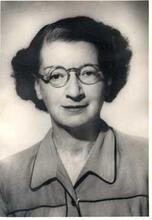
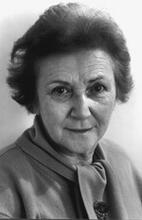
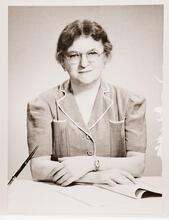
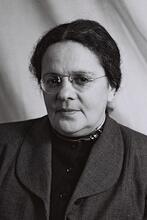
Botanist Naomi Feinbrun (1900 – 1995), one of the first women professors at the Hebrew University in Jerusalem, conducted pioneering research of the flora of Israel and the Middle East until her death at the age of ninety-one. Her memory lives on in the Astragalus feinbruniae and other plants named in her honor by colleagues in Israel and abroad.
Photographer: Werner Braun.
Institution: Hebrew University of Jerusalem.
Born to a Zionist family, Naomi Feinbrun-Dothan began studying natural sciences at Moscow University in 1918 and earned a degree in botany from the University of Romania in 1923 before following her family to Palestine. By 1926 she joined the Institute of Agriculture and Natural History in Tel Aviv, and in 1929 she started teaching genetics at Hebrew University, where she was the only genetics professor for two decades. In 1931, with her longtime collaborators Alexander Eig and Michael Zohary, she published the first comprehensive analysis of plants in Hebrew. Although she earned her PhD in 1938, Feinbrun was not made an associate professor until 1960. Nevertheless, she continued working as an active researcher, respected teacher, and prolific author into her 90s and was honored with the Israel Prize in 1991.
Botanist Naomi Feinbrun-Dothan was one of the first women who became part of the academic staff at the Hebrew University of Jerusalem, a rarity in the days when very few women had scientific careers, not only locally but also worldwide. For more than six decades she studied the flora of Israel and published dozens of articles and several analytical flora books. At the age of 91 she received the 1991 Israel Prize for her unique contribution to Land of Israel studies.
Early Life and Education
Naomi Feinbrun was born to a Zionist family in Moscow in 1900. Both her parents, Rachel and Aharon Feinbrun, belonged to Members of Hibbat ZionHovevei Zion and her father was also a member of the Benei Zion association in Moscow. Naomi had an older sister, Shulamit, and two younger brothers, Miron and Moshe. They grew up in Kishinev, Bessarabia, but the 1905 Kishinev pogrom did not reach the street where the family had lived.
Naomi Feinbrun studied at an elementary school where one hour of Hebrew was taught every day and later at a Jewish girls’ high school in Kishinev. The family moved back to Moscow in 1907, and after her high-school graduation (cum laude) in 1918 Feinbrun began her studies at the Faculty of Natural Sciences at Moscow University. When her family again moved to Bessarabia in 1920, Feinbrun continued her studies at the University of Romania, in Cluj, Transylvania, where she received her first degree in botany in 1923. She then taught natural sciences for a while at the Jewish girls’ high school in Kishinev.
Emigration to Palestine
field_section_text_value
Research Career
Following the meeting with Eig, Feinbrun attended the Institute of Agriculture and Natural History in Tel Aviv, directed by Otto Warburg (1859–1938). Accepted as a guest researcher for a few months, she was given a half-time position in 1926. While she was working at the Institute, Feinbrun learnt English, primarily by using G. E. Posts’s book, Flora of Syria, Palestine and Sinai (Beirut 1898). From 1930 to 1938 her publications were in Hebrew or German, and only after 1938 did she start publishing in English.
When the Hebrew University of Jerusalem was founded in April 1925 it was decided that the Institute of Agriculture and Natural History would be part of the new university. Its name was changed to the Systematic Botany Branch, with Warburg still at its head. In 1929 Feinbrun became an untenured assistant at the university and moved to Jerusalem together with Alexander Eig and Michael Zohary (1898–1983). Together these three botanists in 1931 published the first full analytical flora book in Hebrew. In 1936 Eig established the Palestine Journal of Botany Jerusalem (Later: Israel Journal of Botany), in which Feinbrun and her colleagues used to publish their works. The first issue of the journal included a phytographic map based on the three researchers’ many field trips.
Budgetary problems and distance from the overseas scientific community plagued research at Hebrew University at this period. The feelings of distance turned into total isolation during World War II. At the same time, the land itself offered somewhat of a compensation. Being a bridge between Europe and Africa, the area is rife with plant and animal life that are transitional links between species on the neighboring continents. Consequently, many field trips were conducted locally and in bordering countries in order to study the local fauna and flora. While the systematic research was based on the European research tradition and on the colonial tradition of creating collections for museums of natural history, it was also influenced by the national atmosphere, one of emotional relationship to the landscape and a desire to become familiar with it, leading to a sense of belonging.
In 1933 Feinbrun joined a delegation of seven Hebrew University scientists who were invited to Iraq by the Iraqi Ministry of Agriculture. Their main purpose was to conduct a survey of the forests of Kurdistan—preparing an inventory of trees and presenting a proposal for afforestation and for preserving the forests. Other research expeditions in which Feinbrun participated were to Transjordan, the Sinai Peninsula, Lebanon, Cyprus and, in 1944, to the eastern desert in Egypt.
Teaching Career
field_section_text_value
Selected Works
“Alexander Eig: A Biography” (Hebrew). Nature and Country 5 (1938): 412–418.
“Allium section Porrum of Palestine and the neighbouring countries.” Palest. J. Bot. Jerusalem ser. 3 (1943): 1–21.
with Atsmon, D. “Chromosome counts in Israeli Cistaceae.” Caryologia 13 (1960): 240–246.
“Beiträge zur Kenntnis der Umbelliferen Transjordaniens” (Contributions to the knowledge of the Trandjordanian Umbellifers of Transjordan). Feede Repert. nov. Spec. Regni veg. 29 (1931): 133–136.
“Beiträge zur Kenntnis der Variabilität von Aegilops ventricosa Tausch” (Contributions to the knowledge of the variability of Aegilops ventricosa). Feede Repert. nov. Spec. Regni veg. 28 (1930): 65–66.
“Chromosome counts in Palestinian Allium species.” Palest. J. Bot. Jerusalem ser. 5 (1949): 13–16.
“Chromosome numbers and evolution in the genus Colchicum.” Evolution 12 (1958): 173–188.
“Chromosome numbers in Crocus.” Genetica 29 (1958): 172–192.
“Chromosome numbers in the genus Colchicum.” Bull. Res. Counc. Israel 6B (1957): 283.
“Chromosomes and taxonomic groups in Allium.” Caryologia 6 (1954), supplement, 1036–1041, Proc. 9th Int. Cong. Genetics.
“Chromosomes of some East-Mediterranean Papaver species.” Caryologia 16 (1963): 649–652.
“The contribution of the late Tuvia Kushnir to the plant knowledge of Palestine” (Hebrew). Nature and Country 7 (1948): 478–480.
“Cuscuta.” In Flora Europaea, vol. 3, edited by Thomas Tutin. Cambridge: Cambridge University Press, 2010.
“Cytology.” In Encyclopedia of Agriculture, vol. 1.: 1966.
with Eig A. “Bellevalia desertorum. sp. n.” Beih. Bot. Centralbl. 49 (1932): 666–668.
Eig, A., M. Zohary and N. Feinbrun. Magdir le-tsimḥe Erets-Yiśrael (The plants of Palestine: an analytical key). Jerusalem: University Press, 1931.
Eig, A., M. Zohary and N. Feinbrun. Magdir le-tsimḥe Erets-Yiśrael. Second edition. Jerusalem: Ha-‘Lton le-Botanikah, 1948.
with Eig, A. “A new plant of the Negev, Leopoldia eburnea sp. nov.” Palest. J. Bot. Jerusalem ser. 4 (1947): 58.
with Eig, A. “Plants new for Palestine II.” Palest. J. Bot. Jerusalem ser. 2 (1940): 97–102.
with Eig, A. and M. Zohary. “E prelis Universitatis Hierosolymis.” Centuria IV (1938): 1–30.
“Ein Beitrag zur Kenntnis der Flora des Amanus-Gebirges (Syrien)” (A contribution to the knowledge of the flora of the Amanus Mountains (Syria)). Beih. Bot. Centralbl. 51 (1933): 374–388.
with Evenari, M., S. Klein and H. Anchori. “The beginning of cell division and cell elongation in germinating lettuce seed.” Bull. Res. Counc. Israel 6D (1957): 33–37.
Flora Palaestina. Part 3: Ericaceae-Compositae. Jerusalem: Israel Academy of Sciences and Humanities, 1978.
Flora Palaestina. Part 4: Monocotyledoneae. Jerusalem: Israel Academy of Sciences and Humanities, 1986.
“Further studies on Allium of Palestine and the neighbouring countries.” Palest. J. Bot. Jerusalem ser. 4 (1948): 144–157.
“The genus Bellevalia in Palestine” (Hebrew). The Magnes Volume (1938): 386–389.
“The genus Colchicum of Palestine and neighbouring countries.” Palest. J. Bot. Jerusalem ser. 6 (1953): 71–95.
“The genus Iphiona in Palestine.” Israel J. Bot. 15 (1966): 22–24.
“The genus Lycium in the Flora Orientalis region.” Collnea bot. 7 (1968): 359–379.
“The genus Ornithogalum in Palestine and neighbouring countries.” Palest. J. Bot. Jerusalem ser. 2 (1941): 132–150.
“The genus Rhamnus in Palestine.” Palest. J. Bot. Jerusalem ser. 3 (1946): 167–169.
with Hedge, I. C. “Satureia thymbrifolia Hedge et Feinbrun, sp. nov.” Israel J. Bot. 17 (1968): 213–216.
“In memory of a young botanist, Yitzhak Halevi” (Hebrew). Ha-Sadeh 28 (1948): 453–455.
with Kollmann, Fania. “A cyto-taxonomic study in Palestinian Anagallis arvensis L.” Notes R. bot. Gdn. Edinb. 28 (1968): 173–186.
with Klein, S. “3H-thymidine incorporation into cell nuclei in germinating lettuce seeds.” Pl. Cell Physiol. 3 (1962): 407–413.
“Materials for a revised Flora of Palestine I.” Proc. Linn. Soc. London 157 (1944–1945): 46–54.
“Materials for a revised Flora of Palestine II.” Bull. Res. Counc. Israel 8D (1960): 169–172.
“A monographic study on the genus Beb levalia Lapeyr. (Caryology, Taxonomy, Geography).” Palest. J. Bot. Jerusalem ser. 1 (1938–1940): 42–54; 131–142; 336–409.
“New data on some cultivated plants and weeds of the Early Bronze Age in Palestine.” Palest. J. Bot. Jerusalem ser. 1 (1938): 238–240.
“A new nettle from Huleh.” Palest. J. Bot. Jerusalem ser. 4 (1947): 114–115.
“A new Rheum species from Palestine.” Palest. J. Dot. Jerusalem ser. 3 (1944): 117–118.
“On the occurrence of Drosera rotundifolia L. in Lebanon.” Palest. J. Bot. Jerusalem ser. 2 (1942): 251–252.
“On the vegetation of Tel Aviv” (Hebrew). Nature and Country 2 (1933): 124–128.
with Parag, Y. and J. Tas. “Study in atmospheric pollen in Jerusalem in 1953–1954.” Bull. Res. Counc. Israel 6D (1957): 5–17.
“Plants new for Palestine III.” Palest. J. Bot. Jerusalem ser. 4 (1949): 237–238.
“Poa series Roshev. of Palestine and Syria.” Bull. of misc. Inf. R. Bot. Gdns. Kew, 7 (1940): 277–285.
with Rahat, A. and J. Tas. “Further studies in atmospheric pollen in Jerusalem.” Bull. Res. Counc. Israel 8D (1959): 31–40.
The Rose: Edited and revised from a manuscript by the late M. Schwartzman. Tel Aviv: 1948, 1–64.
“Revision of the genus Hyacinthella Schur.” Bull. Res. Counc. Israel IOD (1961): 324–347.
“Schedae ad Floram Exsiccatam Palaestinae.” Centuria III 1–36 (1934).
Simhe bar beEres Yisra'el (Wild Plants in the Land of Israel). Plates by Ruth Koppel. (Hebrew and English editions) Tel Aviv: Hakibutz Hameuchad, 1960.
“Species of Lycium in Palestine.” Mada 13 (1968): 221–224.
“Spontaneous Pineta in the Lebanon.” Bull. Res. Counc. Israel 7D (1959): 132–153.
with Tas, J. “A survey of airborne pollen in Jerusalem.” Acta Allerg. 17 (1962): 246–267.
with Taub, Sarah. “The Cuscuta species of Palestine.” Israel J. Bot. 13 (1964): 1–23.
“A taxonomic review of European Cuscutae.” Israel J. Bot. 19 (1970): 19–29.
“Taxonomic studies on Papaver Sect. Orthorhoeades of Palestine and of some other Mediterranean countries.” Israel J. Bot. 12 (1963): 74–96.
with Stearn, W. T. “A revision of Sternbergia (Amaryllidaceae) in Palestine.” Bull. Res. Counc. Israel 6D (1958): 167–173.
with Stearn, W. T. “Typification of Lycium barbarum L., L. afrum L. and L. europaeum.” L. Israel J. Dot. 12 (1963): 114–123.
“Über die Variabilität von Trigonella monspeliaca L. und die pflanzen-geographischen Verhältnisse ihrer Formen” (On the variability of Trigonella monspeliaca L. and the plant-geographical relationships of their forms). Beih. Bot. Centrabl. 51 (1933): 389–396.
“Useful wild plants in Palestine” (Hebrew). Ha-Sadeh 10 (1930): 298–301, 362–368; 433–477.
with Zohary, M. “A geobotanical survey of Transjordan.” Bull. Res. Comic. Israel 5D (1955): 5–35.
with Zohary, M. “Outline of vegetation of the Northern Negev.” Palest. J. Bot. Jerusalem ser. 5 (1951): 96–114.
with Zohary, M. Tsimhiyat Erets-Yisrael be-tsiyurim (Flora of the Land of Israel: Iconography). Plates by Ruth Koppel. I. Pls. 1–50, 1949; II. Pls. 51–100, 1952; III. Pls. 101–151 (Hebrew and English editions). Tel Aviv: La Da’at, 1959.
More Like This

Double your impact to amplify Jewish women’s stories—
All gifts matched up to $35,000
Before you close this article, please consider supporting the Jewish Women’s Archive and uplifting Jewish women’s voices.
At JWA, we preserve the voices of Jewish women and gender-expansive people past and present, share them freely with millions online, and empower a new generation of Jewish feminists to lead with courage, creativity, and conviction.
But none of this happens without you. JWA is an independent nonprofit— we rely on people, like you, who believe that history belongs to all of us and that the voices of Jewish women must remain powerful, and heard.
This month, a generous JWA board member will match every gift dollar for dollar—up to $35,000—through June 30. Your contribution goes twice as far right now.
Every contribution—no matter the size—helps us document, teach, and inspire through Jewish women’s stories.
It takes less than a minute to make a difference.
Thank you for being a part of the JWA community,


Judith Rosenbaum, CEO

