
Clara Heyn

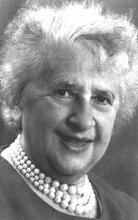
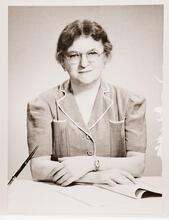
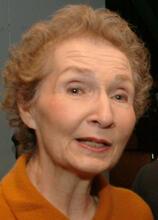
Clara Heyn named several new species and helped scientists better understand the variety of plants native to Israel. Born Chaia Clara Blau, Heyn fled Vienna in 1938 with her parents and made Aliyah to Palestine, where she studied at a teacher’s college in Tel Aviv and taught primary school for seven years. She earned her doctorate in botany in 1960 and began a successful career. Her dissertation became a book that has remained a classic in the study of Medicago. Heyn began teaching at Hebrew University and directed the school’s herbarium from 1969 to 1997. She won Optima’s Gold Medal for her scientific contributions.
Botanist Chaia Clara Heyn was born on June 13, 1924, in Cluj (Transylvania), Romania, to Paul-Pinchas (1889–1948) and Sima (née Grünfeld, 1895–1990) Blau, who also had a son, Jehoshua. Theirs was an affluent Jewish family. Paul Blau had a doctorate in international relations and worked as a journalist and businessman, while Sima was a homemaker. In 1931 the family moved to Baden, Austria, relocating to Vienna in 1937. One year later, in response to the Anschluss, the Blaus immigrated to Mandatory Palestine.
Education and Dissertation
field_section_text_value
Teaching Career
Heyn joined the staff at the Hebrew University of Jerusalem in 1962 and was promoted to full professor in 1978. An excellent and popular teacher, she never left the classroom until the last student had departed. For almost three decades (1969–1997) she directed the Hebrew University’s Herbarium and in 1980 launched the computerization of this herbarium’s collections.
Heyn was invited to join many academic boards and committees throughout Israel and served as an active leader and thoughtful member. In 1974 she was among the founders of the international organization of the Mediterranean Sea botanists, Optima, continuing to serve on its board and executive council until 1993. In 1995 she won Optima’s gold medal, honoring her scientific contributions to the phytotaxonomy of the Mediterranean area.
Heyn’s primary fields of interest were the systematic and evolution of plants, but in the mid–1980s pollination biology caught her eye. In addition, she considered bryophytes her hobby and began studying the mosses of Israel, an interest that peaked in 1978 and on which she collaborated with her former student and long-time research partner Dr. Ilana Herrnstadt. Heyn planned to focus her efforts on this hobby after her retirement.
After a courageous battle with cancer, Clara Heyn passed away on December 27, 1998. Until her last days, she scribbled the finishing touches on the final manuscript of the Bryophyte flora, written together with Israeli colleagues. The memory of her wisdom and humor lives on in the wide circle of close friends, colleagues, students and family. Three taxa bear her name: Medicago sect. Heynianae Greuter; Medicago Heynianae Greuter; and Prangus subg. Heynia Pimenov & V. H. Tikhom.
A chronological list of her scientific publications in English can be found in Flora Mediterranea (1999) 9:13–16.
Selected Works by Clara Heyn
The Annual Species of Medicago. Jerusalem: Magnes Press, 1963.
The Bryophyte flora of Israel and adjacent regions. Jerusalem: Israel Academy of Sciences and Humanities, 2004.
More Like This

Double your impact to amplify Jewish women’s stories—
All gifts matched up to $35,000
Before you close this article, please consider supporting the Jewish Women’s Archive and uplifting Jewish women’s voices.
At JWA, we preserve the voices of Jewish women and gender-expansive people past and present, share them freely with millions online, and empower a new generation of Jewish feminists to lead with courage, creativity, and conviction.
But none of this happens without you. JWA is an independent nonprofit— we rely on people, like you, who believe that history belongs to all of us and that the voices of Jewish women must remain powerful, and heard.
This month, a generous JWA board member will match every gift dollar for dollar—up to $35,000—through June 30. Your contribution goes twice as far right now.
Every contribution—no matter the size—helps us document, teach, and inspire through Jewish women’s stories.
It takes less than a minute to make a difference.
Thank you for being a part of the JWA community,
Judith Rosenbaum, CEO