

Yardena Cohen

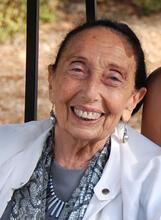
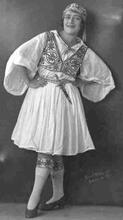
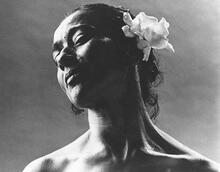
Incorporating biblical themes and Sephardic music into her dances, Yardena Cohen helped create a uniquely Israeli artistic culture. Cohen joined the youth group Mahanot ha-Olim and helped found Kibbutz Bet ha-Shittah with them before a fellow kibbutznik, American-born Shemaryah Tzameret, gave her the funds to study dance formally in Vienna in 1930. She returned to Palestine in 1933, opened her own dance studio in Haifa, and taught dance in elementary schools while choreographing performance pieces for herself. Her dances incorporated biblical themes, Middle Eastern costumes, and Sephardic music. In 1937 she won first prize in the National Dance Contest in Tel Aviv. She continued to teach well into her nineties and in 2010 was awarded the Israel Prize for Lifetime Achievement.
Early Life and Family
Yardena Cohen, daughter of Miriam Rafalkes and Pinhas Cohen (1887–1956), was born on July 1, 1910, in Wadi Nisnas (the Arab name of a district near the Haifa port). Yardena was the oldest of three children; the others were musicologist and writer Ruth Keviti Jordan (c. 1921–c. 1997) and Nir. Her father, who was born in Zikhron Ya’akov, graduated first from the Mikveh Israel agricultural school and then from an agricultural college in Berlin. In 1908 he founded the first Hebrew school in Haifa. Her mother, who was born near Vilna c. 1880 and was a descendant of the Vilna Head of the Torah academies of Sura and Pumbedita in 6th to 11th c. Babylonia.Gaon (Elijah ben Solomon Zalman, 1720–1797), studied science with Chaim Weizmann in Geneva, and then joined her parents, who were founders of Rehovot. She died in Haifa c. 1960.
Yardena was immensely energetic as a child and was often seen dancing spontaneously, especially on the beach in Bat Galim, Haifa. She studied in Tel Aviv at the Herzlia Hebrew Gymnasia where she joined a youth group, Mahanot ha-female/sing.; individual(s) who immigrates to Israel, i.e., "makes aliyah."Olim, a section of Ha-No’ar ha-Lomed. Here she met Shemaryah Tzameret, an American idealist who had come on Lit. "ascent." A "calling up" to the Torah during its reading in the synagogue.aliyah. Together with the youth group, they worked in the orchards of Haderah and then helped found A voluntary collective community, mainly agricultural, in which there is no private wealth and which is responsible for all the needs of its members and their families.Kibbutz Bet ha-Shittah, where Yardena was known for her spirited impromptu dancing in the evenings. Shemaryah was so moved that he gave his allowance from America to Yardena in order to encourage her to obtain professional training, using his gift as a stipend to study dance in Europe. His hope that she would return with dance skills was fulfilled.
Early Dance Career
field_section_text_value
Dances for Kibbutzim
field_section_text_value
Dance Studio, Awards, and Legacy
field_section_text_value
Ashkenazy, Ruth. “Celebrating in the Valley and on the Hilltops: Yardena Cohen and the Creation of
Cultural Patterns in Nature-Connected Festivities in Kibbutzim in the 1940s.” Israel Dance Annual (1985):25–29.
Aldeen, Niseem Nisar. “Ha-Debka ha-Druzit be-Doroteha be-Yisrael” (The History of the Druze Debka in Israel) (Hebrew). Daliyat Al-Karmil: 2001.
Barfman, Ora. “Ha-Kena’anit Bat Galim”(Hebrew). Kol-Bi local newspaper, October 20, 2000.
Blumfield, Wendy. “Dancing with the Waves.” Jerusalem Post, July 13, 2001.
Cohen, Yardena. Ha-Tof ve-ha-Yam (The Drum and the Sea) (Hebrew). Tel Aviv: 1976.
Idem. Be-Tof u-Mahol (With Drum and Dance) (Hebrew). Tel Aviv: 1963; Eshel, Ruth. Lirkod im ha-Halom (Dancing With The Dream: The Development of Artistic Dance in Israel, 1920–1964) (Hebrew). Tel Aviv: 1991.
Hazan, Ruth. “Nishmat ha-Mahol shel Yardena (Hebrew).” Al ha-Mishmar, July 11, 1975.
Ingber, Judith Brin. “The Priestesses.” Dance Chronicle (1995): 445–465.
Ingber, Judith Brin. “Shorashim: The Roots of Israeli Folk Dance.” Dance Perspectives (Autumn 1974): 1–59.
Shanit, Gili. producer. ZED films “Ha-Tof ve-ha-Yam” (Hebrew). Produced by the Dance Library of Israel. Premiered January 26, 2003Rappaport Theater, Haifa.
Spiegel, Nina S. “Cultural Formation in Eretz Israel: The National Dance Competition of 1937.” Jewish Folklore and Ethnology Review, 20/1–2 (2000): 24–39.
Spiegel, Nina. Embodying Hebrew Culture: Aesthetics, Athletics, and Dance in the Jewish Community of Mandate Palestine. Detroit: Wayne State University Press, 2013.
More on Yardena Cohen



Double your impact to amplify Jewish women’s stories—
All gifts matched up to $35,000
Before you close this article, please consider supporting the Jewish Women’s Archive and uplifting Jewish women’s voices.
At JWA, we preserve the voices of Jewish women and gender-expansive people past and present, share them freely with millions online, and empower a new generation of Jewish feminists to lead with courage, creativity, and conviction.
But none of this happens without you. JWA is an independent nonprofit— we rely on people, like you, who believe that history belongs to all of us and that the voices of Jewish women must remain powerful, and heard.
This month, a generous JWA board member will match every gift dollar for dollar—up to $35,000—through June 30. Your contribution goes twice as far right now.
Every contribution—no matter the size—helps us document, teach, and inspire through Jewish women’s stories.
It takes less than a minute to make a difference.
Thank you for being a part of the JWA community,


Judith Rosenbaum, CEO