
Rina Yerushalmi

Theater director and choreographer Rina Yerushalmi, one of Israel’s leading artists, is the founder and artistic director of the experimental Itim Theater Ensemble. After serving in the Israeli Defense Force she moved to London, where she learned the Laban technique and studied stage management. Her vision was to create a theater laboratory dedicated to the research and performance of classical texts in contemporary theater. In each of her projects she aims to reflect and touch life in the present by examining the flux and changing dynamics between actors, audiences, and familiar texts. Her unique theatrical language is based on visual images that present the classical texts in a new light, making them acute and relevant by means of expressive movement, music, and lighting.
Theatrical Career
field_section_text_value
The 1970s and 1980s
field_section_text_value
Later Career and Honors
In her next production, Woyzeck 91 (1991), she adapted the play in order to explore the theme of eugenics, depicting Woyzeck (played by Shuli Rand) as a victim of military and medical experiments. She added to the doctor’s lines (played by a cross-dressed actress, Dina Blei) medical texts about the anatomy of the human body, and placed the audience as spectators observing an operation in a sterile white room. In her 1993 Romeo and Juliet she examined the concept of “being in love” by creating repetitive and simultaneous images that capture the feeling of timelessness. This was the first Israeli production to appear at the International Shakespeare Festival in London, under the auspices of the Royal Shakespeare Company.
Following this, Yerushalmi received many more honors and awards, including the 1992 Ha-Levi award for Best Director of Woyzeck 91 and the 1999 Theater Academy Award for Best Theatrical Creation for her Bible project. This monumental and complex project—Va-Yomer/Va-Yelech (He Said/And Went), which was followed in 1998 by Va-Yishtahu/Va-Yera (They Bowed/And He Saw), an eight-hour-long epic performance based solely on selected and re-edited excerpts from the Hebrew Bible performed in the original ancient and poetic Hebrew. Perhaps Yerushalmi’s most innovative and political work, this performance is also her most Jewish one. Like all her works it examines characters, actions and social concepts from unexpected and shifting points of view. The story of the sacrifice of the Daughter of Jephtah, for example, was narrated by an actress whose movement and action gradually intensified, accompanied by the increasing volume of modern electronic music, emphasizing the perspective of the young daughter rather than the traditional viewpoint of the father.
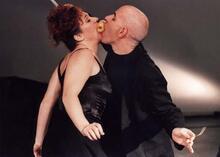
By re-examining the Bible from a secular point of view, resisting any use of religious or cultural folklore, and creating contemporary images (the scene of the temptation was danced by the group of actors eating apples with forks and knives and evoking visual metaphors of sexual relationships) she explored the meanings and role of the Bible for Israeli society. Especially political was the second part of the project, Va-Yelech, which paralleled the biblical story of the Exodus from Egypt and the conquest of the land of Israel with the twentieth-century’s ordeals of the Jewish people. In an almost empty theatrical space, the actors in modern black dress evoked the imagery and iconography of the Holocaust, the founding of the State of Israel and the ongoing situation of war—all transmitted solely via the biblical texts. Following this project (which ran for over five years, and was invited to leading theaters and festivals around the world, including the London International Festival of Theater, the Berlin Theater Der Welt, the Adelaide Festival in Australia, the Hamburg Sommer Theater Festival, and the Wiener Festwochen in Vienna), Yerushalmi created Mythos (2002), an adaptation of nine Greek tragedies about the House of Atreus that deals with the theme of personal and national revenge. In this performance, the theatrical space is “never completed” but is composed of hundreds of wooden boards that denote an archeological search into the haunting memories of Electra and Orestes.
Yerushalmi currently serves as Professor of Theater at Tel Aviv University. In 2001 she was awarded an honorary doctorate from the Hebrew University of Jerusalem. In 2002, for the first time in her career, Rina Yerushalmi received a theater building for the Itim Ensemble from the Tel Aviv Municipality. Located on Nahmani Street in the heart of Tel Aviv, this space is where she works daily, rehearsing and developing new theatrical projects committed to the exploration and reflection of the symphonic, simultaneous and complex experience of life.
Selected Works by Rina Yerushalmi
Mythos, adaptation (2002).
Electra, opera (1999).
Va-Yishtahu/Va-Yera, Bible Project Part II (1998).
Va-Yomer/Va-Yelech, Bible Project Part I (1996).
Hedda Gabler (1994).
La Juive, opera (1993).
Romeo and Juliet, adaptation (1992).
Woyzeck 91, adaptation (1991).
Hansel and Gretel, opera (1990).
The Chairs (1990).
Hamlet, adaptation (1988).
Six Characters in Search of an Author (1986).
Macbeth (1986).
Malone Dies, adaptation (1978).
Shiffman, Galia. “Rina Yerushalmi: The Freedom to Act” (Hebrew). Iton 77 52 (1984): 64–67. Rozik, Eli. “A Sympathetic View: Rina Yerushalmi’s Woyzeck 91” (Hebrew). Bamah 135 (1994): 37–52. Idem. “Stage Metaphor: With or Without: On Rina Yerushalmi’s Production of Ionesco’s The Chairs.” Theater Research International 19:2 (1994): 148–155. Linda Ben-Zvi. “Interview with Rina Yerushalmi.” In Theater in Israel, edited by Linda Ben-Zvi, 373–382. Ann Arbor: 1996. Adi, Einat. “The Land She Shows us: A Conversation with Rina Yerushalmi” (Hebrew). Studio 90 (1998): 34–43. Aronson-Lehavi, Sharon. “Clues to Contemporary Israel in the Bible: A Theatrical Interpretation” (Hebrew). Ha-Teatron 1 (1998): 68–73.
Double your impact to amplify Jewish women’s stories—
All gifts matched up to $35,000
Before you close this article, please consider supporting the Jewish Women’s Archive and uplifting Jewish women’s voices.
At JWA, we preserve the voices of Jewish women and gender-expansive people past and present, share them freely with millions online, and empower a new generation of Jewish feminists to lead with courage, creativity, and conviction.
But none of this happens without you. JWA is an independent nonprofit— we rely on people, like you, who believe that history belongs to all of us and that the voices of Jewish women must remain powerful, and heard.
This month, a generous JWA board member will match every gift dollar for dollar—up to $35,000—through June 30. Your contribution goes twice as far right now.
Every contribution—no matter the size—helps us document, teach, and inspire through Jewish women’s stories.
It takes less than a minute to make a difference.
Thank you for being a part of the JWA community,

Judith Rosenbaum, CEO