

Rina Nikova

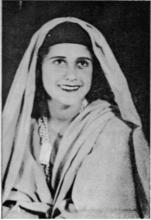
Rina Nikova, a pioneer of classical and biblical ballet in Palestine, distinguished herself mostly in character dances, which had a nationalist style influenced by ethnic folklore. In 1924 Nikova visited Palestine as a tourist together with her father and decided to stay and bring classical ballet to Palestine. Nikova was the first to perform as a professional dancer of classical ballet at the Palestine Opera. In 1924 Nikova established the first school for classical ballet in Tel Aviv. At the beginning of 1933 Nikova founded the Biblical Ballet, which was based on Yemenite folklore and focused on Biblical subjects. The Biblical Ballet, which featured Yeminite dancers, grew wildly popular and toured throughout Europe. In the 1940s and 50s, Nikova established the Jerusalem Biblical and Folk Ballet.
Early Life and Family
Rina Nikova, a pioneer of classical and biblical ballet in Palestine, distinguished herself mostly in character dances, which had a nationalist style influenced by ethnic folklore. She was born on June 23, 1898, in St. Petersburg, where her father, Leo Rabinovich, a wealthy merchant and factory owner, had received special permission to live with his family although Jews were not as a rule allowed to live there. Her mother, Esther, was the daughter of Ya’akov Katz. Nikova began to dance relatively late, at the age of sixteen, because of her family’s objections. She first studied dance at the conservatory in St. Petersburg with Nicolas Legat of Moscow’s Great Theater and continued her studies with Eugenia Edwardova in Berlin after World War I. At this time she married a man named Sapoznikov, later adopting the second half of his name as her own.
Bringing Classical Ballet to Palestine
In 1924 Nikova visited Palestine as a tourist together with her father. He returned to Russia but Nikova remained. In an interview from about that time she recalled: “I decided to remain in Palestine. Life in that tiny, desolate land charmed my heart. I made up my mind to develop ballet there against the exotic, captivating background that the country then seemed to me.” In other words, Nikova saw herself as an artist who would bring classical ballet to Palestine.
In August of that same year, she appeared at a ballet evening at the Eden Cinema in Tel Aviv in a program of classical ballet in which she danced en pointe, wearing a tutu and a headdress of white feathers. A similar performance took place in Jerusalem but in a schoolyard on a stage constructed of tables covered with rugs. The soloist of the Palestine Opera, David Brainin, and a company of three dancers from the Opera, founded by Mordecai Golinkin (1875–1963), appeared together with her. The program was comprised mostly of duets. Although Nikova was not the first to give dance performances in Israel, she was the first to perform as a professional dancer of classical ballet.
In 1924 Nikova established the first school for classical ballet and directed a studio in Tel Aviv. From 1924 to 1927 she appeared as the ballet mistress at the Palestine Opera, together with ten of her students. She was the only one who danced en pointe, since at that time it was impossible to obtain more ballet shoes in the country. Sarah Golinkin, the daughter of Mordecai Golinkin, accompanied the rehearsals. The opera in which Nikova first functioned as director and choreographer and performed as prima ballerina was Carmen, on November 10, 1925. In addition, Nikova appeared in Aïda, Russalka, and The Huguenots. In 1927 Nikova appeared in Tel Aviv in a ballet evening with pupils from her school and was once more joined by the dancer David Brainin.
New York and Founding the Biblical Ballet
field_section_text_value
Yeminite Dancers and Cultural Influence
field_section_text_value
European Tour
Through the offices of the wife of the French consul in Jerusalem, who participated in ballet lessons that Nikova gave to the wives of foreign consuls in Jerusalem, the company traveled to Paris in 1937 as guests of Baron Maurice de Rothschild (1881–1957), who was enthusiastic about the group and arranged a series of performances for high society at his palace. Among the guests were the Duke and Duchess of Windsor and Prime Minister of France Leon Blum (1872–1950). To prepare for the trip to Paris, Nikova made coats of white lambs’ wool for the members and gave them embroidered hats for daily use. This costume of “exotic princesses” made a strong impression. The well-known impresario Solomon (Sol) Hurok (1890–1974), who was in Paris at the time, took the Biblical Ballet under his wing, arranging a successful tour throughout Europe, including Switzerland, Belgium, the Netherlands, Scandinavia, Poland, Finland and England. The ballet won rave reviews. The tour to the United States which Hurok planned for the company was cancelled when World War II broke out and the company returned to Israel, where it was disbanded.
Later Career
In 1942 Nikova married Joseph Gizlat (d. 1948), a soldier in the Polish battalion of General Wladyslav Anders (1872–1970) who remained in Palestine. The couple moved to Jerusalem and Nikova returned to classical ballet. Feeling that the audience was now more willing to accept classical ballet, she established the Jerusalem Biblical and Folk Ballet, which was comprised mainly of young Ashkenazi women from Jerusalem. The company performed many classical ballets for soldiers and tourists at the Hebrew University’s theater on Mount Scopus.
Nikova sought to bring her dancers to the level of dancing en pointe, but the movements were too difficult and Israeli-made ballet shoes too clumsy. Ruth Eshel [link to new entry on Ruth Eshel] cites Galia Novi, Nikova’s principal dancer, who related that Nikova requested that Sol Hurok send her a package of ballet shoes, but they were all size forty and up, since Americans believed that Israeli dancers “walk barefoot in the desert, so their feet are large.” A newspaper cartoon quipped, “Have Nikova’s dancers got camels’ feet?”
At the end of the 1950s Nikova turned to artistic folklore, establishing the Rikudei Ofi (Character Dance) company in partnership with the Jerusalem Workers’ Council. Since this company comprised students and Jerusalem residents who danced in folk-dance ensembles of the Workers’ Council, men also joined it. Nikova presented Biblical-style folk dances, the Sailors’ Dance and even excerpts from Gayane by Aram Khachaturian (1903–1978). She did not introduce ballet into the company because the dancers were not capable of performing it. Instead she allowed them to express themselves as in folk dance. In 1960 the company traveled to South Africa for the International Folk Festival and was very successful, but when one of the dancers was killed in a road accident the company returned to Israel.
Legacy
With the help of contributions from South African Jewry and the participation of the Jerusalem Municipality, the Rina Nikova House was established in Jerusalem’s Valley of the Cross in 1970, when Nikova was seventy-two years old. Thus she at last acquired a building that met the needs of a dance company: two studios and a small apartment for herself.
Rina Nikova died in 1974 when a motorcycle struck and killed her.
Eshel, Ruth. “The Ballerina and the Yemenite Girls.” Musikah (August 1989).
Eshel, Ruth. Dancing with the Dream: The Development of Artistic Dance in Israel, 1920–1964. Tel Aviv: 1991, 14–16.
Friedhaber, Zvi. “Rachel Nadav, Dancer and Choreographer.” Rokdim 10 (September 1991): 6–7.
Double your impact to amplify Jewish women’s stories—
All gifts matched up to $35,000
Before you close this article, please consider supporting the Jewish Women’s Archive and uplifting Jewish women’s voices.
At JWA, we preserve the voices of Jewish women and gender-expansive people past and present, share them freely with millions online, and empower a new generation of Jewish feminists to lead with courage, creativity, and conviction.
But none of this happens without you. JWA is an independent nonprofit— we rely on people, like you, who believe that history belongs to all of us and that the voices of Jewish women must remain powerful, and heard.
This month, a generous JWA board member will match every gift dollar for dollar—up to $35,000—through June 30. Your contribution goes twice as far right now.
Every contribution—no matter the size—helps us document, teach, and inspire through Jewish women’s stories.
It takes less than a minute to make a difference.
Thank you for being a part of the JWA community,


Judith Rosenbaum, CEO

