

Sara Adler

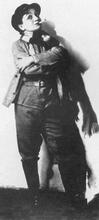
Sara Adler, photo courtesy of Steven Lasky, Museum of Family History.
In her powerful performances of plays ranging from Shakespeare’s tragedies to Ibsen’s A Doll’s House, Sara Adler helped elevate the possibilities of Yiddish theater. Adler first performed on stage at the age of eight and trained in voice at the Odessa Conservatory before choosing a career in Yiddish theater. Adler toured widely throughout Russia before bans on Yiddish theater brought her troupe to Britain and then America. It was there she met her second husband, Jacob P. Adler, who developed many of the roles that she brought to life on stage. Despite a tumultuous marriage, the two collaborated for decades to enhance Yiddish theater for New York audiences. Admired for her strong presence on the stage, Adler continued to give highly praised performances into her eighties.
Early Life and Career
Although her reputation as an artist must have benefited from the association with her husband, Jacob P. Adler, Sara Adler was an admired actor and a strong presence on the Yiddish stage. Born in Odessa about 1858, the daughter of Pessye and Ellye Levitsky, Sara (Levitsky) Adler was educated in Russian-language schools. She made her stage debut at age eight as Amalia in Schiller’s The Robbers. After winning a scholarship to study voice at the Odessa Conservatory, she decided on a stage career. The Jewish Theater Circle hired her as a between-acts divertissement, singing Russian songs. After learning Yiddish, she joined the troupe of Moishe Heine-Haimovitch (Maurice Heine) and studied with the Viennese stage director Gritzkopf. While on a tour of Russia, she married Heine. The banning of Yiddish theater and other restrictions on Jews in Russia led the troupe to relocate to London, where hardship almost caused the young actor to abandon the profession. After Heine joined forces with Jacob P. Adler, the combined troupes went to America in 1883, where, as Madam Heine, she became leading lady in Shomer’s The Orphans. After divorcing Heine, she joined Jacob Adler, who was with the Finkel-Feinman-Mogulesko troupe, becoming their principal actor for both dramatic and operetta roles. She married Adler in 1891, following his divorce from Dina Shtettin, becoming his third wife.
Work with Jacob Adler
field_section_text_value
Legacy
Her major roles included Mina in Kobrin’s Mina, Fania Zorchis in Gordin’s Emese Kraft [True power], Batsheva in Gordin’s The Homeless, the woman in Gordin’s The Stranger, Beata in Gordin’s Elisha ben Avuya, Gittele in Libin’s Broken Hearts, the mother in Marcovich’s melodrama A Mother’s Tears, Nora in Ibsen’s A Doll’s House, Yelena in Tolstoy’s Kreutzer Sonata, and the gypsy in Tolstoy’s Resurrection. Adler performed actively until 1928 in both New York and the “provinces.” In her eightieth year, she performed the third act of Resurrection at a benefit performance, where a critic compared her with Eleanora Duse. She died in New York on April 28, 1953.
AJYB 55:454.
DAB 5.
EJ.
Obituary. NYTimes, April 29, 1953, 29:1.
Rosenfeld, Lulla Adler. The Yiddish Theatre and Jacob P. Adler (1988).
Sandrow, Nahma. Vagabond Stars (1977).
UJE; Zylbercweig, Zalmen. Leksikon fun Yidishn Teater (1931).

Double your impact to amplify Jewish women’s stories—
All gifts matched up to $35,000
Before you close this article, please consider supporting the Jewish Women’s Archive and uplifting Jewish women’s voices.
At JWA, we preserve the voices of Jewish women and gender-expansive people past and present, share them freely with millions online, and empower a new generation of Jewish feminists to lead with courage, creativity, and conviction.
But none of this happens without you. JWA is an independent nonprofit— we rely on people, like you, who believe that history belongs to all of us and that the voices of Jewish women must remain powerful, and heard.
This month, a generous JWA board member will match every gift dollar for dollar—up to $35,000—through June 30. Your contribution goes twice as far right now.
Every contribution—no matter the size—helps us document, teach, and inspire through Jewish women’s stories.
It takes less than a minute to make a difference.
Thank you for being a part of the JWA community,

Judith Rosenbaum, CEO