
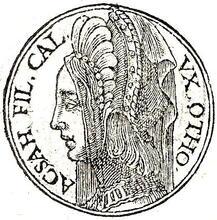
Wife of Lot: Bible

Lot, his wife, and his daughters are urged to escape the violence in Sodom that ensues when the local people want to rape two visitors to Lot’s house. Lot and his family are told not to look back when they flee, but Lot’s wife does look back and is turned into a pillar of salt. This gripping narrative contains elements of folklore and provides an explanation for the salt formations along the Dead Sea.
Article
Lot’s wife appears in Genesis 19 in a narrative that concludes interactions between the patriarch Abraham and his nephew Lot. The opening scene (Gen 19:1–3) has Lot inviting two visitors, who are really divine emissaries, to stay with him in his home in Sodom, a city near the Dead Sea. His hospitality turns sour when the men of Sodom want to have sex with his guests. Lot is appalled and offers his two virgin daughters instead, but the mob refuses them and violence ensues. The emissaries intervene, saying Sodom will be destroyed. They urge Lot to escape with his family, telling all of them “flee for your life; do not look back…or else you will be consumed” (Gen 19:17). Lot’s wife is the only one of the escaping family to disobey the warning. When God sends “brimstone and fire” (Gen 19:24) on sinful Sodom, its sister city Gomorrah, and all the cities in the area, Lot’s wife looks back. Because she disobeys the warning, she becomes “a pillar of salt” (Gen 19:26).
This disturbing tale is reminiscent of other folktales or myths with a “don’t-look-back-or-everything-will-be-lost” motif, which here adds drama to the narrative line. This motif appears in Hittite rituals, Babylonian charms, and elsewhere—but perhaps most notably in the Greek legend of Orpheus and Eurydice. (Orpheus is told not to look back as he leads his wife Eurydice out of Hades; but he does, and she remains there forever.) In addition to using this folkloristic motif, the story of Lot’s wife and her transformation into a salt pillar has an etiological function. An etiology explains the origins of something, often a strange natural phenomenon; in this case it provides an explanation for the striking salt formations along the Dead Sea, appropriately called Sea of Salt in Hebrew.
<p>Arnold, Bill T. 2009. “Genesis 18:1–19:38 – Yahweh Visits Hebron, then Sodom and Gomorrah.” In <em>Genesis</em>, 174–87. The New Cambridge Bible Commentary. New York: Cambridge University Press, 2009.</p>
<p>Frumkin, Amos A. “How Lot’s wife became a pillar of salt.” <em>Biblical Archaeology Review</em> 35 (2009): 38-64.</p>
<p>Gaster, Theodore H. 1969. “Sodom and Gomorrah.” In <em>Myth, Legend, and Custom in the Old Testament</em>, 156–61. New York: Harper & Row.</p>
More Like This




Double your impact to amplify Jewish women’s stories—
All gifts matched up to $35,000
Before you close this article, please consider supporting the Jewish Women’s Archive and uplifting Jewish women’s voices.
At JWA, we preserve the voices of Jewish women and gender-expansive people past and present, share them freely with millions online, and empower a new generation of Jewish feminists to lead with courage, creativity, and conviction.
But none of this happens without you. JWA is an independent nonprofit— we rely on people, like you, who believe that history belongs to all of us and that the voices of Jewish women must remain powerful, and heard.
This month, a generous JWA board member will match every gift dollar for dollar—up to $35,000—through June 30. Your contribution goes twice as far right now.
Every contribution—no matter the size—helps us document, teach, and inspire through Jewish women’s stories.
It takes less than a minute to make a difference.
Thank you for being a part of the JWA community,

Judith Rosenbaum, CEO