

Achsah: Midrash and Aggadah

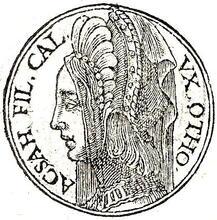
A likeness of Achsah, daughter of Caleb, published in Promptuarii Iconum Insigniorum by Guillaume Rouillé, 1553. Source: Wikimedia Commons
Achsah was the daughter of Caleb, who promised this daughter to the man who conquered the city of Kirath-sepher. Her story is interpreted in the midrashic and aggadic tradition as that of a beautiful woman lacking agency within a patriarchal system, as well as that of a practical woman concerned for her family’s sustenance.
Article
The Rabbis describe Achsah as being a beauty, finding an allusion to this in her name: “Whoever sees her is angry [koes] with his wife,” who is not as ravishing as she is (BT Temurah 16a). Achsah’s beauty explains the willingness of the men to go forth to war against the Anakites (giants) of Kiriath-sepher, since Caleb had promised his daughter Achsah to the man who would conquer the city. The A type of non-halakhic literary activitiy of the Rabbis for interpreting non-legal material according to special principles of interpretation (hermeneutical rules).midrash (Gen. Rabbah 60:3) criticizes Caleb’s pledge, for if a slave had taken the city Caleb would have been forced to give him his daughter. Nonetheless, God “arranged a proper match for her,” because Caleb’s brother, Othniel the Kenizzite, captured the city.
But Achsah herself was not pleased with the match that had been made for her and the Lit. "teaching," "study," or "learning." A compilation of the commentary and discussions of the amora'im on the Mishnah. When not specified, "Talmud" refers to the Babylonian Talmud.Talmud (BT loc. cit.) reports that she complains about this to her father. She is concerned that Othniel is only a Torah she-bi-khetav: Lit. "the written Torah." The Bible; the Pentateuch; Tanakh (the Pentateuch, Prophets and Hagiographia)Torah scholar and that he will not be capable of providing for her livelihood. The Rabbis understand her complaint “For you have given me away as Negeb-land; so give me springs of water” (Joshua 15:19)—as referring to her husband Othniel, who possesses only water (i.e., Torah), but is desolate and dry of property and livelihood. In this narrative the Rabbis compare Achsah to an ass, who immediately cries out if there is no food in his crib. The picture of Achsah that emerges from this midrash is that of a practical woman who is concerned for her family’s sustenance.
More Like This


Double your impact to amplify Jewish women’s stories—
All gifts matched up to $35,000
Before you close this article, please consider supporting the Jewish Women’s Archive and uplifting Jewish women’s voices.
At JWA, we preserve the voices of Jewish women and gender-expansive people past and present, share them freely with millions online, and empower a new generation of Jewish feminists to lead with courage, creativity, and conviction.
But none of this happens without you. JWA is an independent nonprofit— we rely on people, like you, who believe that history belongs to all of us and that the voices of Jewish women must remain powerful, and heard.
This month, a generous JWA board member will match every gift dollar for dollar—up to $35,000—through June 30. Your contribution goes twice as far right now.
Every contribution—no matter the size—helps us document, teach, and inspire through Jewish women’s stories.
It takes less than a minute to make a difference.
Thank you for being a part of the JWA community,


Judith Rosenbaum, CEO


