
Spirituality in the United States

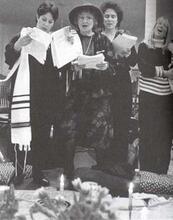
Feminist seders have provided an important context for developing women’s spirituality. In 1975, a group of Israeli and American women decided to create their own Passover seder based on their experiences as Jewish women. Now an annual event held in Manhattan, it has been attended by Esther Broner, Gloria Steinem, Letty Cottin Pogrebin, Bella Abzug, Grace Paley and several other "Seder Sisters" who have played important roles in the development of Jewish feminism. Shown here are Bella Abzug, Phyllis Chesler and Letty Cottin Pogrebin at the Women's Seder in 1991.
Photo: Joan Roth
Spirituality can be defined as life lived in the presence of God. It embraces not only traditional and formal modes of religious expression, but also more informal individual and communal efforts to remain mindful of the sacred in all aspects of experience. Historically, Jewish women’s spirituality developed within the confines of a patriarchal tradition. The proper focus of women’s spiritual home was considered to be the home, and within this sphere women elaborated their own customs and conventions. Over time feminists have developed rituals and created spaces that honor the unique experiences of women. Since the 1970s, feminist theologians have attempted to reimagine every aspect of Judaism, including the gender of God.
Introduction
Spirituality can be defined as life lived in the presence of God. It embraces not only traditional and formal modes of religious expression, but also more informal individual and communal efforts to remain mindful of the sacred in all aspects of experience.
Jewish women’s spirituality developed historically within the confines of a patriarchal tradition. The sages understood woman’s nature as more private than man’s—“the entire glory of the king’s daughter lies on the inside” (Ps. 45:14)—and thus the proper focus of her spiritual life was considered the home. Within this sphere, women elaborated their own customs and conventions that were passed on from mother to daughter. But even if these were distinct from or in tension with the larger male tradition, they remained constrained by its boundaries. Feminist spirituality, as it has developed since the late 1960s, represents a new phenomenon. It constitutes a self-conscious, critical attempt to transform Jewish tradition, for the sake of justice for women and in the name of perspectives and values said to be represented by women. It involves women claiming the power to participate fully in and actively shape Jewish religious life.
The Fight for Equal Access
The first feminist efforts at creating a self-conscious women’s spirituality revolved around claiming equal access to the (formerly male) public Jewish spaces of the synagogue and the house of study. Arguing that women should not be barred from those forms of prayer and learning that have formed the heart and soul of traditional Judaism, women in non-Orthodox denominations fought—successfully—for the rights to lead services, read from the Torah she-bi-khetav: Lit. "the written Torah." The Bible; the Pentateuch; Tanakh (the Pentateuch, Prophets and Hagiographia)Torah, be counted in a The quorum, traditionally of ten adult males over the age of thirteen, required for public synagogue service and several other religious ceremonies.minyan (quorum of ten (men) necessary for a full service), and enjoy admission to the rabbinate and cantorate. Orthodox women formed women’s Prayertefillah (prayer) groups, in which, in the absence of men, they could lead services, read from the Torah and haftarah (additional reading for the Sabbath), and recite all prayers not requiring a minyan. Despite opposition from some segments of the Orthodox world, these groups have proliferated and flourished.
Separate Spaces
Feminists have not confined themselves, however, to laying claim to forms of spiritual expression formerly reserved for men. They have also raised questions about the existence and content of a specifically female spirituality. Should it be the goal of feminism simply to adopt traditionally male forms of study and worship? Are there uniquely female spiritual experiences and perspectives? Do women have anything distinctive to contribute to Jewish spirituality—not because they are more interior or more innately pious than men (as the tradition has sometimes claimed), but because of their long history of separation, subordination, and marginalization? What would it mean for women to begin self-consciously to explore their spiritual lives as women?
These questions represent a strand of feminist exploration that sometimes informs the struggle for equal access but is also distinct from it. Such questions have most often been addressed in women-only contexts in which participants have considerable freedom to play with the boundaries of tradition. Since 1976, when Arlene Agus first wrote about Rosh Hodesh (the new moon) as a woman’s holiday, for example, women’s Rosh Hodesh groups have sprung up all over the United States. Serving as important vehicles of feminist organizing, Rosh Hodesh groups have used the association of women with the moon in A type of non-halakhic literary activitiy of the Rabbis for interpreting non-legal material according to special principles of interpretation (hermeneutical rules).midrash and folk tradition as a foundation for wide-ranging spiritual exploration and liturgical inventiveness. The brief Rosh Hodesh liturgy has provided feminists with a jumping-off point for developing new rituals and stories that attempt to link generations of Jewish women. Rosh Hodesh ceremonies appear in a number of collections, including Penina Adelman’s Miriam’s Well (1986), which draws on twenty years of feminist Rosh Hodesh organizing, and the newsletter Rosh Hodesh Exchange. Orthodox women’s prayer groups, which sometimes are organized around Rosh Hodesh, have also begun creating and circulating new liturgy that reflects women’s life experiences.
Feminist seders (A seven-day festival to commemorate the Exodus from Egypt (eight days outside Israel) beginning on the 15th day of the Hebrew month of Nissan. Also called the "Festival of Mazzot"; the "Festival of Spring"; Pesah.Passover liturgical meals) have provided another important context for developing women’s spirituality. Many college campuses and women’s groups around the country have established a tradition of a third Lit. "order." The regimen of rituals, songs and textual readings performed in a specific order on the first two nights (in Israel, on the first night) of Passover.seder that uses the structures and themes of the The "guide" to the Passover seder containing the Biblical and Talmudic texts read at the seder, as well as its traditional regimen of ritual performances.Haggadah (Passover liturgy) to reflect on the situation of women within Judaism. Moving from the freedom of the Jewish people to the hoped-for liberation of women, feminist seders provide opportunities for both celebrating women’s history and reflecting critically on the erasures of women’s experience from the Haggadah and other mainstream texts that make a third seder necessary. Such seders fall anywhere along a continuum, from those that remain fairly close to the traditional liturgy, integrating women’s history and experience into the established narrative of the liberation from Egypt, to those that shift the focus of the Haggadah from the liberation of the Israelites to the liberation of women.
Another kind of separate space is provided by Jewish feminist retreats, conferences, and spirituality collectives that seek to provide special and concentrated time for exploring issues of women’s spirituality. In 1981, a group of Jewish feminists founded B’not Esh (daughters of fire), a collective that began with the goal of reconfiguring Judaism from a feminist perspective. Meeting annually for four days over Memorial Day weekend, B’not Esh has generated a number of spin-offs, including Achiyot Or (sisters of light) and Bat Kol (daughter of the voice/the divine voice). While these groups differ in tone and emphasis, they all provide opportunities for study, extensive ritual/liturgical experimentation, and exploration of the relationship among feminism, spirituality, and issues of everyday life. Taking up topics from sexuality, to politics, to cost sharing, to the meaning of women’s Torah, they all attempt to imagine and create a Judaism that thoroughly integrates women’s experiences. Such groups—and other conferences and retreats—are necessarily limited in the number of participants who can be directly involved, but they have generated ideas and resources that have spilled over into a larger Jewish feminist community.
Rituals and Ceremonies

Institution: Eleanor Leff Jewish Women’s Resource Center (JWRC) of the National Council of Jewish Women, New York Section
field_section_text_value
Feminist Theology
field_section_text_value
Adelman, Penina V. Miriam’s Well: Rituals for Jewish Women Around the Year (1986).
Agus, Arlene. “This Month Is for You: Observing Rosh Hodesh as a Woman’s Holiday.” In Koltan, The Jewish Woman.
Falk, Marcia. The Book of Blessings (1996).
Haut, Rivka. “Women’s Prayer Groups and the Orthodox Synagogue.” In Daughters of the King: Women and the Synagogue, edited by Susan Grossman and Rivka Haut (1992).
Koltun, Elizabeth, ed. The Jewish Woman: New Perspectives (1976).
Levine, Elizabeth Resnick, ed. A Ceremonies Sampler: New Rites, Celebrations, and Observances of Jewish Women (1991).
Orenstein, Debra, ed. Lifecycles: Jewish Women on Life Passages and Personal Milestones (1994).
Plaskow, Judith. Standing Again at Sinai; Umansky, Ellen M., and Dianne Ashton, eds. Four Centuries of Jewish Women’s Spirituality: A Sourcebook (1992).
Wenig, Maggie, and Naomi Janowitz. Siddur Nashim (1976).
Zones, Jane Sprague, ed. Taking the Fruit: Modern Women’s Tales of the Bible (1981).
More Like This
Double your impact to amplify Jewish women’s stories—
All gifts matched up to $35,000
Before you close this article, please consider supporting the Jewish Women’s Archive and uplifting Jewish women’s voices.
At JWA, we preserve the voices of Jewish women and gender-expansive people past and present, share them freely with millions online, and empower a new generation of Jewish feminists to lead with courage, creativity, and conviction.
But none of this happens without you. JWA is an independent nonprofit— we rely on people, like you, who believe that history belongs to all of us and that the voices of Jewish women must remain powerful, and heard.
This month, a generous JWA board member will match every gift dollar for dollar—up to $35,000—through June 30. Your contribution goes twice as far right now.
Every contribution—no matter the size—helps us document, teach, and inspire through Jewish women’s stories.
It takes less than a minute to make a difference.
Thank you for being a part of the JWA community,
Judith Rosenbaum, CEO