

Feminist Jewish Ritual: An International Perspective

Pictured here is a page from The Journey Continues: The MA'YAN Passover Haggadah. (New York: MA'YAN, the Jewish Women's Project, 2000), a manual for the seder which gives voice both to the women who experienced the Passover events of the past and those celebrating the holiday in the present.
Institution: MA'YAN, Library of Congress
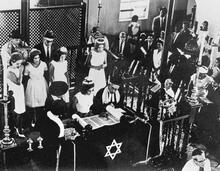
Beginning with the first bat mitzvah in 1922, Jewish women began adapting traditional ceremonies and customs, such as seders and Rosh Hodesh ceremonies, to focus on women. Other rituals have been created for parts of the female life cycle such as menstruation or childbirth. Wedding and divorce rituals have been rewritten to be more egalitarian by removing language that implies a husband’s ownership over his wife. Ceremonies surrounding the birth of a child have been adjusted to give the same attention and respect to the birth of a female child as is traditionally given to the birth of a male. However, there continues to be a lack of recognition of women in recently created holidays that are based on nationalist and Zionist beliefs.
Introduction
field_section_text_value
Bat Mitzvah

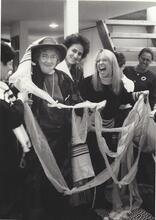
One aspect of feminist ritual development is the modification of existing rituals to enable women's full participation and recognition. A primary example is the participation in seders which highlight women's contribution to the Passover story. This photograph was taken at MA'YAN's first Community Feminist Seder, which was held in 1994. More than two hundred women attended.
Photographer: Joan Roth
field_section_text_value
Marriage and Divorce
field_section_text_value
Birth of a Child
The ceremonies marking the birth of a child, especially the birth of a daughter and her entry into the covenant of the Jewish people, reflect the encounter between ideological interpretation and liberal cultural and radical feminism. The classic sources of Jewish tradition viewed the birth of a daughter with at best limited joy, according to the dictum, “Happy is he whose children are males; alas for him whose children are females” (BT Bava Batra 16b). Therefore, the blessing which according to halakhah is recited by the father upon learning of the birth of a son— “Blessed be You, our Lord and God, Ruler of the Universe, who is good and who does good”—is not recited upon the birth of a daughter, though the blessing of She-Heheyanu is recited. Neither is there any ceremony mandated by halakhah that expresses the community’s joy upon the birth of a daughter. The only congregational expression for the birth of a girl in the pre-modern period was the honoring of her father with an aliyah to the Torah, which took place in only some congregations. In Descendants of the Jews who lived in Spain and Portugal before the explusion of 1492; primarily Jews of N. Africa, Italy, the Middle East and the Balkans.Sephardic synagogues, the cantor also sings verses from the Song of Songs in honor of the birth. In various ethnic groups the baby is welcomed with local folk ceremonies such as the hollekreisch, a ceremony customary in medieval Ashkenaz in which baby boys and girls were given their non-Hebrew names. Children would surround the baby’s cradle, raising and waving it from side to side while shouting “Holle! Holle!”
Simhat bat ceremonies that were feminist-inspired revived some of these folk traditions and added parts of various Jewish ceremonies (Lit. "distinction, division." The blessing recited at the close of the Sabbath and Festivals to indicate the distinction between holy and ordinary days.havdalah, immersion in the mikveh, ritual hand-washing, circumcision), as well as of Biblical, midrashic, and halakhic ceremonies. All these created a “weave of ceremony” of which no specific ceremony has so far emerged as definitive. On the contrary: most ceremonies include elements from various others.

Over the past quarter of a century, feminists have developed a variety of new rituals to highlight women's life cycle events, in some cases building on traditional forms of female-oriented ritual. One example is the Simhat Bat ceremony to welcome baby girls, which finds precedent in the Zeved ha-Bat birth ceremonies held in past and present Sephardi, North African, and Syrian communities. Pictured here is a guide to the Simhat Bat ceremony published by the Jewish Women's Resource Center of the National Council of Jewish Women.
Institution: Eleanor Leff Jewish Women’s Resource Center (JWRC) of the National Council of Jewish Women, New York Section
field_section_text_value
“Life Cycle” Ceremonies
field_section_text_value
Mikveh
field_section_text_value
Midrashic Interpretations
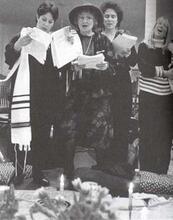
As with immersion, Jewish feminism has also given significance to several dates on the Hebrew calendar that have a midrashic connection with feminine motifs. These dates have become opportunities for ceremonial gatherings, the empowerment of Jewish feminists, and the creation of commentary and liturgy. First among them is Rosh Hodesh. According to the midrash (Pirke de-Rabbi Eliezer 45), the first day of the month was given to women as a reward for their refusal to surrender their jewelry to create the Golden Calf. The midrash maintains that because of this tradition women were more meticulous in celebrating Rosh Hodesh and even abstained from work on that day. Rabbi Solomon ben Isaac; b. Troyes, France, 1040Rashi (Rabbi Solomon ben Isaac, 1040–1105) quotes this midrash in his commentary on the Talmud (Megillah 22b). With time, the custom fell into desuetude, though in some communities women customarily lit candles without a blessing on the eve of Rosh Hodesh. The original custom inspired groups of contemporary feminist women to meet at the beginning of every Hebrew month. As with simhat bat ceremonies, Rosh Hodesh has no fixed liturgical format. Orthodox feminists meet to study Torah and read from the Torah scroll on Rosh Hodesh morning, while others meet for study and discussion of a subject pertaining to the month that begins that evening. Still other groups emphasize ritual, including drama, artistic and creative activity and singing.
A similar interpretive process led to the creation of feminist A seven-day festival to commemorate the Exodus from Egypt (eight days outside Israel) beginning on the 15th day of the Hebrew month of Nissan. Also called the "Festival of Mazzot"; the "Festival of Spring"; Pesah.Passover The "guide" to the Passover seder containing the Biblical and Talmudic texts read at the seder, as well as its traditional regimen of ritual performances.Haggadot and the holding of feminist seders for women, mostly during the intermediate days of the festival rather than instead of the family Lit. "order." The regimen of rituals, songs and textual readings performed in a specific order on the first two nights (in Israel, on the first night) of Passover.seder. Here, too, a traditional foundation inspired the feminist ceremony, in this case the midrash that “the Israelites were redeemed from Egypt thanks to righteous women” (BT Suspected adulteressSotah 11b). These midrashim stand in jarring contrast with the total absence of women from the traditional The "guide" to the Passover seder containing the Biblical and Talmudic texts read at the seder, as well as its traditional regimen of ritual performances.Haggadah and the patriarchal construction of the Passover seder. Despite the fact that the entire nation was redeemed from Egypt, the men, led by the male head of the family, recite the story of the Exodus while the women—who have cleaned and prepared the house for Passover for weeks before—serve the food they cooked during the previous days and wash the dishes.
Pictured here is a page from The Journey Continues: The MA'YAN Passover Haggadah. (New York: MA'YAN, the Jewish Women's Project, 2000), a manual for the seder which gives voice both to the women who experienced the Passover events of the past and those celebrating the holiday in the present.
Institution: MA'YAN, Library of Congress
The Haggadot recited by the women at the communal feminist seders stress both women’s contribution to Israel’s redemption from slavery and their own continued enslavement. Unlike the Passover Haggadah’s ideological intent, which emphasizes the freedom of the children of Israel even during times of subjugation and persecution, the object of feminist seders is to raise awareness of the hidden oppression of women, which they themselves tend to repress and internalize in various ways. Thus, some feminist Haggadot depict the Ten Plagues as ten kinds of subjugation of women, the Four Daughters as four types of women who respond to subjugation in four different ways, and so on. Such seders take place all over the world, attracting a growing number of women who see these events as an expression of women’s empowerment.
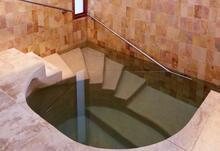
All the aforementioned ceremonies bestow feminist significance on events and dates in the Hebrew calendar and the human life cycle, as well as Jewish significance on events in a woman’s life. However, unlike these ceremonies, the “Mishkan Ceremony” developed by Rabbi Lynn Gottlieb of the Jewish Renewal Movement is based on a Native American tradition with which she became acquainted while serving as a rabbi in New Mexico. In this ceremony, a kind of “mishkan” is built for prayer that includes drumming, singing, dance, and immersion in a spring of living water, a mikveh. Its object is to strengthen those who participate in it, sometimes a single participant, via the group of women celebrating the ceremony. Like other women’s ceremonies in pre-modern Jewish communities (such as the North African shehur) that closely resembled ceremonies held by women in the surrounding community, here too the liturgy includes Biblical verses and passages of Hebrew poetry that emphasize the appeal to a “female Deity,” the Shekhinah.
Exclusion of Women in Ceremonies
field_section_text_value
Hebrew
Cohen-Vardi, Alma, ed. Kabbalat Panim. Tel Aviv: 2002.
Friedland ben Arza, Sarah, ed. Bat Mitzvah. Jerusalem: 2001.
Lopian, Esther. “The Thunderous Silence: The Bat Mitzvah in the Orthodox Community.” In To Be A Jewish Woman, edited by Margalit Shilo, 207–216. Jerusalem: 2003.
English
Adelman, Penina V. Miriam’s Well. Fresh Meadows, NY: 1986.
Adler, Rachel. “In Your Blood, Live”: Re-Visions of a Theology of Purity.” In Lifecycles, v. 2, edited by Rabbi Debra Orenstein and Rabbi Jane Rachel Litman, 197–206. Woodstock, Vermont: 1997.
Adler, Rachel. Engendering Judaism. Philadelphia: 1998, 190–207.
Adler, Rachel. “Tumah and Taharah: Ends and Beginnings.” In The Jewish Woman: New Perspectives, edited by Elizabeth Kulton, 63–71. New York: 1976.
Agus, Arlene “This Month Is for You: Observing Rosh Hodesh as A Woman’s Holiday.” In The Jewish Woman: New Perspectives, edited by Elizabeth Koltun, 84–93. New York: 1976.
Alpert, Rebecca T. “Coming Out in the Jewish Community.” In Lifecycles vol. 1, 144–153.
Beckerman, Cheryl. “Kiddushin and Kesharin: Toward an Egalitarian Wedding Ceremony.” In Kerem: Creative Explorations in Judaism 5 (1997): 84–100.
Cohen Anisfell, Sharon, Tara Mohr and Catherine Spector. The Women’s Seder Sourcebook. Woodstock, Vermont: 2003.
Cohen, Debra Nussbaum. Celebrating Your New Jewish Daughter. Woodstock, Vermont: 2001.
Diamant, Anita. The New Jewish Wedding New York: 1985.
Falk, Marcia. “Interpretive Amidah.” In Kol Haneshamah: Shabbat Eve. Wyncote: 1989, 150–178.
“The First Bat Mitzvah, A Bat Mitzvah in Rome.” In Communings of the Spirit: The Journals of Mordecai M. Kaplan. edited by Mel Scult, Vol. I, 159, 163–164: Detroit: 2001.
Frymer-Kensky, Tikva. Motherprayer: The Pregnant Woman’s Spiritual Companion. New York: 1995.
Geller, Laura. “Brit Milah and Brit Banot.” In Lifecycles, vol. 1, edited by Debra Orenstein, 57–67. Woodstock, Vermont: 1994.
Gottlieb, Lynn. “The Mishkan Ceremony.” In She Who Dwells Within: A Feminist Vision of a Renewed Judaism. San Francisco: 1995.
Greenberg, Blu. On Women and Judaism. Philadelphia: 1981.
Hollander, Vicki. “Weathering the Passage: Jewish Divorce.” In Lifecycles, vol. 1, edited by Debra Orenstein, 201–210. Woodstock, Vermont: 1994.
Levi Elwell, Sue. Women at Worship: Interpretations of North American Diversity, edited by Marjorie Procter-Smith and Janet R. Walton, 111–126. Westminster: 1993.
Levitt, Laura, and Sue Ann Wasserman. “Mikvah Ceremony for Laura.” In Four Centuries of Jewish Women’s Spirituality, 321–326.
Magnus, Shulamit. “Re-Interpreting Miriam’s Well: Feminist Jewish Ceremonials.” In The Uses of Tradition: Jewish Continuity in the Modern Era. New York: 1992, 331–347.
Magnus, Shulamit. “Simhat Lev: Celebrating a Birth.” In Lifecycles, Vol. 1, 68–75.
Orenstein, Debra. “Introduction.” “Afterword: How to Make a Ritual.” Lifecycles vol. 1, xvii–xxix; 359–373.
Plumb, Marcia. “Simhat Brit Me’ugelet.” In Taking Up the Timbrel, edited by Sylvia Rothchild and Sybil Sheridan, 66–72. London: 2000 (hereafter cited as Taking Up the Timbrel).
Ramon, Einat. “Tradition and Innovation in the Marriage Ceremony.” In The Life of Judaism, edited by Harvey Goldberg, 105–119. Berkeley, California: 2001.
Rothchild, Sylvia. “A Ritual for the Termination of a Pregnancy.” In Taking Up the Timbrel, 92–98.
Scult, Mel. Judaism Faces the Twentieth Century: A Biography of Mordecai Kaplan. Detroit: 1993, 301–303.
Sohn, Ruth, et al. “The Covenant of Washing: A Ceremony To Welcome Baby Girls into the Covenant of Israel.” Menorah 4 (May 1983): 3–4.
Teubal, Savina. “Simchat Hochmah.” In Four Centuries of Jewish Women’s Spirituality, edited by Ellen M. Umansky, 257–265. Boston: 1992.
More Like This
Double your impact to amplify Jewish women’s stories—
All gifts matched up to $35,000
Before you close this article, please consider supporting the Jewish Women’s Archive and uplifting Jewish women’s voices.
At JWA, we preserve the voices of Jewish women and gender-expansive people past and present, share them freely with millions online, and empower a new generation of Jewish feminists to lead with courage, creativity, and conviction.
But none of this happens without you. JWA is an independent nonprofit— we rely on people, like you, who believe that history belongs to all of us and that the voices of Jewish women must remain powerful, and heard.
This month, a generous JWA board member will match every gift dollar for dollar—up to $35,000—through June 30. Your contribution goes twice as far right now.
Every contribution—no matter the size—helps us document, teach, and inspire through Jewish women’s stories.
It takes less than a minute to make a difference.
Thank you for being a part of the JWA community,
Judith Rosenbaum, CEO

