

Shelomith 2: Bible
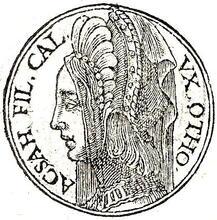
Shelomith was the daughter of one prominent Judean governor and possibly the wife of his successor. Her name is the only woman’s name to appear in the Davidic line in 1 Chronicles. Her name also appears on a Judean seal, an object used for personal identification, alongside the title amah, which connotes high status, possibly indicating the changing status of women in the Persian period.
Article
Shelomith was the daughter of Zerubbabel, a governor (c. 520–510 B.C.E.) of the postexilic province of Yehud. She is the only woman mentioned among the descendants of David in 1 Chronicles. As a woman’s name, Shelomith is otherwise mentioned only in Leviticus (24:11). It is a fairly common man’s name (1 Chr 23:9, 18; 2,6:28; 2 Chr 11:20; 26:25; Ezra 8:10), although in Ezra and 2 Chronicles 11, the names could just as well designate women. In 1 Chr 3:19, Shelomith is listed as the sister of Meshullam and Hananiah rather than as the daughter of Zerubbabel, their father. This awkward designation led some older commentators to suggest that she was either the head or founder of an important family or had a “marked personality.”
The discovery of a late-sixth-century B.C.E. Judean seal (an inscribed stone used as an official “signature”) with the name Shelomith inscribed alongside that of Elnathan the governor has opened new possibilities for understanding Shelomith’s role in Judean society. The seal reads: “Belonging to Shelomith, maidservant of Elnathan the governor.” The word for “maidservant” is amah, which can connote a high status or honorific title, as well as marital status, when it is associated with an important official such as Elnathan the governor. Shelomith could well have been the co-regent as well as spouse of Elnathan, who is mentioned as governor in another seal.
The importance of Shelomith’s marriage to the governor who succeeded her father, Zerubbabel, a scion of the royal Davidic family, cannot be over-stated. In the Judean restoration, Zerubbabel’s acceptance of limited civil power alongside Joshua the high priest was symbolic of the commitment of the new Jewish leadership to cooperate with Persian imperial policy. Scholars have regularly asserted that the transition to limited autonomy under Zerubbabel and Joshua was traumatic. The inclusion of a female Davidic descendant as amah with Elnathan was certainly one way of solidifying local support for the Persian-appointed administration. In any case, Shelomith’s involvement in the public arena may testify to the changing status of women in the Persian period.
Avigad, Nahman. Bullae and Seals from a Post-Exilic Judean Archive. Jerusalem: 1976.
Meyers, Carol, General Editor. Women in Scripture. New York: 2000.
Meyers, Carol L., and Eric M. Meyers. Haggai, Zechariah 1–8: A New Translation with Introduction and Commentary. Garden City, New York: 1987.
Meyers, Eric M. “The Shelomith Seal and the Judean Restoration: Some Additional Considerations.” Eretz Israel 18 (1985): 33–38.
More Like This



Double your impact to amplify Jewish women’s stories—
All gifts matched up to $35,000
Before you close this article, please consider supporting the Jewish Women’s Archive and uplifting Jewish women’s voices.
At JWA, we preserve the voices of Jewish women and gender-expansive people past and present, share them freely with millions online, and empower a new generation of Jewish feminists to lead with courage, creativity, and conviction.
But none of this happens without you. JWA is an independent nonprofit— we rely on people, like you, who believe that history belongs to all of us and that the voices of Jewish women must remain powerful, and heard.
This month, a generous JWA board member will match every gift dollar for dollar—up to $35,000—through June 30. Your contribution goes twice as far right now.
Every contribution—no matter the size—helps us document, teach, and inspire through Jewish women’s stories.
It takes less than a minute to make a difference.
Thank you for being a part of the JWA community,


Judith Rosenbaum, CEO

