
Prose Writing in the Yishuv: 1882-1948

The three generations of female Yishuv writers have often been ignored in discussions of Jewish literature from the period. Their work spanned every genre, such as political writings (generally about socialism), children’s books, poetry, and novels. The migration to pre-state Palestine around the turn of the twentieth century helped women writers receive attention for their work, and the number of women writers increased. But, as the sometimes-melancholy tone and escapist themes of their writing show, these women struggled to escape the margins in pre-state Palestine, especially in the patriarchal Zionist movement. Nonetheless, the works of these female writers offer important insights into the lives of Yishuv women and paved the way for contemporary women writers.
Selection of Yishuv Writers and their Work
field_section_text_value
Reception of Women in Yishuv Literature
field_section_text_value
Male Reactions to Female Writers
Especially noteworthy in this context are the actions of Asher Barash who, as a writer and editor at the Mizpeh publishing house, provided a platform for women’s prose as part of his stated policy of encouraging young artists, both male and female. In fact, the works of Rivkah Alper, Shoshana Shababo, Batya Kahana, Miriam Bernstein-Cohen, Miriam Tal, and others were edited and published by him.
It should also be noted that there were a number of leading male authors who deviated from the general consensus and took a woman writer under their wing. A good example of this is the writer and poet Avigdor Hameiri, who assisted a young writer by the name of Miriam Tal Hameiri, a major writer of the 1930s; Hameiri not only helped to get her first book, Mezayefei ha-Hayyim, published but also wrote an introduction to it, an “advance review,” in which he warmly recommended the novel and described what made it innovative and special: “It is blessed with three qualities that not every first work can lay claim to: it is genuine, candid and tragic.”
In addition, Hameiri stressed the fact that the work was written by a woman and welcomed her as part of the young “reinforcements” who could bring new life to the old literature. As he wrote, free of any gender bias: “A new name. A new writer. The appearance of a new Hebrew creative force stimulates us in a pleasant, intense way. Anyone who has fought in a war knows what it means to hear in the trenches: ‘Fresh forces have arrived!’ or ‘A new squadron has come!’ or even just ‘A newcomer!’” Needless to say, others were not swept up by his enthusiasm and remained largely indifferent; his fellow writers and critics barely reacted and wrote no reviews, either favorable or unfavorable. The same held true with the works of Kahana, whom Klausner sought to promote, and Shoshana Sherira, who was frequently published by Yizhak Lamdan in his periodical, Gilyonot.
The fact that the women writers were ignored by the male literary community placed them in the contradictory position of being both “present” and “absent.” On the one hand, they wrote, published, and expressed their opinions in literary outlets of one sort or another; yet at the same time, the fact that their work was disregarded had the effect of stifling and obliterating them. Angela Ingram, editor of Women’s Writing in Exile (1989), argues in her Introduction that there is actually an advantage to the marginalization of women writers, in that their presence on the sidelines (or as she terms it, their “metaphoric exile”) creates a territory of their own, in which the writing itself becomes a free and independent “home” or living space, from which it is possible to engage in a discourse with the patriarchal literary hegemony in a more unrestrained and decisive manner. Indeed, it is from this literary hinterland that the women writers of the Yishuv made their voices heard, both individually and collectively.
Yishuv Audiences

What sort of literary alliances did the women form? It is necessary at this point to clarify, however briefly, the sectorial-ideological structure of the Yishuv at the time, in keeping with which we can also distinguish between the various groups of women writers. The Yishuv was divided into two major camps: the labor sector and the “civil” sector (used here in the sense of the general, non-labor public). The Zionist-socialist sector encompassed the labor movement with its assorted subgroups (moderates, activists, and radicals), while the civil sector reflected the gamut of Zionist belief (excepting the socialist stream), with its varying degrees of democracy: the moderate right, the progressives, the extreme right and the unaffiliated.
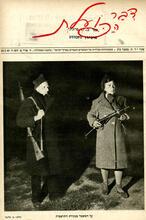
In addition to these sectors there was the religious-Zionist sector, which produced such women writers as Malka Shapira and Penina Kaspi. Although it constituted a partisan body of its own, this sector was divided ideologically into a civil oriented bloc (some of whom were traditional, in terms of religious observance) and a labor oriented one (Ha-Po’el ha- Lit. "Eastern." Jew from Arab or Muslim country.Mizrahi). The latter division applied to the Descendants of the Jews who lived in Spain and Portugal before the explusion of 1492; primarily Jews of N. Africa, Italy, the Middle East and the Balkans.Sephardic Jewish community as well. Shoshana Shababo, who came from a Sephardic family in Safed and grew up in the Lit. "village." The dominant pioneer settlement type of the Jews in Palestine between 1882moshavah of Zikhron Ya’akov, belonged to the civil bloc, and also published in its press; not so the young women writers of Yemenite origin, such as Sara Levi-Tanai and Yona Wahab, who published their first stories in Devar ha-Po’elet and were in fact affiliated with the labor bloc.
Women-Led Publications
field_section_text_value
Groups of Female Yishuv Writers
Despite the divisions in Yishuv society, women’s prose from this period comes across as a unified entity, meaning that even if the writers of Ha-Ishah and Olam ha-Ishah were not always personally acquainted, and even if the writers of Devar ha-Po’elet stayed within their own circles, their common condition of marginality or “metaphorical exile” brought them together, inadvertently, into an “imagined community” of women writers (see B. Anderson, 1983). In other words, even if each of the women lived in her particular surroundings, within her Zionist or Zionist-socialist world, and had a personal affinity for this or that school of literature, there was still a feminine, experiential connection that was forged—one that was jointly imagined by all of them. This connection found a common expression with varying doses of feminine meta-politics (to which they were connected ideologically and practically, whether consciously or unconsciously) and varying measures of feminine meta-poetics (in terms of which they recounted the pre-State reality, thematically and esthetically).
Accordingly, even though the present discussion encompasses a period of sixty-six years of women’s prose (1882–1948), the writers are presented here as one literary meta-group—a group that warrants a generational classification of its own, as distinct from the customary categories of men’s prose of the pre-State period, with its various schools and groupings (see for example, Shaked 1997). What follows are the three generations of women’s prose.
The first generation consists of women born in the latter half of the nineteenth century, who immigrated to pre-State Palestine in the late nineteenth and early twentieth centuries and began publishing during this period, including: Nehamah Pukhachewsky, Hemdah Ben-Yehudah, Yehudit Harari, Devorah Baron, and Ira Jan. This group also includes Shulamit Klugai and Miriam Bernstein-Cohen, who began to publish in the 1920s, and Hannah Luncz (later Bolotin) (1892–1987), who was born in Palestine.
The second generation encompasses women born in the first decade of the twentieth century, who immigrated to pre-State Palestine in the Third (1919–1923) and Fourth Lit. "ascent." A "calling up" to the Torah during its reading in the synagogue.Aliyahs (1924–1928) and began publishing during this period: Batya Kahana, Yehudit Mensch, Rivkah Alper, and Emma Levine-Talmi, as well as Shoshana Shababo, who was born in Palestine.
The third generation includes women born between roughly 1915 and the 1920s, who were brought to Palestine at an early age and were raised there as if native-born. They began to publish in the 1930s and 1940s, and included Ruhama Hazanov (1912–1994), Sarah Gluzman, Shoshana Sherira, and Penina Kaspi.
The Female Yishuv Writing Community
field_section_text_value
Motivations for Writing
field_section_text_value
Literary Themes
These shared points of departure can provide an insight into the creative dynamic that animated this imagined community of writers and, of course, into the meta-poetics that produced their work. The following is a brief, illustrative glimpse into the nature of this poetic, touching on such elements as the female thematic display; the national narrative of women; the constructive and the melancholic viewpoints; and marginalization as the source of a different type of writing.
Women’s prose during the Yishuv period focused, for the most part, on the female space, embracing two levels of content: (1) woman as woman (that is, issues of intimacy, sexuality, motherhood, the female body, women’s discourse, women’s friendship, relationships within couples and families, the exploitation of women [sexual harassment], women’s work and livelihood [including all the problems of discrimination and exclusion], childhood, adolescence, old age); and (2) woman in context of the Yishuv community, or, what it means to be a woman in pre-State Palestine (the transition from Diaspora to homeland and from conservative to liberal patterns of behavior, the encounter with the Land, conflict between various Jewish ethnic groups, cross-gender work concerns, tension between the individual and the group, the absence of an extended family, and the national revival as a female resurgence).
Needless to say, this feminine thematic scheme also contributed to the creation of a national narrative of its own. The question is: in which scenarios did women writers choose to formulate such a narrative for themselves, and in what way did they recount this narrative by means of their plots, characters, and statements? It should be noted here that the meta-poetics of women offered a national narrative that was separate and distinct from that of the men—one whose story lines were marked not by dramatic struggles between success and failure (what Gershon Shaked terms “the literature of the homeland”) but by the routine, unassuming existential story of a society surviving from day to day. In other words, the male national narrative proclaimed itself as the standard-bearer, reasserted the founding principles, and amplified every ordinary event (such as working in the field, a night spent on guard duty, or a trek through the country) into a heroic historical statement (“one cannot conquer the mountain without graves along the way”).
Not so the female national narrative, which delved more deeply into the personal and the particular; it treated the individual environment as a communal test case—an opportunity to seek, to question, to explore what the Land of Israel was for them. Thus, if the male narrative stressed “conquering the mountain” as a totality, the female narrative pointedly rejected the “heroic sagas” and “spoils of battle” in favor of gradual minor progress and the attitude of “only a path have my feet paved,” “only a tree have my hands planted” (in the words of the poet Rahel).

An examination of the national narrative of the women writers from the First Aliyah onward reveals two distinct “feminist” positions: the first is the constructive view introduced by Hemdah Ben-Yehudah, and the second, the melancholic view, first seen in the work of Nehamah Pukhachewsky. Ben-Yehudah’s work depicted the secondary, marginal status of women in Yishuv society of the early twentieth century as a transient phenomenon that could be improved through suitable education and national awareness; thus, even if her national narrative exposed the exploitation and oppression of women in a male society (“Lulu”) and in fact denounced it, it always hastened to reassure the reader that the situation would ultimately be corrected and to conclude with a rosy vision of the future. This optimistic feminism also created alternative scenarios involving models of the ultimate Yishuv woman who stands out by virtue of her opinionated, independent nature, remaining unbowed in the face of the all-powerful Zionist male (Tahat ha-Shaked [Under the almond tree], Simlah Hadashah [A new dress], Ba-Moledet [In the homeland]). While these examples are works of literature, they also serve as a constructive guide to the development of the new woman in pre-State Palestine.
The melancholic view is more realistic and at the same time more critical. According to this perspective, the Zionist enterprise (which was a male undertaking, as stated above) failed to implement the moral and ethical values that were supposed to be realized in Palestine with the restoration of Jewish society to its homeland and the attempt to create a new land, a new people, a new individual. On the contrary—this Jewish society only repeated earlier misdeeds and perversions, revealing itself to be a reactionary society that perpetuated social gaps and developed an insensitivity to the downtrodden (workers, women, and other ethnic groups).
This view is apparent from the outset in the works of Pukhachewsky, who prefers to present her national narrative from the perspective of the weak, exposing their dismal situation with a critical, clear-eyed realism that is, at the same time, bleak and melancholic. While Pukhachewsky also portrays a hired laborer and a Yemenite Jew, her primary concern is the oppression of women. Whether Sephardic or Ashkenazic, women are always presented as victims, if not doubly so—victims of a male member of the family (husband, brother, brother-in-law, etc.; see “Sarah Zarhi,” “Ha-Meshek” [The farm], “Rumah,” and victims of a chauvinist, male-dominated society that adopts demeaning behavioral codes towards women, like the male society of the moshavah (see Bi-Vedidut [Lonely]), or of an ethnic group, in this case the Yemenites, in Aharei Simhah (After celebration) and Asonah shel Afyah (The tragedy of Afyah).
Pukhachewsky’s melancholic view was often poorly received by the critics. In the review of her book Bi-Yehudah ha-Hadashah (1911), Ya’akov Zerubavel (1886–1967) attacked her for the prevalence of sickness and bereavement in her stories, and Gershon Shaked in his historiography (1983) argued that her writing was melodramatic and aimed only at “evoking pity and drawing tears.” It appears that these critics did not plumb the depths of her ambivalent text; rather than seeking to be a perfect mirror of reality, it stands as an act of protest by a woman artist who, using melancholy as a device, undermined the Zionist and literary consensus and shattered the national narrative of the heroic male (which had captivated the public), replacing it with an alternative narrative of her own.
This subversive literary device spans fifty years and three generations of women’s writing, demonstrating that it is not in fact the constructive view but the melancholic one (in varying degrees) that dominates this literature. For example, in the work of Sarah Gluzman (the second generation), Tel Aviv is not a gleaming “white city” rising from the sands but a sullen and oppressive place for its workers and pioneers (Al Saf ha-Mavet); or Ruhama Hazanov who, of all the possible family histories in a flourishing moshavah, places at the forefront of her novel Gederot (Fences) a family that came to “build and be built” and finds itself burying its sons and daughters, one after another. Likewise, Devorah Baron, of the first generation (Ketanot, Mah she-Hayah [What was]); Yehudit Mensch (Ne’urim) and Batya Kahana (Elbonot), of the second generation; and Shoshana Sherira (Almanot [Widows], Lev Navokh [Confused heart]) and Miriam Tal (Mezayefei ha-Hayyim), of the third generation. An atmosphere of intense sadness emanates from these works, not to mention those of Penina Kaspi, in which anger and depression produce such disturbing stories as “Shuna,” “Zelalim Melavim” (Accompanying shadows), “Ha-Ahot Na’omi” (Sister Naomi).
There is no doubt that this strategy could only have emerged from those same literary margins to which the woman writer was consigned, for it was precisely these margins that afforded her an advantage by releasing her from any sense of obligation, self-negation or the need to pursue important groups or fashionable schools of thought. Thus, without any binding models and without the fear of “influence,” “acceptance,” “demands of expectation,” and the like, it became possible for women to create literature freely and independently, on both the intellectual/political and emotional/intuitive levels. Indeed, the “poetics of the margins” offered a form of women’s art that was different—in content, genre, and language. For example, it was only after Devorah Baron placed herself “on the fringes” that she felt freer to transgress the established literary imperative that utterly negated the Diaspora and to continue treating the religious and Diaspora-centered themes of the Lithuanian Jewish (Yiddish) Small-town Jewish community in Eastern Europe.shtetl (Parshiyot [Affairs]).
No less daring was the position taken by Shoshana Shababo who, at the height of the Jewish-Arab conflict and the Yishuv’s struggle for Palestinian land, chose to tell a story of an Arab family and in a lengthy novel spread over two volumes (Maria). Miriam Tal (Mezayefei ha-Hayyim) and Ora Zonenschein (Hayyai Yathilu Mahar) [My life will begin tomorrow] perverted the portrait of “the new Jew,” no longer depicting him as the ideal symbol of a new life in Palestine but as a grotesque subject of ridicule, in the person of a wily merchant (or official) who perpetuates the Diaspora in the homeland.
Batya Kahana goes even further, placing the “new Jew” in a romantic contest against two rivals/adversaries—the native-born Arab (Ha-Hitzim Mimkha ve-Hal’ah [The arrows are beyond you]) and the anti-Zionist Jew (Bi-Froah Ez ha-Hadar [When the citrus blooms])—who compete for the heart of the Jewish woman of the Land of Israel and even succeed for a while.
As with subject matter, so too with genre, yielding the unexpected hybrid of the “national romantic novel.” This genre, which customarily unfolded within the intimate “forbidden” space between an innocent young girl and a compelling stranger, is situated between the “intimate” and the “national,” combining the consummation of a love affair with Zionist messages (Bi-Froah Ez ha-Hadar by Batya Kahana, Roman be-Mikhtavim by Miriam Schneid, Hayyai Yathilu Mahar by Ora Zonenschein).
An additional genre is the woman’s fantasy, which stood out as “different” against the backdrop of the realistic, naturalistic male story in the early decades of the twentieth century (examples include Parparim by Batya Kahana and “Ha-Nasikh Ba’al Shesh ha-Ezba’ot: Rishmei Masa” [The six-fingered prince: Impressions of a journey], by Penina Kaspi). These fantasies, which tended to paint the grim reality of Yishuv life in rosy hues, were presented in the form of collective national yearnings (Hemdah Ben-Yehudah), but this genre could also portray reality as a horrific apocalypse through the use of surrealistic allegory (Ira Jan).
As for the language complex in the writings of the women authors, here too there is an unmistakable difference between female and male linguistic stylizations. The Jewish male encountered the Hebrew language as an integral part of his education in the Diaspora (the heder and the yeshiva); not so the Jewish woman, who was introduced to Hebrew only if she joined the Zionist youth movements of the Diaspora, and of course upon settling in Palestine (with the exception of writers such as Devorah Baron and Nehamah Pukhachewsky, who had studied Hebrew from childhood, and writers born in Palestine). Over time, however, the attitude toward their use of language has shifted; the male text of the Yishuv period, which stood out for its lexicographical torrent of description and variety, is now perceived as outdated and cumbersome; on the other hand, the text of the women writers not only flows better but its style comes across as modern and relevant.
Conclusion
field_section_text_value
Hebrew:
Berlovitz, Yaffah. “Exploring the Zionist Narrative of Women—Dawn of a Century/Close of a Century.” In Sifrut ve-Hevrah be-Tarbut ha-Ivrit ha-Hadashah, edited by Joseph Bar-El, Y. Schwartz, and Tamar Hess, 421–439. Tel Aviv: 2000.
Berlovitz, Yaffah. “In Search of a Portrait of the ‘Erez-Israel Woman’ in Women’s Literature of the ” In Bikoret u-Farshanut, Kovetz Meyuhad: Ha-Ishah ha-Yisraelit, edited by Tova Cohen, 91–113. Ramat Gan: 2000.
Berlovitz, Yaffah. “Literature from a ‘Lost Continent.’” In She-Ani Adamah ve-Adam: Sipurei Nashim ad Kom ha-Medinah, 319–336. Tel Aviv: 2003.
Berlovitz, Yaffah. “‘Our Time Has Come’: Feminine Identity, Feminine Writing.” In Le-Hamzi Erez, le-Hamzi Am, 49–79. Tel Aviv: 1996.
Berlovitz, Yaffah. “The Voice of Melancholy as the Voice of Protest: A Study of the Writings of Nehamah Pukhachewsky—One of Palestine’s First Women Storytellers.” In A View into the Lives of Women in Jewish Societies, edited by Yael Azmon, 325–336. Jerusalem: 1995.
Berlovitz, Yaffah. “Women as Presented in Women’s Literature of the First Aliyah.” Cathedra 54 (December 1989): 107–124.
Berlovitz, Yaffah. “Women’s Literature in the Yishuv Period: Reorganization of an Excluded Culture.” In Harimi be-Koah Kolekh: Kolot Nashi’im u-Farhshanut Feministit be-Limudei ha-Yahadut, edited by Renée Levine Melammed, 97–121; Tel Aviv: 2001.
Berlovitz, Yaffah. “Women’s Meeting Points in the Early Days of the ‘New Yishuv’ (1878–1918): A Look of their Writings” (‘Al tzomtei mifgashim bein nashim bereishit haYishuv [1878–1918]: ‘Iyun bekitveihen shel rishonot). In Iyunim bitkumat Israel: Gender in Israel – New Studies on Gender in the Yishuv and State, edited by Margalit Shilo and Gideon Katz, 369-408. Sde Boker: 2011.
Berlovitz, Yaffah. “‘My Whole Intention Is to Write to the Extent of My Ability and My Strength’: A Study of the Early Literary Work of Sara Levi-Tanai (1929–1934)” (Kol kavanati hi likhtov lefi yakholti ulefi koḥi). In Sara Levi-Tanai: A Life of Creation (Sarah Levi-Tanai: Ḥayim shel yetzirah), edited by Henia Rottenberg and Dina Roginsky, 59-88. Tel Aviv: Resling, 2015.
Ben-Yehudah, Hemdah. “Our Time Has Come.” Do’ar Hayom, 30.9.1919.
Feiner, Shmuel. “The Modern Jewish Woman: Test Case in Attitudes of the Modern Haskalah.” Zion 4 (Jerusalem 1993): 470–497.
Fogiel-Bijaoui, Sylvie. Eve’s Eyes—the Woman in the Jewish Yishuv in Palestine, 1904–1948. A Summary of a Doctoral Dissertation (University of Paris-X, Nanterre, 1981). Tel Aviv: 1982.
Govrin, Nurit. “‘Nefesh’ mi-Rishon le-Zion Homiyah: Nehamah Pukhachewsky.” In Devash mi-Sela, 114–171. Tel Aviv: 1989.
Guez, Ronit. “Women’s and Men’s Fiction in the Period of the Yishuv: Negotiations over the National Narrative” (Sifrut nashim vesifrut gevarim bitekufat hayishuv: Masa umatan ‘al hanarativ hale’umi). Ph.D. Dissertation, Ben-Gurion University of the Negev, 2011.
Guez, Ronit, “A Gender Re-vision of the Historiography of the Period of the National-Zionist Revival” (Re-viziyah [re-vision] migdarit shel hahistoriyografiyah bitekufat hateḥiyah hale’umit-Tziyonit). Hador: The Hebrew Annual of America, Fall 2016, 117–124.
Isha, Adi, “The Poetics of Disassembly in the Works of Shoshana Shababo” (“Vehayetah hapeli’ah haḥalutzah haḥadashah”: Po’etikat hapeiruk beyetziratah shel Shoshanah Shababo). Israelis: A Bilingual Periodical for the Study of Israel and Zionism 9 (2019): 45–70.
Melman, Billie. “From the Margins to the History of the Yishuv: Gender and ‘Israeliness’ (1890–1920).” Zion 3 (1997): 253–278.
Pukhachewsky, Nehamah. “More on the issue of the female question.” Ha-Meliz, 23.1.1889.
Rattok, Lily. “Every Woman Knows It: An Afterword.” In Ha-Kol ha-Aher: Siporet Nashim Ivrit, edited by Lily Rattok. Tel Aviv: 1994, 272–274.
Rosenberg, Lilach. “Farms of Religious Women Laborers in Erez Israel, 1925–1939.” Cathedra 90 (December 1998): 87–114.
Shavit, Zohar, and Jacob Shavit. “History of the Hebrew Crime Novel in pre-State Palestine.” Ha-Sifrut 18–19 (December 1974): 30–45.
Shavit, Zohar, ed. Building a Hebrew Culture in Pre-State Palestine. Jerusalem: 1999.
Shilo, Margalit, Ruth Kark, and Galit Hazan-Rokem, eds. The New Hebrew Women: Women in the Yishuv and in Zionism From a Gender Perspective. Jerusalem: 2001.
Shirav, Penina. Non-Innocent Writing: Discourse, Position and Female Representation in Works by Judith Hendel, Amalia Kahana-Carmon and Ruth Almog. Tel Aviv: 1998.
English:
Anderson, Benedict. Imagined Communities: Reflections on the Origin and Spread of Nationalism. London and New York: 1983.
Berlovitz, Yaffah. “No Home at Home: Women’s Fiction vs. Zionist Practice.” In Discourse on Gender/Gendered Discourse in the Middle East, edited by Boaz Shoshan, 95–115, 159–161. Westport, CT and London: 2000.
Bernstein, Deborah, ed. Pioneers and Homemakers: Jewish Women in Pre-State Israel. New York: 1992.
Geva, Sharon. "Ahead of its Time: Ha'ishah Bamedinah—The Story of a Forgotten Women's Journal in Israel." Nashim: A Journal of Jewish Women's Studies & Gender Issues 34 (2019): 98-122.
Makov-Hasson, Hadar. “Oedipus’ Sister: Narrating Gender and Nation in the Early Novels of Israel Women.” Ph.D. Dissertation, New York University, 2009.
Sartre, Jean-Paul. What Is Literature? New York: 1949.
Zakai, Orian. “Zion of Their Own: Hebrew Women's Nationalist Writing.” Ph.D. Dissertation, University of Michigan, 2012.
More Like This
Double your impact to amplify Jewish women’s stories—
All gifts matched up to $35,000
Before you close this article, please consider supporting the Jewish Women’s Archive and uplifting Jewish women’s voices.
At JWA, we preserve the voices of Jewish women and gender-expansive people past and present, share them freely with millions online, and empower a new generation of Jewish feminists to lead with courage, creativity, and conviction.
But none of this happens without you. JWA is an independent nonprofit— we rely on people, like you, who believe that history belongs to all of us and that the voices of Jewish women must remain powerful, and heard.
This month, a generous JWA board member will match every gift dollar for dollar—up to $35,000—through June 30. Your contribution goes twice as far right now.
Every contribution—no matter the size—helps us document, teach, and inspire through Jewish women’s stories.
It takes less than a minute to make a difference.
Thank you for being a part of the JWA community,
Judith Rosenbaum, CEO