
Peace Movement in the United States
Throughout the twentieth century, Jewish women played a major role in American peace organizations and movements. Protesting against issues like nuclear proliferation and the Vietnam War, these groups also expanded their interests to align with the civil rights and women’s liberation movements. Jewish women have also been in prominent roles advocating for peace between Israel and Palestine, both in the Knesset and with private organizations, especially after the 1982 war in Lebanon. In the many international women’s peace conferences in the late twentieth century, Jewish women were featured guests; these gatherings often brought together Palestinian and Israeli Jewish women to discuss their experiences.
field_section_text_value
A Long History of Organizing for Peace

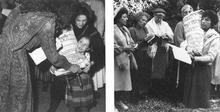
Bella Abzug at a New York press conference in 1972.
Copyright © Diana Mara Henry, dianamarahenry.com

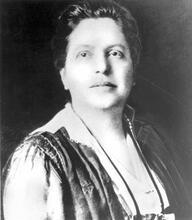
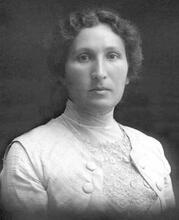
Educator and founder of the World Affairs Council and Center at the University of Minnesota, Fanny Fligelman Brin (1884–1961).
Image courtesy of the University of Minnesota Alumnae Association via The Washington Nuclear Museum and Education Center.
field_section_text_value
Jewish Peace Movements and the Israeli-Palestinian Conflict
An explicitly Jewish peace movement emerged out of a confluence of forces in the 1970s. The 1967 war and Israel’s annexation of the West Bank, Gaza, Sinai, and Golan changed the physical and political terrain of Israel. It altered the relationship between the United States and Israel, newly focusing the attention of United States Jews on Israel. It transformed the nature of Palestinian political movements and fostered peace movements within Israel and the diaspora.
Although Tandi, the “Movement of [Palestinian and Jewish] Democratic Women in Israel,” had formed as early as 1948 to work for peace and equal rights for women and children, it stood largely alone until a number of Israeli peace movements organized in the 1970s. In 1975, Marcia Freedman, an American-born member of the Israeli Lit. "assembly." The 120-member parliament of the State of Israel.Knesset, elected with the support of the Israeli women’s movement, advocated a “two-state solution” to the Israeli-Palestinian conflict, that is, negotiations toward a Palestinian state alongside Israel. In 1978, Peace Now formed in Israel, and American Friends of Peace Now in the United States.
Within the United States, Jews began to form organizations such as Breira (1973–1978), proposing that the Israeli Labor Party pursue peace more affirmatively. In 1980, New Jewish Agenda formed as “a progressive voice within the Jewish community and a Jewish voice within the Left community.” A multi-issue group, it, too, soon focused on promoting the two-state solution.
The 1982 war in Lebanon created a turning point in the formation of Israeli-Palestinian peace movements. The massacres at Sabra and Shatilla refugee camps of hundreds of Palestinians, predominantly women and children, by Lebanese Falange forces under Israeli military supervision caused painful soul-searching and protest demonstrations by Jewish women and men in Israel and in the diaspora. Four hundred thousand Israelis, constituting 10 percent of the Israeli people, demonstrated against the war and the massacres. Thousands of Jews and non-Jews demonstrated throughout the diaspora.
The International Jewish Peace Union (IJPU), formed in Paris in 1982 in response to the Lebanon War, was quite male-oriented. Among the organizers of American chapters, however, were Ellen Siegel, who had practiced nursing (and seen conditions firsthand) in Lebanon, Hannah Davis (also a member of New Jewish Agenda), and Ellisa Sampson, an observant Jew with a long history of activism and political analysis dating back to her experiences living in Israel from 1972 to 1978. Sampson led the New York chapter.
The IJPU initially concentrated on the Israeli incursion into Lebanon and supported Yesh Gvul, a movement of Israeli soldiers who refused to serve in the occupied territories. Later, influenced by an increasingly female membership and by the activities of the Israeli, Palestinian, and Jewish American women’s peace movements, the IJPU also organized medical relief in Lebanon and the territories, most of whose recipients were women.
Feminism, Peace, and the Israeli-Palestinian Conflict

field_section_text_value
Influence of the Israeli Women’s Peace Movement
field_section_text_value
Women and Peace Conferences
Demonstrations, retreats, and conferences played a major role in Jewish women’s peace activities, both in Israel and the diaspora. These activities encouraged introspection, consciousness-raising, mutual influence, and public education.
There were four major international women’s peace conferences between 1987 and 1991, and two major nongovernmental international conferences within the United States. Through the four women’s conferences, Israeli and Palestinian women developed an increasing amount of mutual understanding and ability to work together, and Jewish women in the diaspora learned of their work.
The First International Jewish Feminist Conference, organized jointly by Israeli and American Jewish women, brought Jewish women from around the world to Jerusalem in November 1988 to discuss “The Empowerment of Jewish Women.” With the outbreak of the Intifada and the crisis of Israeli governmental policy, members of the planning group split over the question of whether to permit discussion of the effect of the Intifada on women. The newly formed Women in Black and SHANI organized a demonstration at the conference, inviting participants to attend a “Post-Conference,” entitled “Occupation or Peace? —A Feminist Response.”
The Post-Conference included testimony by two Palestinian women from the West Bank about their conditions as women and as Palestinians. This was the first time that most of the participants had heard from Palestinian women directly, and it was the first time that many of the diaspora women met the Israeli women’s peace movement and were able to hear their point of view.
As a result of these conferences in late 1988, Israeli Jewish women began to have greater contact with Palestinian women, both within the Israeli Green Line and in visits to the West Bank and Gaza. They began to plan, in coordination with one of the four major Palestinian women’s organizations, a Women Go for Peace Conference for the following December.
The 1989 Women Go for Peace Conference was significant for several reasons. For the first time, representatives of major Israeli Jewish women’s social service organizations committed themselves to combining the quest for Israeli-Palestinian peace into their program of furthering the status and condition of women in Israel. Also, for the first time, the Israelis shared the podium with leaders of a Palestinian women’s organization. In drawing American and other diaspora women back to Israel for an explicitly women’s peace conference, it furthered their understanding and therefore their work in Jewish women’s peace movements at home.
Coinciding with a major international effort by Peace Now to draw people from around the world to join local Israelis and Palestinians in a “Hands Around Jerusalem” peace chain, it gave the Israeli and Palestinian women’s peace movements worldwide press coverage. Like their international counterparts, American Jewish women returned with reports about the conference, which they shared with other Jewish women at meetings organized by the JWCEO, the NCJW, NJA, and various synagogues and women’s organizations.
The success of the 1989 conference led the Israeli and Palestinian women’s organizations to plan together a Women’s International Conference for Israeli Palestinian Peace for December 1990. Assistance in funding and planning was elicited from Swedish WILPF and from Jewish women’s peace organizations in other countries. American women played an important role.
The process of planning the 1990 conference added three new dimensions to the Jewish women’s peace efforts. (1) Joint planning. Whereas the 1988 Post-Conference had been organized by the Israeli women, with invitations to Palestinian women to participate, and the 1989 conference had been planned separately, with Israelis organizing the morning session and Palestinians the afternoon, the 1990 conference was planned together. The Israel Women’s Peace Coalition (composed of eight different women’s peace groups), the Israel Women’s Peace Network (Reshet), and three of the four Palestinian women’s organizations caucused separately, but the monthly planning meetings were integrated.
(2) Modeling of a conflict resolution process. As the planners put it: “We hope that the 1990 conference, and the process by which we are mutually planning for it, may serve as a model for making peace in the Middle East and as a demonstration of the possibility for a peaceful settlement of the conflict.”
(3) The articulation of a feminist orientation to peace. In contrast with the typical absence of women from official peace conferences, the Women’s International Conference was to demand women’s participation in the peace process, provide women’s perspectives on the issues dividing Palestinians and Israelis (utilization of resources, Law of Return, etc.), and address women’s issues typically neglected in men’s considerations of war and peace, among them the effects of militarization on women’s rights, the relationship between war and the level of sexual harassment, domestic violence, and the many other ways that war differently affects women and men.
The women intended to model and push for actual internationally backed negotiations between the official Palestinian leadership and the Israeli government. Consequently, they wished to have the participation of representatives who were as highly placed as possible. Because it was still illegal for members of the PLO to enter Israel-Palestine, and illegal for Israelis to meet with members of the PLO, a double conference was planned. Part would take place at the United Nations offices in Geneva, Switzerland, and part would take place in Jerusalem.
These plans were interrupted by the Iraqi invasion of Kuwait on August 2, 1990. The resulting war virtually silenced peace groups in Israel. Although both the Israeli and Palestinian women proclaimed that “now, more than ever, we must work for peace,” the war forced the planners to have a much smaller conference in Jerusalem in December and to postpone the Geneva portion of the conference. American Jewish women spoke and observed at the December conference and reported back afterward.
In May 1991, the second half of the Women’s International Conference for Israeli-Palestinian Peace convened at the Palais des Nations in Geneva, attended by seventy-five women from thirteen countries. Among the representatives were members of the European and Swedish parliaments, high-level members of the PLO, six other Palestinians from the territories, and ten Israelis, two of them members of the Israeli Knesset, including Yael Dayan, daughter of the acclaimed Israeli general Moshe Dayan.
Three days of intensive discussion and negotiation produced a three-page consensus document covering most of the major issues in the Israeli-Palestinian conflict. The document called for official negotiations, regional security and arms control, human rights, and attention to the economic and social consequences of the occupation. “We are women talking to each other while war is going on between our two peoples,” said the PLO ambassador in her closing remarks. “It is very important for our people to know that we can meet together to work for peace.”
News of the Geneva conference was transmitted by the participants and observers returning to their countries, in the form of speeches (primarily before women’s organizations, including JWCEO, the National Jewish Women’s Resource Center, the American Association of University Women, NJA, and various synagogues), radio programs such as Pacifica KPFA, and articles in such journals as Bridges and New Directions for Women.
The conference coincided with U.S. Secretary of State James Baker’s as yet fruitless efforts to get Israel and the Palestinians to agree on terms for an international peace conference. Four months later, an official international peace conference began in Madrid, Spain, with Israeli and Palestinian participation. Women in Black as a symbol and activity of women’s direct action for peace was adopted by Serbian women protesting the war in Bosnia and by American women expressing their support for the victims of that war. It became an international symbol and resource for women’s work for peace.
Women in Black held their vigils week in and week out for nine years, from the beginning of the First Intifada to the promised peace of the Oslo Accords. And although the inherent flaws of the Oslo Accords were obvious to many of them, they stopped vigiling, only to be brought back to the streets with the second Intifada.
By the year 2000, seven lean years of the Oslo peace Accords had doubled the number of Jewish settlements on Palestinian land in the West Bank and Gaza. Bypass roads for Israeli Jews (only) carved up the territories—the land of the Oslo-promised Palestinian State—into a Swiss cheese of Israeli settlements and bypass roads guarded by more and more Israeli soldiers. The importation of Russian Jews and foreign workers, and the exclusion of Palestinian laborers from their former jobs within Green-Line Israel, (border before June 10, 1967) plunged the Palestinian economic situation into ever more desperation. When Ariel Sharon, accompanied by 1500 Israeli police, took his controversial and provocative Jerusalem walk to the Moslem holy places, Palestinians erupted, and the second Intifada began.
With the second Intifada, Women in Black resumed their vigils, and joined Bat Shalom, Tandi, Israeli branch of the Women’s International League for Peace and Freedom, and other organizations in forming the Coalition of Women for a Just Peace, an umbrella group of “Jewish and Palestinian women (all citizens of Israel) ... calling for peace and justice for all inhabitants of the region.” In March 2001 they were joined by Machsom Watch, and later by “The Fifth Mother,” and “New Profile.”
Machsom Watch
Machsom (or checkpoint) Watch is an organization of women who monitor military and police behavior at checkpoints. The Israeli government justifies the checkpoints it has set up throughout Palestine as necessary to protect Israelis against suicide bombers. Most of these checkpoints, however, are not at the borders with Israel, but within Palestinian territories. They separate Palestinians not, primarily, from Israel, but from their lands, livelihoods, schools, jobs, and each other. At the checkpoints, young Israeli soldiers have the power to decide whether sick Palestinians can get to a hospital, whether teachers can get to work, whether children can get to school, or parents can pick them up. Several Palestinian women have had to give birth on the ground at checkpoints, because soldiers would not let them pass to go to a hospital. Many mothers and new-borns have died. Waiting for permission to pass through checkpoints, Palestinians are subject to humiliation, derisive laughter, and physical abuse. An ordinary fifteen-minute trip can take hours.
Two Israeli organizations have responded specifically to the problems at checkpoints: Btselem, the [gender-mixed] Israeli Human rights organization, and Machsom Watch. Begun by three women in 2001, Machsom Watch now has 400 women who show up at checkpoints throughout the country “to monitor the behavior of soldiers and police; to ensure that the human and civil rights of Palestinians attempting to enter Israel are protected; to record and report the results of [their] observations to the widest possible audience, from the decision-making level to that of the general public.” Mostly made up of “mature professional women,” they attempt to exert a chastening moral influence on militarized young men.
“The Fifth Mother” calls for involving conflict resolution experts to break the impasse in negotiations for peace. They also focus on eradicating military language from public discourse, a concern they share with “New Profile.” The latter organization aims at the demilitarization of Israeli society in education, discourse, and practice:
We support the right to resist the draft, conscientious objection, and refusal to serve in the Occupied Territories for all men and women. We work with women whose lives have been damaged by militarization, such as victims of sexual harassment in the military, or of exploitation by the Ministry of Defense.
In addition to its activist activities, often in coordination with such gender-mixed organizations as Gush Shalom, Palestinian non-violent activist organizations, and the International Solidarity Movement, The Coalition of Women for a Just Peace supports scholarly studies, such as the two most recently posted on its website (www.coalitionofwomen.org) on the impact of the armed conflict on women within Israel and the Occupied Territories.
Continuing their long tradition, begun in 1988, of international conferences for Israel/Palestine peace, Women in Black held their latest conference, called "Women Resist Occupation and War" in Jerusalem from August 12 to 16, 2005. While the 1991 Geneva conference had drawn 75 women from 13 different countries, the 2005 conference drew over 650 women from 44 countries. As in the previous conferences, the conference was planned jointly by Israeli and Palestinian women. They faced formidable obstacles:
Since there is no movement of Women in Black in Palestine, and since the Israeli army prevents us from entering each other's areas (only internationals are allowed to cross), there were great difficulties in trying to plan this together. Nevertheless, both sides were committed to coordinating the planning and implementation of the conference. Palestinian women also conducted the solidarity visit in the occupied territory.
Each of the workshops related to the Palestinian-Israeli conflict was co-facilitated by a Palestinian and an Israeli. In addition, the conference addressed “Women’s Global Challenges,” among them War Crimes against women, domestic violence, effects of globalization and privatization, and “The Politics of Fear, Hatred, and Racism.”
A major point of contention—the insistence by Palestinian women that a workshop on lesbianism be canceled—sparked concerted discussions of the interrelationships among patriarchy, homophobia, and other forms of oppression, including the Occupation. The controversy continued beyond the conference itself. Given the important role of lesbians in organizing for peace and women’s rights, it is likely to promote further efforts at resolution.
As befits a conference of activists, 200 international participants joined the Friday Women in Black vigil in Jerusalem, and the Conference ended with a demonstration at the Kalandia checkpoint.
In 2005 there are almost 400 Women in Black vigils in 37 different countries, from Belgium to Bahrain, from Australia to the United Kingdom. The international movement of Women in Black was honored with the Millennium Peace Prize for Women, awarded by the United Nations Development Fund for Women (UNIFEM) in 2001. The international movement, represented by the Israeli and the Serbian groups, was also a candidate for the Nobel Peace Prize in 2001. Israeli Women in Black won the Aachen Peace Prize (1991); the peace award of the city of San Giovanni d’Asso in Italy (1994); and the Jewish Peace Fellowship’s “Peacemaker Award” (2001).
In the USA, there are vigils in multiple locations within each of forty of the fifty states. In addition to participating in Women in Black vigils, U.S. Jewish women have led other organizations dedicated to Israeli/Palestinian peace. For example, Marcia Freedman, who had, as a member of the Israeli Knesset advocated a “two-state solution” to the Israeli-Palestinian conflict as early as 1975, heads “Brit Zedek V’Shalom, ‘the Jewish Alliance for Justice and Peace... a national organization of American Jews deeply committed to Israel's well-being through the achievement of a negotiated settlement to the long-standing Israeli-Palestinian conflict.” Barbara Lubin and Penny Rosenwasser lead The Middle East Children’s Alliance, “A non-governmental organization working for peace and justice in the Middle East, focusing on Palestine, Israel, Lebanon and Iraq... [with special emphasis] on the rights of children.”
For almost a century, Jewish women have continued to participate in peace movements, working for peace with justice in Israel/Palestine, in Iraq, and wherever war and oppression threaten human life.
Adams, Judith Porter. Peacework: Oral Histories of Women Peace Activists (1991).
Balka, Christie, and Reena Bernards. “Israeli and Palestinian Women in Dialogue: A Model for Nairobi. New Jewish Agenda’s Role at the UN ‘Decade for Women’ Conference Forum ’85 in Nairobi: Final Report.” 4107 v.f. Jewish Women’s Resource Center, National Council for Jewish Women, NYC.
Beck, Evelyn Torton, ed. Nice Jewish Girls: A Lesbian Anthology (1982. Revised and expanded 1989).
Brettschneider, Marla. Cornerstones of Peace: Jewish Identity Politics and Democratic Theory (1996).
Bulkin, Elly. “Hard Ground: Perspectives on Jewish Identity, Racism, and Anti-Semitism.” In Yours in Struggle: Three Feminist Perspectives on Anti-Semitism and Racism, edited by Elly Bulkin, Minnie Bruce Pratt, and Barbara Smith (1984).
Chazan, Naomi. “Israeli Women and Peace Activism.” In Calling the Equality Bluff: Women in Israel, edited by Barbara Swirski and Marilyn P. Safir (1991).
Degan, Marie Louise. The History of the Women’s Peace Party (1939).
Espanioli, Nabila, and Dalia Sachs. “Peace Process: Israeli and Palestinian Women.” Bridges: A Journal for Jewish Feminists and Our Friends 2 (1991): 112–119.
Falbel, Rita. “Jewish Women.” New Directions for Women (March/April 1989), and “Women’s Vigil Against the Occupation.” Genesis 19, no. 2 (Summer 1988): 7.
Falbel, Rita, Irena Klepfisz, and Donna Nevel. Jewish Women’s Call for Peace: A Handbook for Jewish Women on the Israeli/Palestinian Conflict (1990).
Foster, Catherine. Women for All Seasons: The Story of the Women’s International League for Peace and Freedom (1989).
Freedman, Marcia. Exile in the Promised Land: A Memoir (1990).
Gorelick, Sherry. “The Changer and the Changed: Methodological Reflections on Studying Jewish Feminists.” In Gender/Body/Knowledge: Feminist Reconstructions of Being and Knowing, edited by Alison M. Jaggar and Susan R. Bordo (1989), and “Doing the Impossible for Peace.” New Directions for Women 2, no. 5 (September/October 1991), and “Geneva Conference: History and Goals.” Bridges 2 (1991): 120–123.
Kaye/Kantrowitz, Melanie, and Irena Klepfisz, eds. The Tribe of Dina: A Jewish Women’s Anthology.
Klepfisz, Irena. Dreams of an Insomniac: Jewish Feminist Essays, Speeches and Diatribes (1990).
“An Open Letter to Women Attending the American Jewish Congress Conference ‘Empowerment of Jewish Women’ from SHANI—Israeli Women Against the Occupation.” #4288. Jewish Women’s Resource Center, National Council for Jewish Women, NYC.
Pogrebin, Letty Cottin. “Anti-Semitism in the Women’s Movement” Ms. (June 1982, and see “Letters Forum: Anti-Semitism” in the February 1983 issue for responses). (Reprinted in Eye 9, no. 2, March 1983), and Deborah, Golda and Me: Being Female and Jewish in America (1991), and “Going Public as a Jew: How I Was ‘Born Again’ to My Own People.” Ms. (July/August 1987).
The Road to Peace: Israeli-Palestinian Dialogue in New York. Special edition, New Outlook 32, no. 3–4 (March–April 1989).
Rogow, Faith. Gone to Another Meeting: The National Council of Jewish Women, 1893–1993 (1993).
Swerdlow, Amy. Women Strike for Peace: Traditional Motherhood and Radical Politics in the 1960s (1993).
Sharoni, Simona. Gender and the Israeli-Palestinian Conflict: The Politics of Women’s Resistance (1995).
IN POSSESSION OF THE AUTHOR
“Final Document.” Women’s Geneva Conference for Israeli-Palestinian Peace. Palais des Nations, Geneva, Switzerland, May 13–15, 1991. 3 pages.
Sachs, Dalia. Speech given (in Hebrew; English translation by its author) at the panel on women and their contribution to peace. Women Go for Peace Conference, Jerusalem, Israel, December 29, 1989.
More Like This


Double your impact to amplify Jewish women’s stories—
All gifts matched up to $35,000
Before you close this article, please consider supporting the Jewish Women’s Archive and uplifting Jewish women’s voices.
At JWA, we preserve the voices of Jewish women and gender-expansive people past and present, share them freely with millions online, and empower a new generation of Jewish feminists to lead with courage, creativity, and conviction.
But none of this happens without you. JWA is an independent nonprofit— we rely on people, like you, who believe that history belongs to all of us and that the voices of Jewish women must remain powerful, and heard.
This month, a generous JWA board member will match every gift dollar for dollar—up to $35,000—through June 30. Your contribution goes twice as far right now.
Every contribution—no matter the size—helps us document, teach, and inspire through Jewish women’s stories.
It takes less than a minute to make a difference.
Thank you for being a part of the JWA community,

Judith Rosenbaum, CEO