

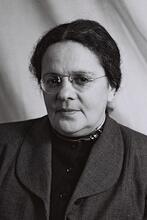
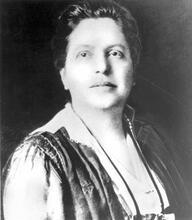
Rachel Kagan (Cohen)

Courtesy of WIZO Archives, Tel Aviv.
One of two women to sign the Israeli Declaration of Independence, Rachel Kagan shaped women’s rights in the new state. Raised in a Zionist family in Odessa, Kagan followed her husband to Palestine with their son in 1919. There she began working for the Histadrut Nashim Ivriot (HNI), a women’s labor organization, and co-founded child welfare centers. Kagan was elected head of the Agency for Jewish Social Welfare in Haifa and in 1946 became the National Council’s head of Social Welfare. She was elected to the first Knesset, where she initiated the Law of Equality for Women. Over the years, she lobbied for women’s rights to divorce, women’s rights to serve in combat units, and protections for disadvantaged children.
EARLY LIFE AND WORK
field_section_text_value

Upon the establishment of the State, she served as a member of the Provisional Government and in 1949 was elected to the First Lit. "assembly." The 120-member parliament of the State of Israel.Knesset of the State of Israel as the leading candidate submitted by WIZO/Union of Hebrew Women for Equal Rights in Erez Israel. When WIZO voted to discontinue the practice of submitting their own women’s party list to the national elections Rachel Kagan left the Knesset to serve as chairperson of WIZO Israel, a post which she occupied from 1951 to 1961. She was then elected to the Fifth Knesset as a representative of the Liberal Party.
EQUAL RIGHTS FOR WOMEN
Kagan’s Lit. "assembly." The 120-member parliament of the State of Israel.Knesset career was studded with important legislative achievements and contributions. As a member of the First Knesset, she initiated deliberation in 1951 on the Law of Family and the Equality of Women, a very detailed bill dealing with the broad issues of equality of the sexes in society and in the family. Kagan took on this task with much enthusiasm and no small measure of humor: former Justice Minister Pinhas Rosen recalled that when Rachel Kagan stood up in the Knesset to speak about Equal Rights for Women, “she did not pass up the opportunity to remark with a mischievous smile that she also supported Equal Rights for Men.” Although her comprehensive Bill was not adopted in its entirety, the Knesset did pass a Law of Equality for Women and several years later, in 1973, passed the Law of Common Property, based on Kagan’s bill of 1951.
Throughout her Knesset career, Kagan fought tirelessly for women’s rights, submitting proposals for a minimum sentence for wife-beaters and urging for a solution to the problem of Woman who cannot remarry, either because her husband cannot or will not give her a divorce (get) or because, in his absence, it is unknown whether he is still alive.agunot. Kagan evinced an unswerving faith in the potential of women to shape and influence public life. Although she maintained that one must indeed recognize the biological differences between men and women, recognition need not make one beholden to old notions of women’s proper sphere. From her early days as a WIZO member Kagan felt that the role of a women’s organization was to “emancipate the woman from her passive attitude to public life—to bring home to her the significance and the importance of the right to vote which had been afforded to her; [and] to explain to her the magnitude of her task in forging enlightened public opinion.”
“AN OBLIGATION TO FIGHT”
As an advocate for women’s rights, Kagan was ready and willing to adopt iconoclastic positions. Concerning women’s service in the IDF, Kagan felt that there was no reason why women who were physically able and willing should not be allowed to do combat, an issue which is still a subject of controversy. Against great opposition, she defended the need for a women’s party presence in the First Lit. "assembly." The 120-member parliament of the State of Israel.Knesset. “Do we not have what to protect?” she asked. “In theory, there may be equality of the sexes, but in practice, we women do not have a prerogative, we have an obligation to fight on behalf of our interests.” Since women were being widely encouraged to have more children in order to boost the Jewish birth rate, Kagan raised her voice on behalf of needy mothers. “It is our responsibility as women,” she wrote, “to pressure the government to give aid to families so that an increased birth-rate does not lead to the enslavement of the women.”
BROAD RANGE OF CONCERNS
Kagan’s contributions to Israeli politics and social welfare were not limited to the sphere of women’s issues. Her range of concerns was broad and her powers of empathy, formidable. Municipal leader Shmuel Bialik recalled a visit that he made with Rachel Kagan to a Haifa nursery, where they found young children resting on the floor on thin mats. “Tell me, Mr. Bialik,” she said, “how can I sleep on my soft bed when they are resting on hard ground?”—a comment which led to the purchase of proper mattresses for the nursery. When the Black Panther Movement began to rise as a force in the economically depressed sectors of the country, Kagan was responsible for encouraging the establishment for the Building of the Social Gap Committee, which eventually became The Family and Social Welfare Department. She helped establish the WIZO Mobile Library, which brings books in nine languages to seventy remote settlements in Israel, as well as the WIZO Legal Advice Bureau on Family Matters. Under WIZO auspices, she also helped institute an organization for consumer rights. In her later years, as honorary President of WIZO, she became extremely involved in issues concerning the elderly, working among other projects for the establishment of the The Friendship Fund for needy WIZO veterans.
Blessed with uncommon vitality, an endless reservoir of energy and—not least important—an excellent sense of humor, Rachel Kagan remained productive and active until her 90s, commuting from Haifa to Tel Aviv and Jerusalem to attend WIZO Executive meetings and pursue her good works. When she arrived in Tel Aviv from Haifa on days of heatwave or rainstorm, WIZO Israel chairperson Shula Braude would welcome her with an appreciative greeting of “Kol ha-Kavod Lakh” (All power to you) to which Rachel would wryly respond, “Shula, what do you think, that I walked here?” Asked once what was the secret behind her tremendous working capacity, she said, “Actually, I have only two talents: I know how to relax—reading a book, listening to music, taking a walk; and I have a positive genius for sleep.”
HERE IS A ZIONIST
field_section_text_value
Simmons Levin, Leah. “Setting the Agenda: The Impact of the 1977 Israel Women’s Party.” Israel Studies, vol. 4, no. 2 (Fall 1999): 40–63.
More Like This


Double your impact to amplify Jewish women’s stories—
All gifts matched up to $35,000
Before you close this article, please consider supporting the Jewish Women’s Archive and uplifting Jewish women’s voices.
At JWA, we preserve the voices of Jewish women and gender-expansive people past and present, share them freely with millions online, and empower a new generation of Jewish feminists to lead with courage, creativity, and conviction.
But none of this happens without you. JWA is an independent nonprofit— we rely on people, like you, who believe that history belongs to all of us and that the voices of Jewish women must remain powerful, and heard.
This month, a generous JWA board member will match every gift dollar for dollar—up to $35,000—through June 30. Your contribution goes twice as far right now.
Every contribution—no matter the size—helps us document, teach, and inspire through Jewish women’s stories.
It takes less than a minute to make a difference.
Thank you for being a part of the JWA community,

Judith Rosenbaum, CEO