

Shulamit Aloni

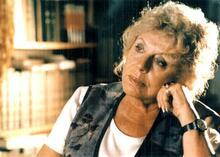
Passionate, principled, provocative, and above all path breaking, Shulamit Aloni (shown here in 2001) has dedicated her life to transforming Israel into an open, just and liberal society based on human dignity, tolerance for diversity and equality. Since the 1950s, she has been a major player in the struggle for progressive stances on human rights, civil rights, religious pluralism, the status of women and Israeli-Palestinian relations.
Photographer: Yizhak Elhadar, "Scoop 80"
Institution: Shulamit Aloni
Born in Poland, Shulamit Aloni grew up in Tel Aviv and from an early age asserted her independence of thought and spirit. She received a teaching certificate just before Israel's independence in 1948. Following the war, she started teaching, hosted radio shows, earned a law degree, and become a champion of individual rights, women's rights, and religious freedom. In 1970, after one term as a member of the Knesset on behalf of Alignment (now the Labor party), she established her own political party (Ratz, which later became Meretz)—a progressive party dedicated to combatting discrimination and religious coercion, protecting civil liberties, and promoting peace. She was instrumental in changing the public agenda and discourse, leaving a legacy of humanism and commitment to the development of a just society in an Israel at peace with its neighbors.
field_section_text_value
Family and Education
field_section_text_value
Campaigner for Civil Rights
During the 1950s, the young Shula began to focus on what was to become her life-long pursuit: civil rights. She pioneered the introduction of citizenship studies into the school curriculum (under the rather awkward title “Procedures of Government and Jurisprudence”). Her book, The Citizen and His Country, first published in 1958, went through ten editions and became the standard text for generations of Israeli secondary school students. In 1957 she launched her journalistic career, hosting the popular radio program “Outside Office Hours.” An on-air citizens’ rights bureau, the program provided individuals with an opportunity to voice their grievances against official misconduct and foot-dragging and to demand restitution, an idea that Aloni later developed in 1965, after her election to the Knesset, into the office of the Government Ombudsman. She also designed a special radio show for women: “Know the Law” (Hakiri et ha-Hok). Becoming a regular columnist for Yediot Aharonot (the country’s leading daily) and the weekly women’s magazine, La-Isha, she developed a reputation as an articulate and relentless campaigner for people’s rights.
Election to the Knesset
By the early 1960s, Shulamit Aloni had gained the attention of the Mapai hierarchy, which decided to place her on the party slate for the 1965 parliamentary elections. In her first term in the Knesset, the only one during which she served as a Labor Party, then called the Alignment, deputy, she began her persistent efforts to create a constitution for Israel that would include a bill of rights guaranteeing basic human freedoms. To promote these objectives, as a member of the Constitution, Law and Justice Committee (on which she served throughout her extended parliamentary career, which spanned seven terms and 27 years), she formed and chaired the Basic Laws Committee in 1965. In her first term in office, while the country was still almost completely preoccupied with defense and economic development, Shula founded the Israel Consumer Council, which she headed during its formative years (1966–1970), and solidified her social-democratic agenda.
Shulamit Aloni’s fierce independence and sharp tongue did not sit well with her Labor party colleagues. She quickly fell out with Golda Meir, then the party’s secretary-general, who accused her of peddling an Israeli form of “liberal bourgeois egoism.” When Aloni, as was her wont, lashed back, Golda told her that in the Labor party “we don’t know what ‘I think’ means, we only know what ‘we’ think,” to which Shula responded, “I don't know what you think, but I do know what I think.” By the time the 1969 elections rolled around, in the heady years after Israel’s victory in the Six Day War, the two women who symbolized more than anyone else the old and new Israel were not on speaking terms. Aloni was unceremoniously dropped from the Labor party list.
Shula was not idle during her four years outside the Knesset. She set up the Bureau for Civil Rights, which dispensed legal aid and advice to citizens from all walks of life. Frequently called upon to help people, especially women, facing discrimination in the rabbinical courts, in 1970 she began organizing contractual civil marriages and encouraged couples wishing to bypass the orthodox monopoly on personal law to explore marriage possibilities outside the country. She fast became the foremost spokesperson in the struggle against religious coercion. Her book, The Arrangement: From a State of Law to a State of Religion, published in 1970, set the tone for the still ongoing campaign for religious pluralism in the country.
Ratz: Civil Rights and Peace Movement
field_section_text_value
Later Life and Honors
Aloni, however, never left the public arena during her lifetime. She continued to speak out—even more pointedly than in the past—primarily against Israeli violations of Palestinian human rights and for a just two-state solution. She remained a leading voice in the quest for the separation of religion and state in Israel. She carried immense cachet, justifiably, in feminist circles. And she was uncompromising in her ongoing effort to equip Israeli citizens with a Bill of Rights. Increasingly concerned with the headway made by messianic and ultra-nationalist elements in Israeli society and frustrated by what she considered to be the lack of backbone of her successors, during her waning years Shula became, if possible, an even more acerbic critic of the direction of Israel's trajectory after the collapse of the Oslo process and the outbreak of the second intifada in 2000.
After 1996 Shulamit Aloni also gave courses at Ben-Gurion University, Tel Aviv University, Princeton University, the Interdisciplinary Center in Herzliya, and the Academic College of Tel Aviv-Yafo. Until shortly before her death, she continued to play tennis, attend the opening nights of most new productions, travel widely throughout the world, write extensively in the Israel press, and appear regularly on radio and television, providing the most lucid voice in Israel for human rights, social justice, and civil liberty
Shulamit Aloni's achievements were widely recognized in Israel and abroad. She was the recipient of the Kreisky Prize for Human Rights (1985), the Decoration of Honor from the International Academy of Humanism (1996), the Certificate of Honor of the Association for Civil Rights in Israel (1998), and the Israel Prize for her lifetime contribution to Israeli society (2000). She was awarded honorary doctorates by Hebrew Union College (1991), Konkun University in South Korea (1994), the Free University of Brussels (1997), the Weizmann Institute of Science (1999), Ben-Gurion University in the Negev (2000), and Haifa University (2013).
Shulamit Aloni passed away on January 24, 2014, at the age of 86 in her home in Kfar Shmaryahu.
Selected Works
In Hebrew
The Citizen and His Country. Tel Aviv: Ma'arachot, 1958.
Children’s Rights in Israeli Law. Tel Aviv: Culture and Education, 1964.
The Arrangement: From a State of Law to a State of Religion. Tel Aviv: Otpaz, 1970.
Women as Human Beings. Jerusalem: Mabat, 1976.
With Idit Zertal. I Can Do No Other (Ani Lo Yekhola Aheret): A Political Biography of Shulamit Aloni. Or Yehuda: Ma'ariv-Hed Artzi, 1997.
Democracy in Shackles (Democratia Be'azikim), Tel Aviv: Am Oved, 2008.
More on Shulamit Aloni




Double your impact to amplify Jewish women’s stories—
All gifts matched up to $35,000
Before you close this article, please consider supporting the Jewish Women’s Archive and uplifting Jewish women’s voices.
At JWA, we preserve the voices of Jewish women and gender-expansive people past and present, share them freely with millions online, and empower a new generation of Jewish feminists to lead with courage, creativity, and conviction.
But none of this happens without you. JWA is an independent nonprofit— we rely on people, like you, who believe that history belongs to all of us and that the voices of Jewish women must remain powerful, and heard.
This month, a generous JWA board member will match every gift dollar for dollar—up to $35,000—through June 30. Your contribution goes twice as far right now.
Every contribution—no matter the size—helps us document, teach, and inspire through Jewish women’s stories.
It takes less than a minute to make a difference.
Thank you for being a part of the JWA community,
Judith Rosenbaum, CEO

