
Rose Luria Halprin

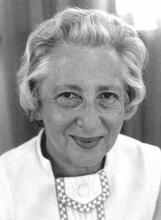
Rose Luria Halprin helped lead Zionist organizations through the tumultuous period of Israeli independence and helped shape international opinions of Zionism. Halprin served as national president of Hadassah from 1932 to 1934 before moving to Jerusalem, where she helped build the Hadassah Medical Organization’s new hospital. After returning to the United States in 1939, she joined the Zionist General Council, became a founding member of the secretariat of the American Jewish Conference in 1943, and was elected an executive of the Jewish Agency in 1946. From 1947 to 1952 she served a second term as president of Hadassah. As a member of the Jewish Agency Executive, Halprin continued to fundraise and speak on behalf of Israel until her retirement in 1968.
Background
field_section_text_value
Time in Palestine
field_section_text_value
Career in American Zionism
Halprin returned to the United States in 1938 on a speaking tour, reporting to Americans on the conditions of Jewish life in Palestine. Despite the seriousness of tensions between Jews and Arabs, she argued that cooperation between the groups was vital and would help to rid Palestine of its economic problems. Halprin blamed the British mandatory government for the Arab riots, citing its failure to live up to promises made in the Balfour Declaration, and for alternately favoring Arab and Jewish interests according to political expediency.
Halprin returned permanently to the United States in 1939, but her experience in Palestine led to her increasing involvement in international Zionist affairs. From 1939 to 1946, and occasionally thereafter, she was a member of the Zionist General Council, the supreme advisory and supervising institution of the Zionist movement. In 1942, she became treasurer of the American Zionist Emergency Council and served as its vice-chair from 1945 to 1947. She was one of the original members of the secretariat of the American Jewish Conference, which was founded in 1943 to coordinate American efforts on behalf of Palestine. In 1946, she was elected to the executive of the Jewish Agency, a post she held for over twenty years.
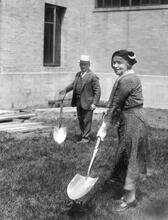
Halprin faced her most dramatic leadership challenges, however, during her second term as Hadassah president between 1947 and 1952. A tremendous blow came to Hadassah’s efforts in Palestine when more than seventy-five doctors, nurses, and students were killed in an ambush as their convoy passed through the Arab neighborhood of Sheikh Jarrah on its way to Mount Scopus. The attack underscored the hospital’s vulnerable position surrounded by Arab-held territory, and the complex was evacuated. Under Halprin’s leadership, five temporary facilities were set up in Jerusalem to deal with the urgent medical needs resulting from the War of Independence. Meanwhile, the Medical Organization continued to grow during her presidency, with the establishment of the Hebrew University–Hadassah Medical School in 1949, and the breaking of ground for a new permanent Hadassah Hospital at Ein Karem in 1952.
In addition to her involvement with Hadassah, Halprin played a pivotal role during the struggle for Israel’s independence as a member of the American Section of the Jewish Agency, which was charged with arguing for the establishment of the State of Israel before the United Nations. She participated in negotiations that led to the acceptance of the Partition Plan in 1947. Later, when fear of bloodshed caused the United States to recommend a delay of statehood and a temporary “trusteeship” over Palestine, Halprin was one of four members of the Zionist General Council who brought word from Jerusalem that Jewish officials were determined to bring the new state into existence as planned. After independence, she continued to serve on the Jewish Agency executive, and was asked by Finance Minister Eliezer Kaplan to head an international effort to raise the funds necessary for Israel to absorb the streams of new immigrants entering the country. From 1956 to 1963, and intermittently until 1968, she headed the American Section, first as acting chair and, after 1960, as chair.
In her work for the Jewish Agency and its parent body, the Zionist General Council, Halprin always stressed the mutual reliance of Israel and American Jewry. Much in line with the founding principles of Hadassah, she saw the State of Israel as embodying American ideals of justice and equality, while serving as a source of spiritual and cultural renewal for American Jews. Thus Halprin insisted on an involvement for American Jews in Israel that went beyond philanthropy, and demanded recognition for such a role from the Israelis. As she admonished the Zionist General Council in 1953, “As long as you look on America only as a potential something or other for Israel, you will not help us, and if you do not help us, you will lose Jewish life in its strength and its numbers.”
Known for her wit and public-speaking skills, she was at home in the often fierce world of Zionist politics. “She never gave up the right to be heard,” recalled Bernice Tannenbaum, one of Halprin’s successors in the Hadassah presidency, “and such was her power of persuasion that she usually carried you along her road whether you willed it or not.” In her later years, an incident that drew strong comment from Halprin was the United Nations 1975 resolution equating Zionism with racism. Although a seasoned international negotiator, she instructed Hadassah members that the most appropriate response was not to protest through diplomatic channels, but to articulate their own definition of Zionism more forcefully through the work they did. Her strong personal qualities and organizational abilities made her perhaps the most revered Hadassah leader since Henrietta Szold.
Rose Luria Halprin died on January 8, 1978.
Cohen, Naomi W. American Jews and the Zionist Idea (1975).
Freund-Rosenthal, Miriam, ed. A Tapestry of Hadassah Memories (1994).
Haber, Julius. The Odyssey of an American Zionist (1956); Hadassah Magazine (February 1978): 9
Halprin, Rose. Oral history interview with Judith Epstein, and Papers. Hadassah Archives, NYC.
Obituary. NYTimes, January 9, 1978, IV 7:3.
More Like This

Double your impact to amplify Jewish women’s stories—
All gifts matched up to $35,000
Before you close this article, please consider supporting the Jewish Women’s Archive and uplifting Jewish women’s voices.
At JWA, we preserve the voices of Jewish women and gender-expansive people past and present, share them freely with millions online, and empower a new generation of Jewish feminists to lead with courage, creativity, and conviction.
But none of this happens without you. JWA is an independent nonprofit— we rely on people, like you, who believe that history belongs to all of us and that the voices of Jewish women must remain powerful, and heard.
This month, a generous JWA board member will match every gift dollar for dollar—up to $35,000—through June 30. Your contribution goes twice as far right now.
Every contribution—no matter the size—helps us document, teach, and inspire through Jewish women’s stories.
It takes less than a minute to make a difference.
Thank you for being a part of the JWA community,
Judith Rosenbaum, CEO