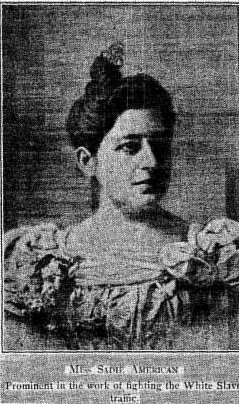
Sadie American

Sadie American was a driving force behind the National Council of Jewish Women.
Courtesy of Project Gutenberg
Sadie American shaped the National Council of Jewish Women for more than twenty years before resigning and severing all ties with the organization. In 1891, American joined the organizing committee for the Jewish Women’s Congress, where she called for the creation of the National Council of Jewish Women. First elected NCJW’s corresponding secretary, she became executive secretary and eventually acted as executive director and national and international spokesperson. Under American, the NCJW greatly expanded its reach, focusing its mandate on social welfare and philanthropy. Over time, American’s strong personality and controversial opinions created tensions, so she resigned in 1914 rather than have her authority severely limited. In addition to her NCJW work, American took on leadership roles for a number of local Jewish and civic organizations.
field_section_text_value
Early life and the National Council of Jewish Women
field_section_text_value
Other reform work
But the National Council of Jewish Women was not American’s only commitment. In the Jewish community, she became a club leader at the newly established Maxwell Street Settlement, working with young Eastern European Jewish immigrants, and she began to teach Sunday school at her own congregation, Sinai Temple. In the wider community, she became a member of the Women’s Club of Chicago and eventually chair of its committee on permanent vacation schools and playgrounds. She wrote two papers based on her research. She was also a vice president and director of the Illinois Consumers’ League, and president of Chicago’s League for Religious Fellowship. In short, her involvement in the National Council of Jewish Women represented only a small part of her commitment to furthering the progressive social reforms of the late nineteenth and early twentieth centuries.
For the twenty-three years she was active in the council, American was a forceful, articulate spokesperson on behalf of the organization. The minutes of the triennial conventions, beginning in 1896, reveal the depth of her influence. She reported at length on her efforts to organize sections, told of the extensive correspondence she engaged in with Jewish women around the country as groups sought to become council affiliates, and detailed the statistics that showed the growing membership. All of these activities revealed her dedication to the council’s success. For many Jewish women in the United States and Europe, she was the National Council of Jewish Women. On many occasions, she traveled both across the country and abroad to represent the council at other meetings of both Jewish and non-Jewish women’s organizations.
New York and a divergence from the NJCW
In the last half of 1900, American left Chicago and moved to New York City with her mother. Her father did not accompany them; by June 1900, he was a patient in the Eastern Illinois Hospital for the Insane in Kankakee. American was soon involved with the council’s New York section and became its president in 1902, a position she held until 1916. During her tenure as president, the New York section instituted immigrant aid programs that helped moved the national organization’s focus away from religion and into social welfare. As she had in Chicago, American devoted much of her time in New York to civic organizations.
As the years passed, however, American became a figure of controversy because of her opinions and her personality. She was first attacked for her support of Sunday Sabbath observance, but members still reelected her as corresponding secretary at the 1900 triennial convention. She then came under increasing criticism for her sometimes brusque manner and autocratic style. A growing number of council members felt that she had become a liability rather than an asset to the organization. But despite this opposition, American was reelected corresponding secretary at both the 1903 and 1905 triennial conventions and appointed executive secretary in 1905. She held the latter position until the 1914 convention in New Orleans, when she could no longer deflect the criticism of her actions and her manner. Rather than face a constitutional change that closely circumscribed the position of executive secretary, she resigned. She continued to serve as the New York section’s president until 1916, when her term ended and she was defeated for reelection.
Without American’s organizational skills and articulate advocacy of the National Council of Jewish Women’s purpose, the group would have disappeared in its infancy, as did many other women’s organizations early in the twentieth century. Sadie American passionately believed in the founding ideals of the council: that a group of Jewish women could come together to promote Jewish observance as well as social service. When the promotion of Jewish observance became too controversial, she helped council leaders to see that philanthropic service to the Jewish and non-Jewish communities would be the organization’s most important contribution to American life. She had a strength of personality that made many people uncomfortable, but it was this strength that enabled her to accomplish her life’s work.
Sadie American died in New York City on May 3, 1944.
AJYB 7 (1905–1906): 34–36, 24:115, 46:333.
American Hebrew (1893–1916).
American Jewess (1895–1898).
American, Sadie. Papers. National Association of Jewish Social Workers, American Jewish Historical Society, Waltham, Mass., and National Council of Jewish Women, Library of Congress, Washington, D.C..
Elwell, Ellen Sue Levi. “The Founding and Early Programs of the National Council of Jewish Women: Study and Practice as Jewish Women’s Religious Expression.” Ph.D. diss., Indiana University, 1982.
JE.
Obituary. NYTimes, May 4, 1944, 19:3.
Reform Advocate (1893–1901).
Rogow, Faith. Gone to Another Meeting: The National Council of Jewish Women, 1893–1993 (1993); UJE.
Double your impact to amplify Jewish women’s stories—
All gifts matched up to $35,000
Before you close this article, please consider supporting the Jewish Women’s Archive and uplifting Jewish women’s voices.
At JWA, we preserve the voices of Jewish women and gender-expansive people past and present, share them freely with millions online, and empower a new generation of Jewish feminists to lead with courage, creativity, and conviction.
But none of this happens without you. JWA is an independent nonprofit— we rely on people, like you, who believe that history belongs to all of us and that the voices of Jewish women must remain powerful, and heard.
This month, a generous JWA board member will match every gift dollar for dollar—up to $35,000—through June 30. Your contribution goes twice as far right now.
Every contribution—no matter the size—helps us document, teach, and inspire through Jewish women’s stories.
It takes less than a minute to make a difference.
Thank you for being a part of the JWA community,
Judith Rosenbaum, CEO