
Book Review: Cooking Jewish
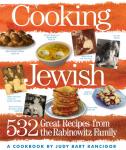 So the thing about getting married is that your precious bookshelf space, which you had reserved for brilliant novels written by brilliant writers, gets quickly engulfed by an ocean of cookbooks, which your mothers, aunts, and family friends are sure you'll just love.
Some of the books (which shall go unnamed to protect the innocence of cookbook author and beloved family member alike), will end up tucked into the uppermost kitchen cabinet where you'll find them on the occasion of your next move. For books like Cooking Jewish: 532 Great Recipes from the Rabinowitz Family by Judy Bart Kancigor, though, you might not mind displacing Love in the Time of Cholera or Portnoy's Complaint to the bookshelf in the living room.
What I love about Bart Kancigor's book (aside from the rugelach recipe, whose dough is made up entirely of cream cheese, butter, and flour!) is her sweeping notion of what makes up a family, and her inclusiveness (some might say permissiveness) when it comes to what it means to "cook Jewish". In creating this cookbook, Bart Kancigor solicited recipes not just from her aunts, siblings, and cousins, but also from best friends, mother-in-law's sisters, nieces' husbands' fathers, all of whom fit into her expansive, old-world idea of family, and all of whom share their stories as well. As I see it, a warmly told anecdote is the backbone of a Jewish family, and the stories of many of the contributors are as interesting as their food. Moreover, as recipes can serve as an expression of history, in many ways Bart Kancigor's project is one of heritage as much as it is about food. Check out our Go & Learn lesson plan about recipes.
As for the recipes themselves, there is a fair share of traditional Jewish cooking. In addition to the rugelach (there is a second rugelach recipe involving yeast that I haven't had time to try yet), classic Ashkenazi foods like stuffed cabbage, brisket, and potato kugel show up in the book, often with multiple variation. From extended family members who are Sephardic or from a diversity of food cultures, we get recipes like Moroccan Lamb Tagine, Cuban Arroz con Pollo, and South African "Bobotie," a traditional meat pie. More contemporary (and occasionally more, let's say, "experimental") recipes appear here too, most notably a Cherry Chili Chicken, which looks like a show-stopper.
To be fair, some of the recipes are what my mother would call a "patchky," and when they call for both vegetable shortening and butter I'd be lying if I said I didn't just put in a whole hunk of margarine, but if in this season of weddings, you feel compelled to buy a cookbook for a blushing bride, this is a smart choice. To read more about Judy Bart Kancigor's food heritage project, visit her website: www.cookingjewish.com
Double your impact to amplify Jewish women’s stories—
All gifts matched up to $35,000
Before you close this article, please consider supporting the Jewish Women’s Archive and uplifting Jewish women’s voices.
At JWA, we preserve the voices of Jewish women and gender-expansive people past and present, share them freely with millions online, and empower a new generation of Jewish feminists to lead with courage, creativity, and conviction.
But none of this happens without you. JWA is an independent nonprofit— we rely on people, like you, who believe that history belongs to all of us and that the voices of Jewish women must remain powerful, and heard.
This month, a generous JWA board member will match every gift dollar for dollar—up to $35,000—through June 30. Your contribution goes twice as far right now.
Every contribution—no matter the size—helps us document, teach, and inspire through Jewish women’s stories.
It takes less than a minute to make a difference.
Thank you for being a part of the JWA community,


Judith Rosenbaum, CEO