
Babies, Babies, Babies
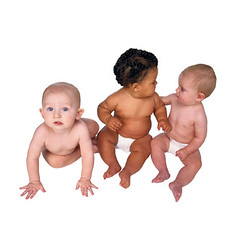 Maybe like me, some of you tried to escape last summer’s heat in the movie theater, where you were privileged to see (about 20,000 times) the music video “I Wanna Have Your babies” by Natasha Bedingfield. You know, the one with the really smart chorus that goes “babies, babies, babies, babies, etc.” I had all but forgotten about that song until recently, when the theme of so much Jewish buzz in the press and on the internet seems to share the offspring theme. And now I have to wonder, what is all the fuss about babies?
Two weeks ago, in reading the Tirtzah post “Think of the Children,” the guest blogger Rochel wrote of coming out to a friend:
“Think of the children,” she begged me. “Where will you send them for school? How will they feel to be the only frum kids with two mothers?” I read her emails to my partner and we laughed together about the absurdity of these questions. We had been dating just a few months, and this woman was talking about our children.
Last week, as we hopefully all saw, Jewish Women Watching put out their Shavuot action chastising the Jewish community for valuing women only as baby-incubators. And yesterday, Rebecca Hoenig Friedman (our illustrious The American Jewess contributor), commented on Jewess and the Lilith blog about this supposed “boy crisis” in liberal Judaism and the deep-seated fear that when Jewish men are disengaged, they are more likely to marry non-Jewish women who won’t know how to raise their babies in a Jewish household (a fear which both Friedman and I think is premature to say the least).
So three different angles on the baby question. What’s the obsession? Sure, Jewish continuity, yada, yada, yada. But it seems to run deeper than that, and I think that perhaps the reason has to do with the embarrassment of riches women of my generation, who are approaching baby-making age, have with regard to the choices we can make about marriage, career, and family. While for my mother’s baby boomer generation of feminists made enormous strides for women at home, at the doctor’s office and in the workplace, they probably couldn’t have conceived thirty years ago, of legal marriage for gays and lesbians, the advances in fertility that make it possible for women in their late 30s and 40s to get pregnant, and the expanding conversation about the balance for women between work and family, all of which complicate the questions: Who can have a baby? When? And What does it mean to opt out of the whole business? Which leaves us with these panicked messages about reproducing, and leaves me, at least, confused about where a young feminist fits into these discussions.
Maybe the central issue is that while women of my generation are made to think that the world is entirely our oyster, we can choose virtually any career we want (albeit with the continuing fight for equal wages), we can have children or not, we can love whomever we choose, those choices are somewhat artificial because the traditional social expectations of womanhood remain peeking over our shoulders, pushing us into corners. And of course, the icon of traditional womanhood is not the woman herself, but the baby.
Double your impact to amplify Jewish women’s stories—
All gifts matched up to $35,000
Before you close this article, please consider supporting the Jewish Women’s Archive and uplifting Jewish women’s voices.
At JWA, we preserve the voices of Jewish women and gender-expansive people past and present, share them freely with millions online, and empower a new generation of Jewish feminists to lead with courage, creativity, and conviction.
But none of this happens without you. JWA is an independent nonprofit— we rely on people, like you, who believe that history belongs to all of us and that the voices of Jewish women must remain powerful, and heard.
This month, a generous JWA board member will match every gift dollar for dollar—up to $35,000—through June 30. Your contribution goes twice as far right now.
Every contribution—no matter the size—helps us document, teach, and inspire through Jewish women’s stories.
It takes less than a minute to make a difference.
Thank you for being a part of the JWA community,
Judith Rosenbaum, CEO