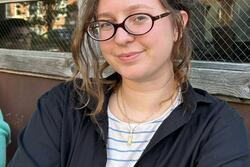
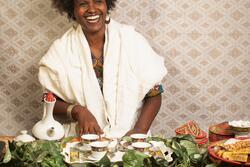
7 Questions for Animator Maya Erdelyi


Maya Erdelyi is an award-winning animator and artist whose works span experimental animation, installation, drawing, printmaking, and collaborative experiments. Her work has been shown in national and international film festivals, galleries, museums, libraries, and DIY venues, including Lincoln Center, MFA Boston, the Ann Arbor Film Festival, the Museum of Modern Art, Harvard Film Archives, Animation Block Party, and Boston Center for the Arts, among others. JWA sat down with Erdelyi to discuss her career and recent animated short film, Anyuka, which traces the life of her Holocaust-survivor grandmother.
Emma Breitman: How did you first get involved in animation?
Maya Erdelyi: I came to animation by surprise. At 25, while pursuing a graduate degree in Arts-in-Education at Harvard, I took an animation class on a whim. I was lucky enough to study with renowned British animator Ruth Lingford. That class changed everything—radically transforming the direction and trajectory of my art practice.
Before animation, I was rooted in the fine arts. I studied painting and printmaking at LaGuardia High School, Cooper Union, and Hunter College in New York City. I worked in charcoal, ink, paint, and later 16 mm film. Creating animation had never crossed my mind; I hadn’t yet seen how deeply personal or artistically singular the medium could be. After years of structured fine arts training, animation felt like a release. I was a beginner again, and making art felt fun, playful, sometimes truly magical. Animation brought all of my interests together: story, memory, design, sound, dreams, and the pleasure of expressing the ineffable. This fascination eventually led me to the Experimental Animation MFA program at CalArts. Since then, I have continued to explore and push the medium of animation, experimenting and expanding my interdisciplinary practice.
EB: What does being Jewish mean to you?
ME: In a nutshell, I come from a Colombian (Catholic/spiritual) and Hungarian-Jewish heritage. I’m a first-generation American, born and raised in New York City (Forest Hills, Queens). I grew up with a lot of Jewish culture around me (and food of course!), and lots of Jewish friends. I even went to a Jewish Y for after-school and did Shabbat with grape juice every Friday. I was also going to church on Sundays, celebrated Christian holidays, and was even in a church choir for many years. I was raised by parents from very different worlds and countries. My father, an experimental psychologist, professor emerita, and writer, is also a Holocaust survivor from Budapest, Hungary. He escaped Hungary with my Grandmother in 1949 after surviving WW2 by going into hiding. My mother is a poet and writer, and professor emerita, born in the tropics of Barranquilla, Colombia. She came from a catholic and spiritual background. All that to say, I was not raised going to temple. I was raised by a very Jew-ish grandmother who happened to be a devout Christian. No joke :)
She always held this dual identity—Christian and Jewish (she was raised going to Hebrew School and Sunday School). My grandmother was very warm, very curious (asked you a million questions), wrote me very long letters, always fed me delicious food, the list goes on. All that to say, I feel Jew-ish, but it's not my whole identity (although the Ashkenazi Jewish diaspora is literally 50% of my DNA according to a test I took). I feel close to Jewish people, Jewish humor, and Jewish traditions (I love celebrating the Sabbath when I can, Passover, and Rosh Hashanah). I feel very close to Holocaust survivors and their children and grandchildren (my Hungarian grandfather–a writer–was killed in Auschwitz). I also identify with Buddhist, Shamanist, Taoist, Shinto, and Christian traditions. I love Jewish culture with all its stinky fish, bagels, self-deprecating humor, questions, rituals, warm people, being super inquisitive, and a love of a good brisket. It’s complicated! Ultimately, I see myself as a true hybrid of these cultures and appreciate all the complex facets.
EB: You also teach animation at the School of the Museum of Fine Arts at Tufts University. What advice do you have for aspiring animators?
ME: Yes, I've been teaching at SMFA for about 10 years now. I'll be teaching an Experimental Animation class at Emerson College this coming Spring as well. I have also taught at RISD, Pratt, MassArt, Lesley, and workshops and talks all over. My advice for students is to follow their curiosity. To push themselves to try new things, new ways of working. To enjoy the magic of animating. I’m a big fan of the artist and educator Corita Kent, and I usually share her "10 Art Department Rules.”
Here are two I love:
RULE ONE: Find a place you trust, and then try trusting it for a while.
RULE SIX: Nothing is a mistake. There’s no win and no fail, there’s only make.
I also suggest taking an entertainment law class or a business class, as you accidentally become a business person if you keep working in the field. LOL. Stay close to mentors and professors as you progress and move on in the world. Their real-world knowledge and advice are invaluable.

EB: Your short film, Anyuka, explores the experience of your grandmother who survived the Holocaust. How did you decide to make this piece of work?
ME: I grew up very close to my grandmother (emotionally and geographically)—she lived a few blocks away from us in Queens, where I grew up. I always say that she was my third parent. She was truly invested in me, always curious, caring, warm, and she truly wanted the best for me. Apparently, she used to tell my Dad that I was one of her soul mates. When I was ten years old, she published her novel “On Whom I Have Mercy”—a fictionalized account of her life, focusing on the time of her and my father’s survival during the Holocaust and WWII. I grew up with her story. I was fascinated and amazed by her. What she had gone through. The strength she had. How did she bear it all?
I had tried to work with her story in different iterations as I moved through my life as an artist. Earlier versions were done in silkscreen and a small graphic novella that I illustrated. It wasn’t until many years later, in the Fall of 2014, just after she had passed away at the age of 95, that I came back to her life story. I had just moved to Boston to teach animation. I was grieving her, and remembered that somewhere my Dad had a big tupperware of Super 8 films that my grandparents had filmed over many decades. I ended up spending many hours in the basement of School of the Museum of Fine Arts watching these Super 8 films on an old projector. I was amazed by the footage; it was gold to me. These incredible memories, luscious color, and this incredible warmth felt between my grandparents on the film footage. It was the Super 8 footage that compelled me to begin editing a film together. I thought I could do it in one year. It took me nine years.
I came across so many other materials. Photos, typed letters, old mortgage papers, passports (across countries and decades), cookbooks, her gorgeous linens, her memoir, and her writings. There were also the audio archives that came from the Fortuneoff Holocaust Archives at Yale (6 ½ hours of her testimony), along with interviews I did with my Dad. When I talk about the process, I sort of joke that I was a chef who was given incredible ingredients to cook with. I just had to get in there and cook the film.
Erdelyi's work can be found on her website or on Instagram.

EB: Anyuka features lots of vibrant colors and playful textures. How did you decide on this creative direction, given the heaviness of the topic?
ME: Finding my voice/aesthetic in the film was probably the hardest thing. I imagine many films that deal with the Holocaust do not look like my film. I tried many iterations (there was a whole grayish-blue scene that was rotoscoped from actors I had hired to reenact the border crossing). Once I animated it, the rotoscoping just didn’t look or feel right. I completely scrapped those months of work. Once I figured out the film was a collage, then I could somehow let loose and get free.
Newly working in monoprint also took the film in a whole new direction. It brought texture, grittiness, and new techniques for me to play with. I brought my aesthetic to the borders, worked directly on film stock, created cut-paper flowers and collage elements, worked with paper puppets, and painted set pieces. It was almost like a visual scrapbook. Working with layers, building up. Bringing all the elements together in After-Effects. For the film to work for me, I had to bring in my own aesthetic, my colors, patterns, and maximalism. I had to find that right balance of my voice with her voice and my Dad’s as well, like symphonic layers and textures in music. Ultimately, I see this film as a multi-generational conversation and collage. Overlapping layers, colors, memories, a palimpsest.
EB: Anyuka was recently acquired by the Jewish Museum of NYC. What was it like to receive that news?
ME: That was incredible. It felt life-changing. It is now part of their permanent collection and will outlive me. What else could you ask for as a filmmaker? I’m extremely honored. My grandmother would have been so proud and amazed to see her story there. She also loved the Upper East Side and all the museums on 5th Avenue. NYC was her last hometown, and she loved it. I’m indebted to the museum for their care, thoughtfulness, and future archiving and preservation of the film. I would especially like to thank curators Liz Munsell and Rebecca Shaykin, who had the vision to champion and bring this film to the Jewish Museum. Also, the education department (shout out to Jamie Auriema and Kelsey King) for their engaging and thoughtful programming for students and adults around the film. It’s been wonderful to work with them. I hope for many more future workshops and connections.
Anyuka is now on exhibit at the Jewish Museum in NYC as part of their show: Identity, Culture, and Community: Stories from the Collection of the Jewish Museum and Pruzan Family Center for Learning.
I’m also super happy to announce that the film was acquired into the permanent collection of The Block Museum of Contemporary Art at Northwestern University. I am also in conversation with one other incredible museum about acquisition as well. Fingers crossed it works out!

EB: What's next for you?
ME: Lots of different things are cooking. I have a solo show in May at Farm Projects, a gallery and project space in Wellfleet, Massachusetts, on the Cape. For this show, I’m experimenting with new monoprints and potentially a ceramic project utilizing an obscure stop-motion technique called “strata-cut,” in which you cut slices off clay to animate the cut sections. I’ll be making a version of this in ceramic clay. Let’s see how this experiment goes!
I also have a long-lost animation project that was put on the back burner due to the pandemic (and having a newborn!). I am returning to this project and trying to finish the pilot episode in the next few months. I am lucky to have an intern and some great friends helping me get to the finish line for this. Stay tuned! It’s a kids’ animation show where we meet animators at their studio and also do a small project together. My log line is: “Art 21 meets Pee Wee’s Playhouse.”
I also have two new animated short ideas I am in super early phases on. I am also a mother to a very amazing daughter and little artist, Paloma (she is 6 now), who keeps me very busy! I continue to screen Anyuka and do artist talks around that film.
You can watch Anyuka on PBS Passport, where it is currently streaming.
Double your impact to amplify Jewish women’s stories—
All gifts matched up to $35,000
Before you close this article, please consider supporting the Jewish Women’s Archive and uplifting Jewish women’s voices.
At JWA, we preserve the voices of Jewish women and gender-expansive people past and present, share them freely with millions online, and empower a new generation of Jewish feminists to lead with courage, creativity, and conviction.
But none of this happens without you. JWA is an independent nonprofit— we rely on people, like you, who believe that history belongs to all of us and that the voices of Jewish women must remain powerful, and heard.
This month, a generous JWA board member will match every gift dollar for dollar—up to $35,000—through June 30. Your contribution goes twice as far right now.
Every contribution—no matter the size—helps us document, teach, and inspire through Jewish women’s stories.
It takes less than a minute to make a difference.
Thank you for being a part of the JWA community,
Judith Rosenbaum, CEO