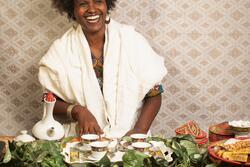
7 Questions for Amy Dell of Sababa Foods


Amy Dell comes from a line of culinary creatives. Her father, Haim Dadi, is the chef and owner of the NYC restaurant, Mr. Broadway, and her husband, Jake, is a third-generation owner of Katz's Deli. Now, she's paving her own path in the culinary world with her Middle Eastern food company, Sababa Foods. JWA sat down with Dell to discuss her journey into cuisine and her food-rich upbringing.
Emma Breitman: How did your family’s history motivate you to create Sababa Foods?
Amy Dell: My father is from Israel, and my grandparents are from Morocco and Tunisia, so I was inspired to create a product that is rooted in that history and culture. Growing up, my father was a restaurant owner and chef, and I was always really passionate about cooking, so food has always been a big part of my life. I was really excited to create a product that honored the traditions of my family (as well as their history). I love being able to share that background and introduce people to flavors that are often underrepresented in grocery stores.
EB: Sababa Foods is known for “Saturday Sauce.” How did you land on that particular recipe?
AD: Saturday Sauce is inspired by something that I grew up eating—my father would always make vats of matbucha for the refrigerator and the freezer, which would be used in everything from Moroccan fish on Fridays to shakshuka on the weekend, or as a dip on the table. I updated his recipe (subbing extra virgin olive oil for canola oil and using mostly organic ingredients) to tailor the product to today’s more health-conscious customers. I decided to call it Saturday Sauce as an ode to the Italian-American “Sunday Sauce,” playing on the idea of a slow-cooked, versatile sauce that’s central to family meals.
EB: How does your Jewish identity interact with your culinary practice?
AD: Shabbat dinners and Jewish holiday meals were always a huge part of my upbringing, and cooking was always at the heart of those moments. So much of my identity is rooted in Jewish culture and tradition, which naturally goes hand-in-hand with food. I love that the preparation and rituals involved in these meals create a sense of togetherness, presence, and connection (which, to me, is what Judaism is rooted in).
EB: How did you decide on the name “Sababa Foods?”
AD: I’ve always loved the word sababa. It’s a feel-good, catchall word that means something like “great,” “everything is good,” or “okay” (kind of like hakuna matata). In Hebrew, you might ask someone how they’re doing, and they’ll say sababa, or you’ll tell them what time you’ll pick them up, and they’ll respond sababa. It’s such an easy, positive word, and I felt like it perfectly captured the laid-back, joyful energy I wanted for Sababa Foods. Plus, it’s fun to say.
EB: Was there a defining moment or moments that grew your love for food?
AD: Yes! I always think back to my childhood trips to Israel—arriving at restaurants and being greeted with 20+ small plates of salatim. I loved how you could mix and match different salads, creating endless combinations of flavors and textures. It was always my favorite part of the meal. Back at home, breakfasts were just as memorable. When my father would make breakfast, it would always be paired with things like olives, tuna, and endless salads, which weren’t typical of an American breakfast. On the other hand, my mother, whose family is from New Orleans, would sometimes make us beignets and grits for breakfast. Both of my parents are phenomenal cooks, so getting to taste everything they made was always exciting. I spent a lot of time in the kitchen with them, whether helping with everyday meals or tasting everything during holiday meal prep. Those experiences really nurtured my love of food and shaped the way I cook today.
EB: What types of culinary traditions excite or inspire you?
AD: I’m excited by culinary traditions that tell a story and connect cultures—whether it’s a Passover or Rosh Hashanah seder, or taking a traditional recipe and using it in a totally new and different way. I’ve had a lot of fun experimenting with how I can use my sauce in dishes outside of Middle Eastern cuisine, from chilaquiles to red lentil curry. It highlights how many cuisines have their own version of a dish, and it bridges so many cultures and traditions.
EB: Where can we find Sababa Foods?
AD: You can find Sababa Foods on our website, on Amazon, or in a store near you (30+ locations nationwide).
Double your impact to amplify Jewish women’s stories—
All gifts matched up to $35,000
Before you close this article, please consider supporting the Jewish Women’s Archive and uplifting Jewish women’s voices.
At JWA, we preserve the voices of Jewish women and gender-expansive people past and present, share them freely with millions online, and empower a new generation of Jewish feminists to lead with courage, creativity, and conviction.
But none of this happens without you. JWA is an independent nonprofit— we rely on people, like you, who believe that history belongs to all of us and that the voices of Jewish women must remain powerful, and heard.
This month, a generous JWA board member will match every gift dollar for dollar—up to $35,000—through June 30. Your contribution goes twice as far right now.
Every contribution—no matter the size—helps us document, teach, and inspire through Jewish women’s stories.
It takes less than a minute to make a difference.
Thank you for being a part of the JWA community,


Judith Rosenbaum, CEO