
10 Things You Should Know About Emma Lazarus


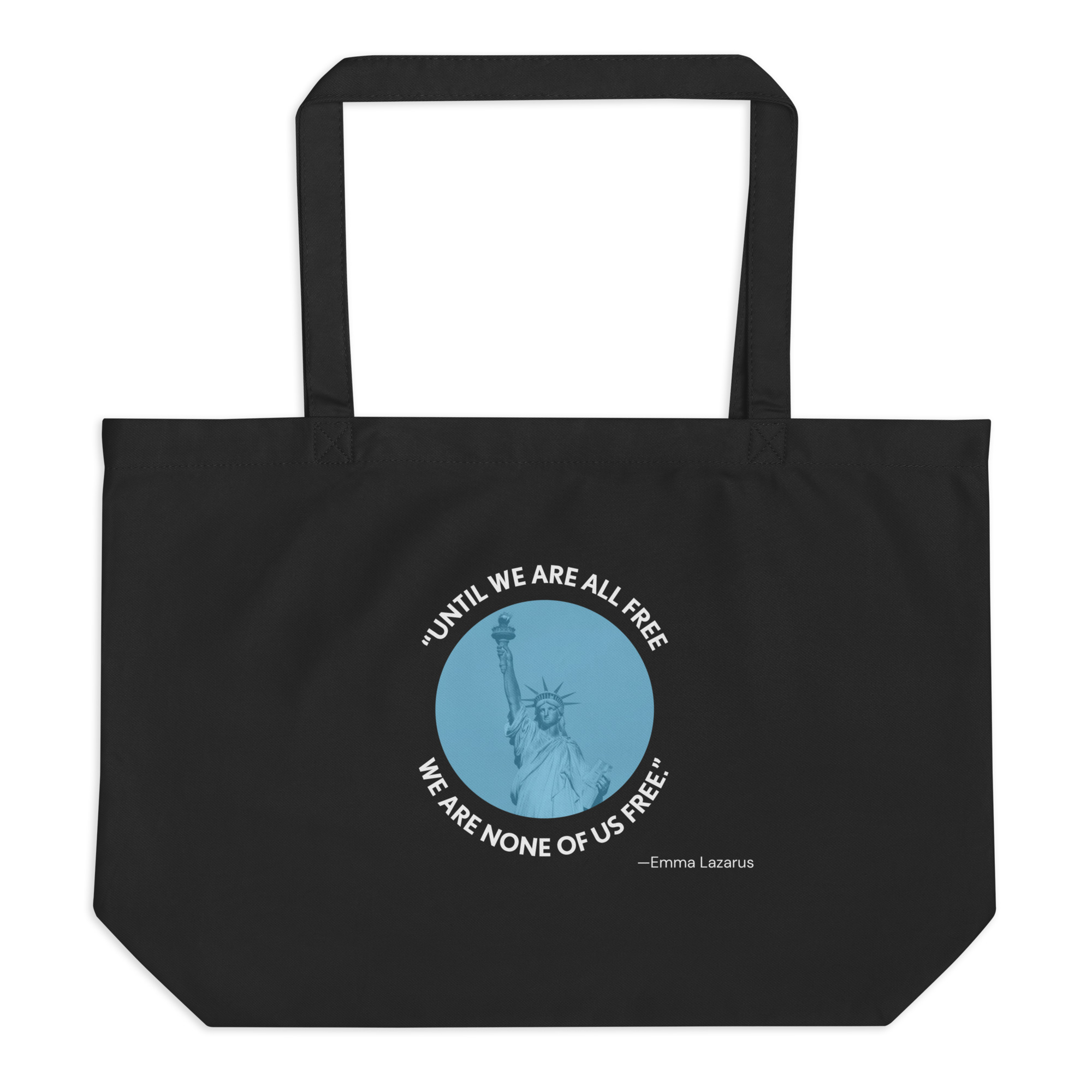
The Jewish Women's Archive Women of Valor posters portray the images, words, and life stories of 18 Jewish American women who challenged conventional expectations and helped change our world. The full-color posters (18″×24″) can be purchased as a set or separately. To order this poster or other posters from our Women of Valor poster series, please contact us with your request.
-
Emma Lazarus was born in 1849 to Moses and Esther Nathan Lazarus, descendants of the pioneering group of Spanish and Portuguese Jews who settled in New Amsterdam in the mid 1600s.
-
While Emma's devout ancestors and relatives were actively involved with the Spanish-Portuguese Synagogue in New York, her immediate family was "outlawed" among the Lazarus clan because they were no longer religiously observant. Moses Lazarus sought instead to place his family among their Christian peers. However, while Emma's friends were almost all Christian, she was usually referred to and seen as a "Jewess."
-
The Lazaruses educated their children at home. Emma's early poems and translations show she had a strong classical education and a mastery of German and French. Her father recognized his young daughter's talent and encouraged her work. When Emma was 17, he had her first book of poems privately published.
-
In 1868, the precocious young poet sent the celebrated Ralph Waldo Emerson a copy of her first book. Over the next few years, Emerson became a trusted mentor, offering notes on her poems that ranged from enthusiastic praise to more critical comments. But whether complementing or criticizing, Emerson remained a supportive reader.
-
By her early 20s, Emma’s talent was widely recognized. One of the first successful Jewish American authors, she was part of the late-19th century New York literary elite, and was celebrated in her day as an important American poet.
-
Her writing combined her interest in European cultural history with her Jewish identity. Her translations of the works of Goethe and her poem “In the Jewish Synagogue at Newport” (where her family had a summer “cottage”) both found a place in her published work.
-
In the 1880s, as tensions rose in Russia and pogroms became more and more common, many Eastern European Jews chose to immigrate to America. Emma Lazarus became increasingly convinced that "the time [had] come for actions rather than words." She visited Russian Jewish refugees and volunteered at the Hebrew Immigrant Aid Society. She became an advocate for the new arrivals, using her pen to call attention to their plight and giving her time to help those who had recently arrived in America.
-
Emma Lazarus’s prose and poetry had always dealt with Jewish themes; in her later years, her work reflected an even stronger identification with her people. She wrote bold, powerful poetry and essays protesting the rise of antisemitism and, a member of the well-established Jewish elite, she defended the rights of recent Russian Jewish immigrants. She called on Jews to unite and create a homeland in Palestine before the Zionist movement was well established.
-
In 1883, Emma was asked to write a poem as part of an effort to raise money to build a pedestal for the Statue of Liberty. In composing “The New Colossus,” she drew inspiration from her work with Jewish immigrants. Although she herself never faced the hardships of Jews who left Eastern Europe to escape oppression and persecution, the words she wrote—“Give me your tired, your poor, your huddled masses yearning to breathe free”— captured the experience of the immigrant to America so perfectly that they still inspire us today.
-
Between 1885 and 1887 Lazarus traveled in England, France, Holland, and Italy. She continued writing even while traveling, Her last work, a collection of prose poems, was published shortly before her death in New York City, probably of cancer, in November 1887. She was 38 years old. A plaque bearing the words she composed was affixed to the nation’s most famous statue in 1903.
Double your impact to amplify Jewish women’s stories—
All gifts matched up to $35,000
Before you close this article, please consider supporting the Jewish Women’s Archive and uplifting Jewish women’s voices.
At JWA, we preserve the voices of Jewish women and gender-expansive people past and present, share them freely with millions online, and empower a new generation of Jewish feminists to lead with courage, creativity, and conviction.
But none of this happens without you. JWA is an independent nonprofit— we rely on people, like you, who believe that history belongs to all of us and that the voices of Jewish women must remain powerful, and heard.
This month, a generous JWA board member will match every gift dollar for dollar—up to $35,000—through June 30. Your contribution goes twice as far right now.
Every contribution—no matter the size—helps us document, teach, and inspire through Jewish women’s stories.
It takes less than a minute to make a difference.
Thank you for being a part of the JWA community,
Judith Rosenbaum, CEO