
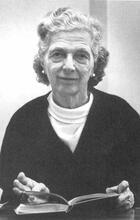
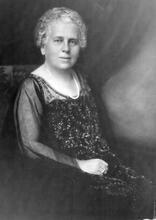
Frieda Schiff Warburg

Frieda Schiff Warburg’s determination to carry on her father’s philanthropic traditions led her to support and shape major Jewish institutions in America and Israel. Warburg began volunteering as director of the Brightside Day Nursery, then moved to the Young Women’s Hebrew Association as director and then president. She was the first woman on the Jewish Theological Seminary’s board of directors, a position she held until her death. A committed Zionist who supported a variety of Jewish philanthropic organizations, she was named honorary chair of the Hadassah Hospital building fund, established a scholarship fund for medical students, and gave generously to United Jewish Appeal’s efforts to aid immigrants to Israel. During World War II, Warburg rescued friends and family from Europe, housing refugees in her homes.
An astute, generous, and well-read woman, Frieda Schiff Warburg was an example both of the opportunities made possible by great wealth and the educational and vocational limitations imposed on women of her time. Her pattern of giving was more a reflection of her desire to carry on her family’s philanthropic tradition—particularly her father’s—than an expression of interests she developed on her own. It also served as a kind of substitute for the religious observance that had been important to her father, but that she did not feel moved to carry on in her own life.
Warburg’s upbringing and family life
field_section_text_value
Philanthropic beginnings
Warburg began her philanthropic work after her marriage as a director of the Brightside Day Nursery. In 1911, she became a director of the Young Women’s Hebrew Association (YWHA) and later its president (1929–1942).

field_section_text_value
Israeli, Jewish, and Holocaust-era work
Although both Frieda and Felix Warburg maintained their position as non-Zionists, their first trip to Palestine in the early 1920s, made with the encouragement of Chaim Weizmann, turned them into enthusiastic supporters of development there. In 1936, Frieda Warburg was honorary chair of the building fund campaign for the Hadassah Hospital in Jerusalem. In 1949, she established a $100,000 fund for medical scholarships at the hospital, and in 1951, she contributed $650,000 to the United Jewish Appeal to house and educate new immigrants to Israel. She also supported the Hebrew University, as had her husband, and she served as the honorary vice president of the International Youth Aliyah Committee.

In 1935 the Warburgs founded the Felix M. and Frieda Schiff Warburg Foundation. With Frieda Warburg as president and her five children as members, the foundation chiefly supported Jewish causes but, reflecting the interests of the Warburg children, also funded health, education, civic, art, music, and African-American organizations.
During the Nazi era, Frieda Warburg responded by helping rescue friends and family members caught in Germany, housing many of these refugees at her homes in Manhattan and White Plains, New York.
Warburg’s legacy
She received honors during her later years, among them honorary degrees from the Jewish Theological Seminary and Hebrew Union College, both in 1945.
Frieda Schiff Warburg died at her home in White Plains on September 14, 1958. In her estate of more than $9 million, she left bequests to her family and to the many organizations she had supported during her lifetime.
Adler, Cyrus. Felix M. Warburg: A Biographical Sketch (1938), and Jacob Schiff. His Life and Letters (1928).
AJYB 61 (1960): 419.
Chernow, Ron. The Warburgs: The Twentieth-Century Odyssey of a Remarkable Jewish Family (1993).
EJ.
JTS Records, R.G.1 and R.G.11. JTS; Miller, Julie. “Planning the Jewish Museum, 1944–1947.” Conservative Judaism 47 (Fall 1994): 60–73.
Obituary. NYTimes, September 15, 1958, 21:3.
UJE.
Warburg, Frieda Schiff. Reminiscences of a Long Life (1956).
“Warburg Estate Put at Nine Million,” NYTimes, September 23, 1958.
Weber, Nicholas Fox. Patron Saints: Five Rebels Who Opened America to a New Art, 1928–1943 (1992).
WWIAJ (1938).
Young Women’s Hebrew Association. Records, R.G.5. YM-YWHA Archives, 92nd Street YM-YWHA, NYC.
More on Frieda Schiff Warburg
Double your impact to amplify Jewish women’s stories—
All gifts matched up to $35,000
Before you close this article, please consider supporting the Jewish Women’s Archive and uplifting Jewish women’s voices.
At JWA, we preserve the voices of Jewish women and gender-expansive people past and present, share them freely with millions online, and empower a new generation of Jewish feminists to lead with courage, creativity, and conviction.
But none of this happens without you. JWA is an independent nonprofit— we rely on people, like you, who believe that history belongs to all of us and that the voices of Jewish women must remain powerful, and heard.
This month, a generous JWA board member will match every gift dollar for dollar—up to $35,000—through June 30. Your contribution goes twice as far right now.
Every contribution—no matter the size—helps us document, teach, and inspire through Jewish women’s stories.
It takes less than a minute to make a difference.
Thank you for being a part of the JWA community,
Judith Rosenbaum, CEO