

Uprising of 20,000 (1909)

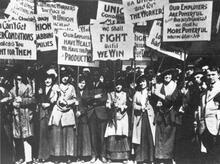
On November 23, 1909, more than 20,000 Yiddish-speaking immigrants, mostly young women in their teens and early twenties, launched an eleven-week general strike in New York’s shirtwaist industry. Dubbed the Uprising of the 20,000, it was the largest strike by women to date in American history. The young strikers’ courage, tenacity, and solidarity forced the predominantly male leadership in the “needle trades” and the American Federation of Labor to revise their entrenched prejudices against organizing women. The strikers won only a portion of their demands, but the uprising sparked five years of revolt that transformed the garment industry into one of the best-organized trades in the United States.
Background
field_section_text_value

field_section_text_value
The Strike
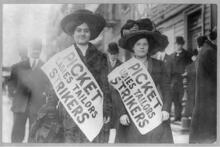
The following morning, approximately 15,000 shirtwaist workers took to the streets. By evening, the number swelled to more than 20,000. According to some estimates, almost 30,000 workers participated in the strike during its eleven-week duration, 90 percent of whom were Jewish and 70 percent women. “Learners” and “operators” made up the bulk of the strikers, but male craftsmen (who themselves employed “learners” and occupied a critical position in the production process) also marched on the picket line, thereby guaranteeing a complete work stoppage.
Pandemonium reigned during the uprising’s initial days as thousands of workers rushed to meetings, swarmed union locals, and milled the streets. In the confusion, some workers returned to their jobs, demoralized. At the same time, a number of small shops quickly negotiated with the union to gain an edge on their larger competitors. Thus, hundreds of workers returned to their shops, even as hundreds of others joined the picket lines.
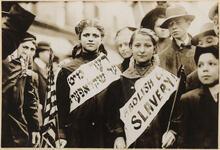
Throughout the uprising, arrests and harassment continued unabated. In one month, 723 people were arrested and 19 sentenced to the workhouse. Bail averaged $2,500 per day, and court fines totaled $5,000. Overall, the strike cost $100,000. Clara Lemlich suffered six broken ribs and was arrested a total of seventeen times. In one egregious miscarriage of justice, a ten-year-old girl was tried without testimony and sentenced to five days in the workhouse for allegedly assaulting a scab. In response to such outrages, the WTUL organized mass rallies at the Hippodrome, Carnegie Hall, and City Hall in which the strikers’ plight was connected to the suffragist cause. Although a degree of mutual suspicion existed behind the scenes, this alliance produced a new perspective that merged class consciousness with feminism (later named “industrial feminism”).

field_section_text_value
Impact
Though not a complete victory, the uprising achieved significant, concrete gains. Out of the Associated Waist and Dress Manufacturers’ 353 firms, 339 signed contracts granting most demands: a fifty-two-hour week, at least four holidays with pay per year, no discrimination against union loyalists, provision of tools and materials without fee, equal division of work during slack seasons, and negotiation of wages with employees.
By the end of the strike, 85 percent of all shirtwaist makers in New York had joined the ILGWU. Local 25, which began the strike with a hundred members, now counted ten thousand. Furthermore, the uprising laid the groundwork for industrial unionism in the garment industry. Inspired by the shirtwaist makers, sixty thousand cloak makers—men, this time—launched the Great Revolt in the summer of 1910, and other garment strikes ensued across the country. After five years of unrest, the “needle trades” emerged as one of the best organized in the United States.
Less tangible, but equally important, the general strike convinced conservative veterans to accept women as capable union activists. The young women themselves discovered their own self-worth through the ideological ferment and economic struggles of 1909–1910. Many of them remembered the Uprising of the 20,000 as the formative event of their adult lives.
Baum, Charlotte, Paula Hyman, and Sonya Michel, eds. The Jewish Woman in America (1976).
Epstein, Melech. Jewish Labor in USA: An Industrial, Political and Cultural History of the Jewish Labor Movement (1969).
Glenn, Susan A. Daughters of the Shtetl: Life and Labor in the Immigrant Generation (1990).
Hyman, Paula. “Immigrant Women and Consumer Protest: The New York City Kosher Meat Boycott of 1902.” AJH 70, no. 1 (September 1980): 68–90.
Kessler-Harris, Alice. “Organizing the Unorganizable: Three Jewish Women and their Unions.” Labor History 17, no. 1 (Winter 1976): 5–23.
Levine, Louis. The Women Garment Workers: A History of the International Ladies’ Garment Workers’ Union (1924).
McCreesh, Carolyn Daniel. Women in the Campaign to Organize Garment Workers 1880–1917 (1985).
Orleck, Annelise. Common Sense and a Little Fire: Women and Working Class Politics in the United States, 1900–1965 (1995).
Seller, Maxine Schwartz. “The Uprising of the Twenty Thousand: Sex, Class and Ethnicity in the Shirtwaist Makers’ Strike of 1909.” In ‘Struggle a Hard Battle’: Essays on Working-Class Immigrants, edited by Dirk Hoerder (1986).
Tax, Meredith. The Rising of Women: Feminist Solidarity and Class Conflict, 1880–1917 (1980).
Tyler, Gus. Look for the Union Label: A History of the International Ladies’ Garment Workers’ Union (1995).
Waldinger, Robert. “Another Look at the International Ladies’ Garment Workers’ Union: Women, Industry Structure and Collective Action.” In Women, Work and Protest: A Century of U.S. Women’s Labor History, edited by Ruth Milkman (1985).
More Like This

Double your impact to amplify Jewish women’s stories—
All gifts matched up to $35,000
Before you close this article, please consider supporting the Jewish Women’s Archive and uplifting Jewish women’s voices.
At JWA, we preserve the voices of Jewish women and gender-expansive people past and present, share them freely with millions online, and empower a new generation of Jewish feminists to lead with courage, creativity, and conviction.
But none of this happens without you. JWA is an independent nonprofit— we rely on people, like you, who believe that history belongs to all of us and that the voices of Jewish women must remain powerful, and heard.
This month, a generous JWA board member will match every gift dollar for dollar—up to $35,000—through June 30. Your contribution goes twice as far right now.
Every contribution—no matter the size—helps us document, teach, and inspire through Jewish women’s stories.
It takes less than a minute to make a difference.
Thank you for being a part of the JWA community,
Judith Rosenbaum, CEO

