
International Ladies Garment Workers Union

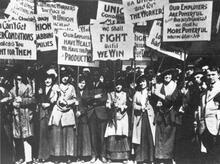
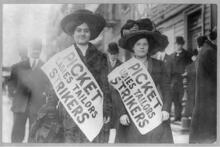
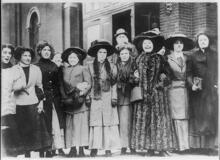
The International Ladies Garment Workers Union (ILGWU) was founded in 1900 by eleven Jewish men who represented seven local East Coast unions with heavy Jewish immigrant populations. Initially excluded from the union, women began to organize after the introduction of the shirtwaist, the surrounding working conditions of which gave women the grounds to join Local 25 of the ILGWU. The Uprising of the 20,000 in 1909, led by Clara Lemlich and directed against employer tyranny in the sweatshop, gave these women bargaining power and bolstered their numbers. Women garment workers went on to shape the ILGWU’s labor philosophy, advocating strongly for education as a means through which to reshape society to better support the working class.
The International Ladies Garment Workers Union was founded in 1900. The eleven Jewish men who founded the union represented seven local unions from East Coast cities with heavy Jewish immigrant populations. This all-male convention was made up exclusively of cloak makers and one skirt maker, highly skilled Old World tailors who had been trying to organize in a well-established industry for a couple of decades. White goods workers, including skilled corset makers, were not invited to the first meeting. Nor were they or the largely young immigrant Jewish workers in the newly developing shirtwaist industry recruited for the union in the early years of its existence. But these women workers still tried to organize.
Introduction of the Shirtwaist
field_section_text_value
The Uprising of 20,000
field_section_text_value
The Triangle Shirtwaist Factory Fire
field_section_text_value
The ILGWU’s Mission: Education and Community Development
field_section_text_value
Decline and Resurgence of the Union
field_section_text_value
The ILGWU’s Contemporary Legacy
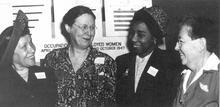
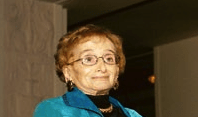
More recently, as the ILGWU’s membership has shifted from Jewish and Italian women to Latino, African-American, and Asian women, one Jewish woman has served as the union’s legislative voice in the halls of Congress for almost half a century. Unlike the other Jewish women of prominence in the union, Evelyn Dubrow was not an immigrant. She grew up in New Jersey and was educated at the New York University School of Journalism. When American labor, through the Congress of Industrial Organizations, began to reach into mass manufacture in the 1930s, Dubrow served as education director for the New Jersey Textile Workers of America. As a writer, she worked as secretary of the New Jersey Newspaper Guild from 1943 to 1946.
Subsequently she became national director of organization of the Americans for Democratic Action and a founder of the Consumer Federation of America. By her performance on the Hill, Dubrow has won recognition and admiration from those who know how the wheels of government run. In 1982 the Washington Business Review named her as one of D.C.’s top ten lobbyists, and in 1994 Washingtonian Magazine listed her as one of America’s top 100 women.
Although Evelyn Dubrow is distinguished for her political work, she was exceptional among the Jewish women in the union only in her official assignment to that mission. All of the women leaders mentioned were intensely political, as were many of the rank and file. For them it was never enough to have a union to ease and enrich the lives of those in the apparel industry. They dreamed of and worked for a movement that would someday transform the world into a place where the ideals of equality and justice for all would be a reality.
Glenn, Susan A. Daughters of the Shtetl: Life and Labor in the Immigrant Generation. Ithaca: Cornell University Press, 1991.
Howe, Irving. World of Our Fathers: The Journey of East European Jews to America and the Life They Found and Made. New York: NYU Press, 1976.
ILGWU. Pauline Newman. 1986.
Kessler-Harris, Alice. “Organizing the Unorganizable: Three Jewish Women and Their
Union.” Labor History 17 (Winter 1976): 5–23. In Labor Leaders in America, edited by Melvyn Dubofsky and Warren Van Tine. Champaign: University of Illinois Press, 1987.
Kessler-Harris, Alice. “Rose Schneiderman and the Limits of Women’s Trade Unionism.” In Labor Leaders in America, edited by Melvyn Dubofsky and Warren Van Tine. Champaign: University of Illinois Press, 1987.
Leeder, Elaine. The Gentle General: Rose Pesotta, Anarchist and Labor Organizer. Albany: State University of New York Press, 1993.
Levine, Louis. The Women’s Garment Workers. New York: B.W. Huebsch, 1924.
Orleck, Annelise. Common Sense and a Little Fire: Women and Working-Class Politics in the Unites States, 1900–1965. Chapel Hill: University of North Carolina Press, 1995.
Pesotta, Rose. Bread upon the Waters. New York: Dodd, Mead & Co., 1945.
Seidman, Joel. The Needle Trades. New York: Farrar & Rhinehart, 1942.
Stein, Leon. Out of the Sweat Shop. Chicago: Quadrangle-New York times Book Co., 1977.
Stein, Leon. The Triangle Fire. Philadelphia: Lippincott, 1962.
Stolberg, Benjamin. Tailor’s Progress. New York: Doubleday, Doran & Co., 1944.
Tyler, Gus. Look for the Union Label. London: Routledge, 1995.
More Like This
Double your impact to amplify Jewish women’s stories—
All gifts matched up to $35,000
Before you close this article, please consider supporting the Jewish Women’s Archive and uplifting Jewish women’s voices.
At JWA, we preserve the voices of Jewish women and gender-expansive people past and present, share them freely with millions online, and empower a new generation of Jewish feminists to lead with courage, creativity, and conviction.
But none of this happens without you. JWA is an independent nonprofit— we rely on people, like you, who believe that history belongs to all of us and that the voices of Jewish women must remain powerful, and heard.
This month, a generous JWA board member will match every gift dollar for dollar—up to $35,000—through June 30. Your contribution goes twice as far right now.
Every contribution—no matter the size—helps us document, teach, and inspire through Jewish women’s stories.
It takes less than a minute to make a difference.
Thank you for being a part of the JWA community,
Judith Rosenbaum, CEO