

Summer Camping in the United States

Since its inception in the 19th century, the Jewish summer camp, advertised as a ‘a worthy use of leisure,’ has provided a means to promote good health, fight anti-Semitism, instill Jewish identity, craft and question religious rituals and traditions, and trouble notions of gender. Throughout the twentieth century, it was a business venture that empowered middle-aged women who founded summer camps, a means of employment for young women who worked as camp counselors and instructors, and a place for the girls who were campers to explore and shape Jewish girlhood. Providing insight into Jewish identity, womanhood, and girlhood, as well as work and leisure, this entry sketches the ways a twentieth-century Jewish endeavor evolved into a twenty-first-century American institution.
‘Sleep-Away’ Summer Camps Emerge in the United States

“Are These Our Children?” questioned a radio series with the same title in the 1920s. The stories of youth gone bad were at the center of the broadcasts that transfixed audiences and the nation. Social commentators and ordinary people believed that the sources of the delinquency were “cheap amusements,” like Coney Island and Hollywood film. Un-chaperoned leisure, jazz, and cigarettes were also to blame. Overindulgent mothers were thought to be at the heart of the problem.
Summer camp was presented as the cure. According to brochures and news releases, this novel educational initiative would transform “physically and spiritually illiterate” boys and girls into “able-bodied” and “morally upright” American citizens. The plan for fulfilling the vow centered on educating the “total child,” his or her “body, mind, and soul,” in an environment that made “learning fun.”
Early turn of the century camping endeavors thrived in cities as well as the countryside. Urban camps were built on the rooftops of neighborhood centers. They provided adults and children with sports and educational activities, like “instruction in sewing and fancywork like basketry,” on a daily basis and within walking distance of home and work (Seman, “A Summer Roof Garden Recreation School,” ca. 1930s). Camps in the country, called “resident camps,” offered working women and men, mothers with young children, and children of both sexes the opportunity to live and learn, for two weeks to two months, “close to nature” within the woods. The resident or “sleep-away” summer camp, the focus of this entry, became an American institution in the aftermath of the first world war.
Government-sponsored 4-H summer camps flourished in the 1920s. The four H’s stood for “head, heart, hand, health.” The central aims were to cultivate agricultural skills, develop nationalism, and counter the loneliness of childhood on isolated farms. The 4H camps approached their goals by welcoming boys and girls from farming families into a community of children from like backgrounds (NMAH-AC). That the number of 4-H camps doubled between 1924 and 1930 testifies to their appeal if not success. According to statistics and the “4-H Goes Marching Along” ballad, approximately 250,000 children were “keeping our nation strong” by learning how to “raise blue ribbon breeds and bumper crops from our seeds…[and] having happy hearts that bring health, and willing hands that bring wealth” at the 2,400 camps premised on the 4-H way (Samuel Berek, “The 4-H Goes Marching Along,” in the Sam De Vincent Collection of Illustrated Sheet Music NMAH-AC).
Federal government summer camp endeavors expanded throughout the 1930s. For example, New Deal initiatives included camps for men established by the Civilian Conservation Core (CCC). In addition, first lady Eleanor Roosevelt was critical in the establishment of the “Educational Camps for Unemployed Women.” The overarching aim was to “restore better physical condition [and] a better mental attitude” to help women without jobs “take their place as responsible, well-informed citizens.” According to campers’ letters and diaries, the summer camp experience provided a “new deal” on life and instilled nationalistic fervor. One young girl described her experience as “refreshing and invigorating.” It gave her “new courage, new determination and new confidence” in herself and the nation (“Report on Educational Camps for Unemployed Women 1934 and 1935,” FERA: May 1936). These sentiments were most likely shared by her peers, 18,000 of whom attended federally funded summer camps in 1934 alone.
Jewish Summer Camps in the 20th Century
The uniquely Jewish “sleep-away” summer camp movement that developed during the interwar years was an expression of national trends, as well as a reaction to a growing nationalism that viewed Jews with fear and hatred and deemed them un-American. Prejudice resulted in social policies and immigration legislation that restricted Jewish-American access to social clubs and elite educational institutions like Yale University, and effectively barred Jews from entering the country. The restrictions shaped the lives of many Jewish children in America.
Leaders and individuals in Jewish communities designed camp life to address the concerns of the nation in general and Jewish people specifically. For example, camp activists countered accusations by racists like E. A. Ross that Jews were “weak and limp” and a cause of “racial decline and degeneracy” with diet and exercise programs, such as “milk call” and athletic competitions like tennis tournaments, that promoted campers’ physical fitness. These activities aimed to develop a “muscular Judaism” paralleling the “rugged Christianity” at Christian camps.
The summer camp embrace of “the” Native American who lived in the country’s collective imagination also speaks to the effort to forge an American identity. Jewish campers, like their Christian and non-denominational counterparts, were encouraged to draw strength, pride, and beauty from Native American heritage. Jewish boys were inspired to develop the athletic skill of their Indian “ancestors,” while camps for girls awarded Indian feathers to campers who displayed “feminine” characteristics. Ruthy B., for instance, received a “green feather for good posture” and described her achievement as “simply grand.” Her joy stemmed from acquiring an esteemed trait and the feather itself, which helped her look and feel more like the mythical Indian she was trying to embody.
Ethnic pride was perhaps even more important than physical development. The routines that structured summer camp days and nights nurtured a strong sense of belonging to a Jewish community, that helped children cope with the antisemitism defining their young lives. The camp day typically began with flag-raising ceremonies that started with the national anthem and ended with the singing of Hebrew songs. Jewishness was then woven into the fabric of daily life. Hebrew place names, symbols, stories, and plays textured the camp’s physical and cultural landscapes. A mezuzah, for example, was hung on doorways, while the Star of David was placed over doors and worked into fences. Jewish illustrations and clippings were posted on the walls of camp buildings and bulletin boards. Bungalows and cabins, like the camp itself, were often given names with Jewish historical significance. The camp milieu was also “made Jewish” through the Jewish calendar that set the pace of summer life. This meant, for instance, that Saturday, rather than Sunday, was the Sabbath.
Camp life conveyed Jewish identity that lasted beyond the summer season. Historian Sandra Fox claims that campers’ identification with “Jewishness” countered the assimilationist impact of suburban life. Campers’ testimonies support the claim. For example, children like Jackie Anscher shared their love of Jewish rituals with family members at the summer’s end (Author’s Interview of Jackie Anscher, 2020). That the sharing fueled an ethnic-American experience of suburbia is suggested in the new Jewish traditions incorporated into Anscher’s life at home.

field_section_text_value

Summer camps also provided innovative places of worship that questioned hierarchal religious traditions. An example is the introduction of egalitarianism in 1972, when Ramah camp directors issued a report endorsing Lit. "ascent." A "calling up" to the Torah during its reading in the synagogue.aliyot for young women and their chanting of the Torah and prophetic portions. The report also suggested that camp directors hold ancillary services where post-Lit. "daughter of the commandment." A girl who has reached legal-religious maturity and is now obligated to fulfill the commandmentsbat mitzvah girls would function as shelihot zibbur [leaders of the service]. The opportunities for girls to study Jewish texts and culture alongside boys, and lead services, were empowering experiences that shaped Jewish girlhood. The impact on boys’ perceptions of what girls could be and become was equally significant.
The meaning of Jewish ethnicity played out in camp life and histories. Yiddish cultural organizations such as the Sholem Aleichem Folk Institute and the Workmen’s Circle, for instance, saw the institution as a means to perpetuate yiddishkayt, a secular Jewish culture developed by radical working-class Jewish workers in the needle trades. In 1913, the Sholem Aleichem Folk Institute established camp Boiberik within the framework of yiddishkayt. According to ex-campers, “The Yiddish language and culture that defined the camp perpetuated Jewish identity and values and sustained a warm and spirited ethical community.” In 1926, Camp Kinderland was founded on Sylvan Lake in New York State, when its organizers separated from the Workmen’s Circle to become part of the Communist-led Jewish Workers Schools. Here, the children in their 36 bunks were, in Irving Howe’s words, “dutifully herded into thirty-six little Soviet Republics.” Yiddish culture was mobilized to teach Communist ideology. Mildred Siminoff attended the camp in 1931 and remembered the communist context of daily life, where she “got up every morning to the pledge of allegiance to the Communist flag.” Although the camp was “proudly secular,” Siminoff nevertheless “felt it was a Jewish camp because most of the children were Jewish.” That she learned to identify being Jewish with being Communist speaks to the camp’s success in collapsing the two identities.
In 1927, the Workmen’s Circle built Camp Kinder Ring across Sylvan Lake from Kinderland on socialist principles. Rather than being united by their shared Jewish constituency, however, Siminoff recalls that “there was a lot of rivalry between the camps because we were the Communists and they were the Socialists.” Anne Bernstein shared the memory. She attended Camp Kinder Ring in the 1930s and later wrote that Kinder Ring campers “hated Communist Kinderland.”
Jewish summer camps were defined by class and gender as well as politics. Camp Woodmere, for instance, was among the summer camps for wealthy Jewish girls established deep within the Adirondack Mountains. Although some campers were granted scholarships to pay for travel expenses and summer fees, most hailed from upper-class backgrounds. That they nevertheless identified with less affluent camps, however, speaks to the existence of a community of Jewish summer camps forged by a shared Jewishness. This ethnicity is partly reflected in charitable behavior that, in turn, confirmed existing class structures. The “Plea Chorus,” performed at Camp Woodmere, shows how this worked. The Woodmere campers performed a play for visiting parents. At the end of the act, the children bowed their heads and took off their top hats. Members of the audience then filled the hats with coins. The money collected was donated to Camp Council for poor Jewish children located in Pennsylvania. The significance of the performance of philanthropy was in its development of self-esteem, not the nominal fundraising. The campers’ display of charity was seen and recorded by their parents. Mothers and fathers witnessed their benevolent selves in their children’s behavior. They then exhibited this benevolence by “filling the actresses’ hats to the brim.” This generated good feelings about themselves and each other that strengthened ethnic solidarity while confirming class status.
Women’s Roles in Jewish Summer Camps
In the winter of 1945, Elsie Reich and her husband Harry bought seven acres of land in Salisbury, Connecticut. She “pawned her diamond ring” and convinced him to borrow money against his pharmaceutical business to finance this purchase. The deed of sale lists Harry Reich as the owner of the grounds, but Elsie managed the property. She employed homeless people recommended to her by a New York City clergyman. Their names were Joe, Turk, the Swede, and Dutch.
In the spring of 1946, Reich drove “her men,” up from the Bowery to Connecticut. They constructed cabins and carved out a waterfront in exchange for room and board. Berkshire Hills Camp opened that summer. It provided the men with a safe space to work and live; Jewish children with “amusement, recreation, entertainment and instruction”; and Elsie Reich with the prospect of financial independence.
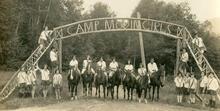
When Elsie Reich opened Berkshire Hills Camp in 1946, she was perpetuating a female tradition that had existed for thirty years. In 1916, Miss Kuhn and Miss Goldsmith founded Camp Woodmere. The “fundamentals of good citizenship” structured life at this summer camp. Democracy, patriotism, and a Jewish-American identity were conveyed on the fields, within the cabins, and around the campfires that were central to the camping experience. Elsie Reich carried these ideals and customs into the second half of the twentieth century.
Throughout the twentieth century, middle-aged Jewish women justified their camping activities in terms of extending their child-rearing duties to a more public sphere. This made it possible for them to journey to summer camp without crossing traditional gendered boundaries. The histories of the women in this survey provide a general sense of how and why women worked at and supported Jewish summer camps. The histories of their camping activities, in turn, suggest that they challenged contemporary ideas about male and female behavior. Camp’s very location in “the wilderness” illustrates this point. The wilderness has featured in historical narratives as a male territory. Be it virginal or savage, it is often described as an object that is either conquered or tamed by men. Camping women ventured into the woods. Neither conquering nor taming it, they transformed pieces of the “great out-doors” into prototypes of the American home. In the process, they redefined gendered norms in Jewish American culture and steered the course of their own lives.
Women participated in many interpretations of Jewish life by crafting “authentic” Jewish traditions that shaped the experiences of childhood. Among them were the religious rituals that took place in the woods, on the lake, or within the “mess hall.” In the summer of 1934, for example, “Miss Sunny conducted services” while “Miss Jean kindled the Sabbath candles” at Camp Council. Like “Aunt Mickey” at Camp Woodmere, they told “moral” tales after conducting the Sabbath prayers. At Camp Berkshire Hills (BHC) in the 1970s, campers and counselors dressed in white for Friday night dinner, where camp director “Aunt Elsie” sang the Sabbath prayers. Campers’ letters and memories reveal that these invented traditions “instilled a proud Jewish identity that lasted beyond the closing of camp itself.”
Twentieth-century camp owners and organizers rallied support for their business ventures by presenting summer camp as a “public family” of motherly and fatherly directors and staff. This familial (and therefore familiar) presentation was embodied in the “camp mother.” Like Ruth Steinbach Steppacher, known to Woodmere campers as “Aunt Dolly,” the camp mother prefaced her name with “Aunt” and treated the campers as if they were her own children. She “dried tears, sewed buttons,” and was the object of the campers’ love and affection. Their many roles, ranging from camp director to counselor, had an impact on the women’s lives as well as on the children. In a letter written in the 1950s to “Aunt Elsie,” for example, Rosalie Stockman reflected that her work as a counselor had helped her become “a more tolerant person.”
The motherhood rhetoric is also evident in the encouragement of female counselors to relate to “their” campers in a “motherly way,” while developing the children’s physical fitness, outdoor skills, and self-confidence. Letters written to their own mothers suggest that they took this directive to heart. Marie Rothschild was a counselor at Camp Tripp Lake. In the summer of 1921, she and two other counselors took a group of campers on a canoe trip. Although they suffered from an “unmerciful sun, hunger, dirt and fatigue,” these dedicated young women “wouldn’t say die.” They tended to and inspired their campers and returned to camp “dead tired but thrilled at the trip” and “singing hymns of Joy.”

Camping women assumed the role of “female fathers” as well as nurturing mothers. Sometimes, the two roles converged. Miss Kuhn and Miss Goldsmith, two Sunday school teachers, directed life at Camp Woodmere throughout the 1920s and 1930s. They signaled the beginning of the day by “ringing the old school bell.” And with “high-heeled shoes and pursed lips,” they oversaw the daily activities. Miss Shulamit was the head counselor at Berkshire Hills Camp in the 1940s. Like the “directresses” of Camp Woodmere, she inspired deference and sometimes fear. “Aunt Minah,” on the other hand, embodied both “masculine” and “feminine” characteristics. This camp dietitian is remembered as imposing yet nurturing. She was “gutsy enough to buy from the meat man,” claimed one ex-camper, “yet loving enough to comfort any home-sick camper.” That contemporaries viewed “guts” as male and love as female, and that leading women combined both characteristics, speaks to the ways summer camp questioned ideas of femininity and masculinity. According to Sharon Weiss-Greenberg, this questioning fueled female empowerment by providing leadership roles in a variety of contexts. Women led children, and each other, in their roles as Olympic Team Captains, Counselors, Dieticians, Camp Mothers, and Camp Directors.

field_section_text_value
Twenty-First-Century Jewish “Sleep-Away” Camps
The cultural, intellectual, social and athletic programs crafted by early twenty-first century summer camps speak to the continuing legacy of innovation that defined Jewish women’s pioneering work. That the programs appealed to parents, if not all children, reflects in contemporary surveys. They indicate that there were approximately 82,000 campers attending 191 Jewish camps during the summer of 2000, 76 of which were privately owned and 115 were not-for-profit.
The rich and varied programs at the different types of 21st-century camps range from academic courses run in partnership with competitive universities; to art programs supervised by world-class artists, to sports programs run by Olympic medalists. They also include “electives” in culinary arts, ocean exploration, robotics, and high-tech entrepreneurship. Summer camps that ban access to the internet nevertheless appeal to technologically savvy campers with courses like digital filmmaking.
These innovative summer camps cater to a wide range of children. Some focus sharply on the inclusion of children with special intellectual, social, and physical needs. Camps like CampChi, for instance, develop confidence, communication, and leadership skills in young campers and counselors like Kelly, a nineteen-year-old CampChi counselor with Down Syndrome. Educational resources such as the Training Guide for Jewish Summer Camps offer guidance, support and resources (Foundation for Jewish Camp and the Ramah Camping Movement, 2017).
Camp Eisner, where “all kids—regardless of their race, sexual orientation, gender identity, family structure or Jewish background—are treasured,” features gender-inclusive cabins (Eisner Camp, https://eisnercamp.org/ Accessed May 11, 2020). Others, like camp Tawonga in California, offer campers the opportunity to live in an all gender (AG) cabin. Like Camp Havaya, part of the Reconstructionist Movement, the camps are dedicated to providing an open and inclusive camp culture that embraces diversity and Judaism. The embrace, evident in daily life and religious rituals, echoes in the final shabbat at Camp Tawonga where “hundreds of voices chanted Hebrew blessings, before crooning a de-gendered version of Sabbath Prayer from ‘Fiddler on the Roof,’ …that sounded like a mantra for Camp Tawonga: ‘May the Lord protect and defend you….May God always shield you from shame’” (Levin, 2019).
Some camps, like the ten residential Ramah camps flourishing across the United States, now venture into campers’ homes with activities collectively referred to as Ramah Ba-Bayit (“Ramah at Home”). They are advertised as “a compilation of programs from Ramah camps on… zoom, facebook live, and more!” These websites engage children with virtual Shabbat Singing, Havdalah, workouts with personal trainers, and courses like “Yiddish through the lens of Gefilte Fish.” The internet initiatives also provide a means to include the campers’ families. An example is the EliTalks, fashioned after TedTalks, that speak to a variety of issues such as “The Art of Jewish Parenting.”
Contemporary Jewish summer camps cater to young adults as well as children, inviting people ages 20-30 (and sometimes 40) to “relive the passion of your youth, where what you do for a living doesn’t define you, and spontaneous adventures await.” Some of the adult camps are religious or Zionist. Others, like Trybal Gatherings, founded by Carin Warsawski, aim to “foster lasting community among Jews (whether you define yourself as ‘Jewish or just ish’).” The shared pledge to “recharge your city-worn spirit” in a picturesque valley, hilltop, or countryside, echo the twentieth-century belief in nature as a means of coping with modernity.
On April 30, 2020, Camp Ramah Darom closed for the summer season. It joined the cancellation of fifteen Reform camps that counted 10,000 campers in 2019. The closings usher in a revolutionary moment in the history of the Jewish summer camp. Loving memories of summers at camp will inspire new approaches to traditional rituals. Articulated in diaries, letters, and interviews, they are also evident in art, memorabilia, film and photographs. Barbara Levine’s framed photograph of her bat mitzvah at Camp Cejwin illustrates this point. The 70-year-old image hangs on a living room wall amongst snapshots that mark the turning points in her family history and chart the course of an ethnic-American life.
The twentieth-century dream of a Jewish place that offered children the opportunity to play, learn, become physically fit, enjoy intellectual challenges, challenge themselves, and forge friendships during the process, became a reality. The idea that the summer camp was a work opportunity that offered young and older women the chance to “take charge” of their lives inspired many to own, direct, and work at summer camp. Campers’ warm memories speak to their success. The twenty-first-century pandemic will give rise to new approaches to summer camp as both a virtual and physical experience. Changing with and over time, the ability to reimagine the summer camp throughout the decades has turned a Jewish endeavor into an American institution.
Borish, Linda. “Jewish American Women, Jewish Organizations and Sports, 1880–1920.” :105-131 (Syracuse University Press: 1998)
Braff, Danielle. “Girls’ Side and Boys’ Side? Not at These Summer Camps.” The New York Times, May 22, 2019.
“Camp” Camp home page, https://www.campcamp.com/ (Accessed April 26, 2020).
Cohen, Erik and Yehuda Bar Shalom. “Teachable Moments in Jewish Education: An Informal approach in a Reform Summer Camp.” Religious Education Vol.105 (2010): 26-44.
Eisen, George. “Sport, Recreation and Gender: Jewish Immigrant Women in Turn-of-the-Century America (1880–1920).” Journal of Sport History (1991): 103–121.
Erenberg, Lewis A., and Susan E. Hirsch. The War in American Culture: Society and Consciousness During World War II. Chicago: University of Chicago Press, 1996.
Fingerman, Jeremy J. “Creating Welcoming, Inclusive, and Supportive Jewish Communities.” EJewishPhilanthropy, February 20, 2020. https://ejewishphilanthropy.com/creating-welcoming-inclusive-and-supportive-jewish-communities/ Accessed MarFox, Sandra. “Here, We’re Real Jews”: Producing Authentic Jews in American Summer Camps: 1945-1980. PhD Diss., New York University, 2018.
Gold, Rachel, Kelly Kogen and Jamie Lake, “Meet Kelly: More than your average Camp Counselor,” Foundation for Jewish Camp, 2018 https://jewishcamp.org/meet-kelly-average-camp-counselor/ (Accessed May 11, 2020).
Glenn, Susan A. Daughters of the Shtetl: Life and Labor in the Immigrant Generation. Ithaca, NY: Cornell University Press, 1990.
Hyman, Paula E. Gender and Assimilation in Modern Jewish History: The Roles and Representation of Women. Seattle: University of Washington Press, 1995.
Hyman, Paula E. “The Unfinished Symphony: The Gerson Cohen Years.” In Tradition Renewed: A History of the Jewish Theological Seminary, edited by Jack Wertheimer. New York: Jewish Theological Seminary,1997.
Joselit, Jenna Weissman, and Karen S. Mittleman, eds. A Worthy Use of Summer: Jewish Summer Camping in America. Philadelphia: National Museum of American Jewish History, 1993.
Kidd, Kenneth B., and Derritt Mason, eds. Queer as Camp: Essays on Summer, Style, and Sexuality. New York: Fordham University Press, 2019.
Kirshenblatt-Gimblett, Barbara. “Philanthropy on Display: The Educational Alliance and its Fare” (May 1998).
Kornblhu, Joyce L. “The She-She-She Camps: An Experiment in Living and Learning 1934-1937” https://temple.manifoldapp.org/read/6d8a1e18-72f7-4821-b9f1-6bd35884510e/section/18e4570c-6f18-495d-980d-834d81a8793c#id_775 (Accessed July 25, 2020).
Levin, Rachel. “Jewish Summer Camp with Campfires, Crafts and No Lights Out,” The New York Times (2019).
Levin. “In an All-Gender Cabin, Summer Campers ‘Don’t Have to Hide,” New York Times, (2019).
Lieber, Chavie. “Jewish Camps to offer a new tech on summer fun.” The Times of Israel, January 21, 2013.
Lorge, Michael M., and Gary P.Zola. “A Place of Our Own: The Rise of Reform Jewish Camping.” Tuscaloosa: University of Alabama Press, 2006.
Mykoff, Nancy. “A Jewish Season: Ethnic-American Culture at Children’s Summer Camp 1918-1941,” UMI Dissertation, 2002.
National Museum of American History and Archives Center, Smithsonian Institution, Washington D.C. (NMAH-AC).
Norwood, Vera. Made from This Earth: American Women and Nature. Durham, NC: University of North Carolina Press, 1993.
Peiss, Kathy. Cheap Amusements: Working Women and Leisure in Turn of the Century New York. Philadelphia: Temple University Press, 1986.
Riess, Steven A. “Sport and the American Jew: A Second Look.” American Jewish History (1995): 1–15.
Rosman, Katherine. “Cozy Campfires. Capture the Flag. Corona Virus Tests?” The New York Times. April 24, 2020.
Sales, Amy L. and Leonard Saxe, “’How Goodly Are Thy Tents’: Summer Camps as Jewish Socializing Experiences.” Lebanon, NH: Brandeis University Press, 2003.
Selvin, Matthew. “When Avodah Goes Beyond Work: A Unique Jewish Inclusionary Camp Experience.” EJewishPhilanthropy, February 25, 2020.
Sorin, Gerald. Tradition Transformed: The Jewish Experience in America. Baltimore, MD: Johns Hopkins University Press, 1997).
“TheZone: Summer Camp home page, https://www.thezone.org. Accessed April 27, 2020.
Tobin, Gary A., and Meryle Weinstein. Jewish Camping 2000. San Francisco: Institute for Jewish & Community Research, 2000.
Weis-Greenberg, Sharon. Empowering youth today for an improved tomorrow: Female staff in the Jewish summer camp setting. PhD Diss, New York University, 2013.
Wenger, Beth S. New York Jews and the Great Depression: Uncertain Promise. New Haven: Yale University Press, 1996.
Wishna, Victor. “New and Improved Jewish camps for our Gilded Age.” Jewish Telegraph Agency, February 29, 2016. https://www.jta.org/2016/02/29/united-states/new-and-improved-jewish-camps-for-our-gilded-age (accessed April 30, 2020)
More Like This

Double your impact to amplify Jewish women’s stories—
All gifts matched up to $35,000
Before you close this article, please consider supporting the Jewish Women’s Archive and uplifting Jewish women’s voices.
At JWA, we preserve the voices of Jewish women and gender-expansive people past and present, share them freely with millions online, and empower a new generation of Jewish feminists to lead with courage, creativity, and conviction.
But none of this happens without you. JWA is an independent nonprofit— we rely on people, like you, who believe that history belongs to all of us and that the voices of Jewish women must remain powerful, and heard.
This month, a generous JWA board member will match every gift dollar for dollar—up to $35,000—through June 30. Your contribution goes twice as far right now.
Every contribution—no matter the size—helps us document, teach, and inspire through Jewish women’s stories.
It takes less than a minute to make a difference.
Thank you for being a part of the JWA community,

Judith Rosenbaum, CEO

