

Rizpah: Bible
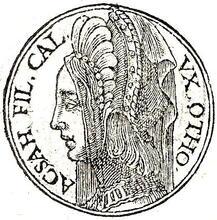
Rizpah is the concubine of Saul, the first king of Israel. She has two sons, one of whom briefly takes the throne. However, both of her children are killed by David and she helps ensure that their bodies get the correct burial.
Article
The daughter of Aiah, Rizpah is the concubine of Saul, the first king of Israel (reigned c. 1025–1005 B.C.E.). Since Saul’s wife Ahinoam has borne him four sons and two daughters, the reason for his taking of a concubine is not to produce an heir. Rizpah bears Saul two sons, Armoni and Mephibosheth. They become potential claimants to the Saulide throne after Saul because Saul’s three eldest sons die in battle at Mount Gilboa (1 Sam 14:49; 31:12), and the youngest son, Eshbaal, who had not been old enough to fight, is crowned Saul’s successor (1 Sam 14:49; 2 Sam 2:8; 1 Chr 8:33; 9:39) and then is assassinated (2 Samuel 4).
In order to usurp the throne, David uses a three-year famine as a pretext to turn over the remaining seven eligible Saulide male heirs to the Gibeonites for ritual execution to atone for the bloodguilt Saul was supposed to have incurred against this group. Rizpah’s two sons and the five sons of Saul’s fertile daughter are killed. Rizpah prevents the executed bodies from being defiled by animals until David agrees to give them proper burial.
At some point after Eshbaal’s installation as king, his great-uncle Abner, the seasoned commander of the Israelite army, makes a bid to wrest the throne from the inexperienced youth by sleeping with Rizpah. It may have been the practice in ancient Near Eastern kingdoms to lay claim to the throne by having sexual relations with the former king’s wives or concubines (see also 2 Sam 15:13–17; 16:17–22).
de Vaux, Roland. Ancient Israel: Its Life and Institutions, trans. John McHugh, 43–46. New York: 1961.
Matthews, Victor H., and Don C. Benjamin. Social World of Ancient lsrael, 1250–587 b.c.e. Massachusetts: 1993.
Meyers, Carol, General Editor. Women in Scripture. New York: 2000.
Patai, Raphael. Sex and Family in the Bible and the Middle East. Garden City, New York: 1959.
More Like This



Double your impact to amplify Jewish women’s stories—
All gifts matched up to $35,000
Before you close this article, please consider supporting the Jewish Women’s Archive and uplifting Jewish women’s voices.
At JWA, we preserve the voices of Jewish women and gender-expansive people past and present, share them freely with millions online, and empower a new generation of Jewish feminists to lead with courage, creativity, and conviction.
But none of this happens without you. JWA is an independent nonprofit— we rely on people, like you, who believe that history belongs to all of us and that the voices of Jewish women must remain powerful, and heard.
This month, a generous JWA board member will match every gift dollar for dollar—up to $35,000—through June 30. Your contribution goes twice as far right now.
Every contribution—no matter the size—helps us document, teach, and inspire through Jewish women’s stories.
It takes less than a minute to make a difference.
Thank you for being a part of the JWA community,


Judith Rosenbaum, CEO

