
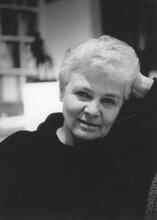
Nora Levin
Nora Levin began her career as a research librarian and public high school teacher concentrating on American and European history. From 1948 to1953 she was executive director of the Philadelphia Council of Pioneer Women, a labor Zionist group, and over the course of her career served as a board member for organizations ranging from the Soviet Jewry Council to the National Conference of Christians and Jews. Her books on modern Jewish history brought her national attention, bringing major events to life by focusing on the stories of individuals. Many critics and general readers found her perspective on modern history gripping.
In the introduction to her 1977 book While Messiah Tarried, a history of Jewish socialist movements, Nora Levin wrote that she hoped “young Jews groping for ways to reconcile their own social radicalism with Jewishness ... will be heartened in their quest by the knowledge that there have been several generations of other young Jews who have made a similar struggle.”
Education and Activism
Levin was the author of three very readable histories and numerous magazine articles about the last hundred years of Jewish history. Her accounts are personalized with stories of individual Jews—and Jewish organizations—who acted and interacted with the political and social world around them. Levin wrote Jewish history not for scholars and specialists, but for the general reader. Her writing conveys remarkable compassion and sensitivity toward the vicissitudes of Jewish life in Europe, czarist Russia, and the former Soviet Union, highlighting social and political nuances within Jewish communities. She especially focused on activists with a core Jewish identity: Jewish partisans in Hitler’s Europe; the Jewish labor movement in America; the socialist Jewish Labor Bund in Russia and Poland; socialist Zionists; and refuseniks and other Jews who struggled to maintain Jewish identity and meaning in the Soviet Union.
Levin lived most of her life in Philadelphia, where she was born September 20, 1916, to Joseph and Bertha (Landberg) Levin. She had an older sister, Dorothy. Levin received her B.S. in education from Temple University and her M.L.S. from Drexel University. Her D.H.Lit was awarded posthumously in 1989 by Philadelphia’s Gratz College of Jewish Studies. Early in her career, she worked as a research librarian and public high school instructor in American and European history. At the time of her death on October 26, 1989, she had taught at Gratz College for nearly twenty years and was the founder and director of the college’s Holocaust Oral History Archives. The archives department has recorded hundreds of interviews with Holocaust survivors, liberators, and eyewitnesses.
Jewish Identity and Authorship
field_section_text_value
Legacy
Her final work, the two-volume The Jews of the Soviet Union Since 1917, was published in 1989, the year that Levin died. The work is marred by Levin’s use of lengthy quotes from other sources without proper attribution. Still, Zvi Gitleman wrote in America, Levin “captures the human drama played out in the often great expectations and equally profound disappointments that have characterized Soviet Jewry.”
Nora Levin’s books, articles, and activism were inspired by her commitment to the Jewish people and to a living legacy of action and community involvement.
Selected Works
“Assaults on Holocaust History.” Midstream (April 1989).
The Holocaust: The Destruction of European Jewry, 1933–1945 (1968).
The Jews of the Soviet Union Since 1917: Paradox of Survival. 2 vols. (1989).
“Postwar Reflections on the Holocaust from a Jewish Point of View.” In Movements and Issues in World Religions: A Sourcebook and Analysis of Developments Since 1945—Religion, Ideology, and Politics (1987).
While Messiah Tarried: Jewish Socialist Movements, 1871–1917 (1977).
Contemporary Authors; Dawidowicz, Lucy. “The Holocaust.” Jewish Social Studies (April 1970).
Dictionary of International Biography; Gitleman, Zvi. “The Jew in the Soviet Union Since 1917.” America (November 25, 1989).
Snyder, Louis. “Two Views of Hell.” Saturday Review (March 9, 1968).
Who’s Who Among American Women. 10th ed.

Double your impact to amplify Jewish women’s stories—
All gifts matched up to $35,000
Before you close this article, please consider supporting the Jewish Women’s Archive and uplifting Jewish women’s voices.
At JWA, we preserve the voices of Jewish women and gender-expansive people past and present, share them freely with millions online, and empower a new generation of Jewish feminists to lead with courage, creativity, and conviction.
But none of this happens without you. JWA is an independent nonprofit— we rely on people, like you, who believe that history belongs to all of us and that the voices of Jewish women must remain powerful, and heard.
This month, a generous JWA board member will match every gift dollar for dollar—up to $35,000—through June 30. Your contribution goes twice as far right now.
Every contribution—no matter the size—helps us document, teach, and inspire through Jewish women’s stories.
It takes less than a minute to make a difference.
Thank you for being a part of the JWA community,

Judith Rosenbaum, CEO