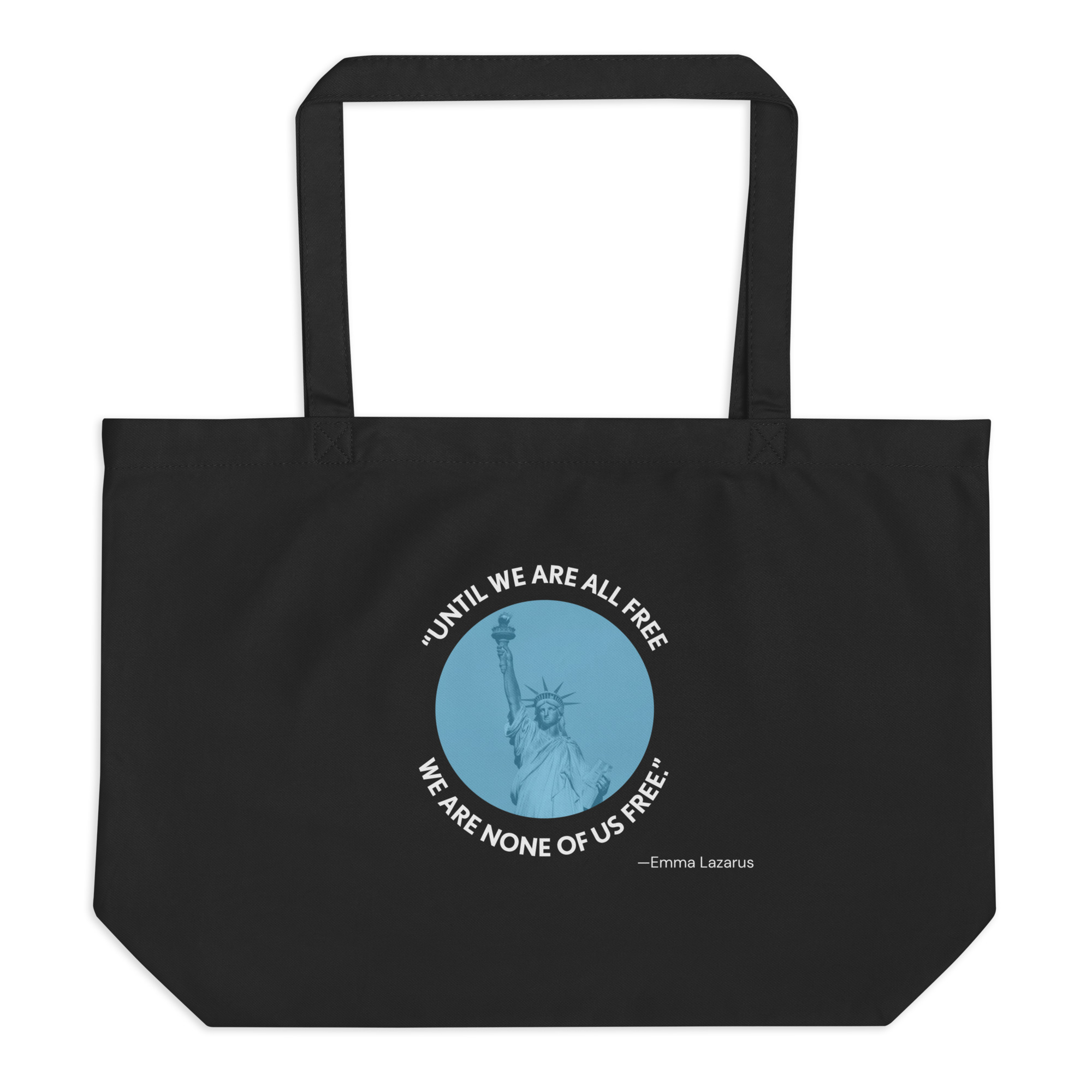

Josephine Lazarus
After the death of her well-known sister Emma, Josephine Lazarus emerged as a writer and activist in her own right. Descended from the first Jews to settle in the United States, Josephine Lazarus came of age in the wealthy and cultured Sephardic community of New York alongside her five sisters. Her first publication was a memorial essay for her sister Emma Lazarus, followed by a series of literary biographies of contemporary women writers. In 1893 she spoke at the Congress of Religions at the Chicago World’s Fair, later expanding her ideas into her first book, The Spirit of Judaism (1895). In her writing, Lazarus advocated for nonsectarian ethical humanism in tension with the need for Jews to have a homeland and political autonomy.
Josephine Lazarus was the best known of the poet Emma Lazarus’s five sisters. Her essays and reviews appeared in several leading journals of the day, and three volumes of her work exploring issues of Jewish destiny and identity were published during her lifetime.
Family and Early Life
Lazarus, the second of seven children, was raised in a home of wealth, culture, and privilege. Her parents, Moses and Esther (Nathan) Lazarus, were both descended from the first Jews to settle in the United States, refugees from Brazil who landed in New Amsterdam in 1654. Moses Lazarus was a successful sugar merchant who was able to retire young. Both parents were Descendants of the Jews who lived in Spain and Portugal before the explusion of 1492; primarily Jews of N. Africa, Italy, the Middle East and the Balkans.Sephardim Jews who were members of Shearith Israel, New York’s prestigious Spanish and Portuguese synagogue. They were also members of the Union and Knickerbocker clubs, which Moses helped to found. These affiliations reflected both a proud Jewish heritage and the family’s secure position in the most sophisticated social circles of late nineteenth-century New York City.
While little is known about Lazarus’ early schooling, like Emma she was educated at home by private tutors. Also like her sister, she was fluent in the major European languages and well educated in literature, music, and the arts. The family summered in Newport, Rhode Island, and the Lazarus daughters were members of Julia Ward Beecher’s exclusive Town and Country Club, where members took turns presenting prepared discourses on a range of scientific and literary topics.
Lazarus’ home life centered on her family. For years, she oversaw the management of family homes in New York and Newport, caring for her parents, her sisters, and, after the death of her sister Agnes, her two nieces. After the death of her parents and all of her siblings except her oldest sister, Sarah, Josephine cared for Sarah until Sarah’s death from pneumonia, succumbing herself ten days later.
Literary Works and Zionism
field_section_text_value
Death and Legacy
The day after Lazarus’s death on February 4, 1910, the New York Tribune published a letter to the Editor signed by F. W. W., who wrote,
Josephine’s death is to very many friends a tragedy which they are unwilling to leave without a word of remembrance. Hers was a rare character. Modest, retiring, gentle, almost timid in manner, she was yet a woman of the soundest judgment and of sure taste…. Every one who knew her…was her friend, and it was her capacity for friendship which gave her distinction. She had a just and open mind, and her power of sympathy and understanding, her benign presence and her devout and lofty spirit made her friendship priceless. Like her sister, she held by the faith of the ancient race to which they belonged, but a friend who knew her well, speaking of her grace and virtue, said: ‘Josephine was the best Christian I ever knew.’
This encomium reflects the mores and assumptions of the time, that a woman could demonstrate gentility and timidity, yet also demonstrate sound judgment and “sure taste.” Most striking, perhaps, to the twenty-first century reader, is final sentence. Josephine Lazarus was raised as a Jew among Christians.
Lazarus’s life and work provide important insights into a pattern of Jewish identification and assimilation in late nineteenth-century America. While identifying with Judaism as she understood it, and with the Jewish people in the abstract, like her sister and many contemporaries she had little in common with the Eastern European immigrants who were flooding America’s shores. While she decried Jews’ ignorance of the rich spiritual inheritance of Judaism, her broad education had not included even the most rudimentary introduction to Jewish sources, so she herself was unable to draw upon classical texts for her own spiritual nourishment. She mistakenly understood rabbinic Judaism, which she rejected, to be the only source of spiritual sustenance for Jews, while claiming that contemporary Reform Judaism was spiritually bankrupt. Josephine Lazarus’ legacy is of a woman yearning for a Judaism that satisfied both the intellect and the spirit, a Judaism that connected the past with the present and the future, a Judaism that embraced the philosophy and social universalism of her day.
Selected Works by Josephine Lazarus
“Emma Lazarus.” Century 36 (October 1888): 875–884.
“From Plotzk to Boston.” Critic 24 (April 1899): 317–318.
“Louisa May Alcott.” Century 42 (May 1891): 56–67.
Madame Dreyfus: An Appreciation (1899).
“Margaret Fuller.” Century 45 (April 1893): 923–933.
“Marie Bashkirtseff.” Scribner’s Magazine 6, no. 5 (November 1889): 633–640.
Mystery, Prophecy, Service, Freedom (1910).
“The Outlook for Judaism.” In The World’s Parliament of Religions, edited by J.W. Hanson (1894).
The Spirit of Judaism (1895).
“Zionism.” New World 8 (June 1899): 228–242.
AJYB 6 (1904–1905): 134, 12 (1910–1911): 110.
Appleby, Joyce, Eileen Chang, and Neva Goodwin. Encyclopedia of Women in American History. New York: Routledge, 2002, 37.
JE.
Lazarus, Josephine. Autograph File. Houghton Library, Harvard University, Cambridge, Mass.
Lazarus, Josephine. Letters. Private collection of Helena Dekay Gilder.
Marcus, Jacob Rader. The American Jewish Woman: A Documentary History. New York and Cincinnati: Ktav and American Jewish Archives, 1981, 728.
Rapport, Joe Rooks. “The Lazarus Sisters: A Family Portrait.” Ph.D. diss., Washington University (1988).
UJE.
Winter, Molly Crumpton. American Narratives: Multiethnic Writing in the Age of Realism. Baton Rouge: Louisiana State University Press, 2007, 19.
Young, Bette Roth. Emma Lazarus in Her World: Life and Letters. Philadelphia: Jewish Publication Society, 1995.
Double your impact to amplify Jewish women’s stories—
All gifts matched up to $35,000
Before you close this article, please consider supporting the Jewish Women’s Archive and uplifting Jewish women’s voices.
At JWA, we preserve the voices of Jewish women and gender-expansive people past and present, share them freely with millions online, and empower a new generation of Jewish feminists to lead with courage, creativity, and conviction.
But none of this happens without you. JWA is an independent nonprofit— we rely on people, like you, who believe that history belongs to all of us and that the voices of Jewish women must remain powerful, and heard.
This month, a generous JWA board member will match every gift dollar for dollar—up to $35,000—through June 30. Your contribution goes twice as far right now.
Every contribution—no matter the size—helps us document, teach, and inspire through Jewish women’s stories.
It takes less than a minute to make a difference.
Thank you for being a part of the JWA community,
Judith Rosenbaum, CEO