
Bertha Landsman

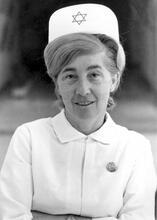
At the beginning of the 1920s, Bertha Landsman, the only registered nurse in Palestine, established community nursing in Israel. She possessed knowledge, initiative and managerial skills, which she used as a public health nurse and in social work. Her career spans from working for the New York City public health department, to founding Hadassah’s public health nursing services in Jerusalem, to administrative work. She helped develop a unique body of knowledge in community nursing and is remembered for her outstanding work ethic and meticulous standards, as well as her passion for the nursing field. Landsman dedicated her life to nursing, becoming one of many who laid the foundation of the nursing profession in Palestine.
At the beginning of the 1920s, Bertha Landsman, who was the only registered nurse in Palestine, established community nursing in Israel. She possessed knowledge, initiative and managerial skills, which she used as a public health nurse and in social work. She worked with Jewish, Christian, and Muslim women, persuading them to abandon folk superstition in favor of “correct knowledge and information,” and also taught nursing to local women students, which was no less a challenge.
Landsman described these pupils critically:
It was an uphill and victorious fight, training a group of young girls, gathered in Palestine from the four corners of the earth, to measure up to the high American standards of public health nurses. Many of these nurses are highly intelligent but have no flair for system and no patience for details, and they are resentful of discipline. (Landsman, “Nursing in Palestine”)
Early Life and Education
field_section_text_value
Nursing and Teaching Career
From 1913 to 1920 Bertha worked for New York City’s public health department in child welfare and hygiene clinics at schools, for the social services at Mount Sinai Hospital in New York, and for about a year at the Battle Hill Tuberculosis Sanitorium in Atlanta, Georgia. She arrived in Palestine in 1920, worked for two years in the pediatrics department at Hadassah Hospital in Jerusalem, and then founded Hadassah’s public health nursing services department, where she worked until 1936. These first baby welfare clinics, the Tipat Halav (lit. “Drop of Milk”), were run according to high American standards and served as a model for the entire country.
In 1922, when two well-baby clinics were established in Jerusalem, one in the Old City and the other in the Sha’arei Pinnah neighborhood, Landsman began giving practical and theoretical training to four students, thus launching the course in public health for registered nurses. This activity was operated in collaboration with the Histadrut Nashim Ivriot (Hebrew Women’s Organization) and the Mothers’ Assistance Association. The Tipat Halav stations, which prepared and distributed pasteurized milk, operated in the Old City from 1922 to 1927. Trachoma and tuberculosis clinics were founded in 1926–1927. Within two years of the opening of the first clinic, nurses trained by Landsman were working in four clinics in Rehovot, Jerusalem, Petah Tikvah and Tiberias. Part of the evolution of the Health Welfare Department, this activity was a significant factor in the decrease in the morbidity and mortality rates of babies in the Jewish Jewish community in Palestine prior to the establishment of the State of Israel. "Old Yishuv" refers to the Jewish community prior to 1882; "New Yishuv" to that following 1882.Yishuv.
Public Health Nursing
field_section_text_value
Administrative Work
Before the hospital moved to Mount Scopus in 1939, the management of Hadassah realized they needed to separate the post of Director of Hospital Nursing Services from that of the director of the nursing school. In consequence, Landsman was asked to serve in the former position, which she did until 1951.
As an administrator, Landsman was remarkable for her organizational skills, her outstanding ability to evaluate workers, her meticulous requirements of the nursing staff, her striving for order and aesthetics, and her excellent rapport with Dr. Haim Yassky (1896–1948), director of Hadassah Hospital in Jerusalem from 1928 to 1948.
Bertha Landsman died in 1962. Never married, she dedicated her life to nursing, becoming one of the generation of giants who laid the foundation of the nursing profession in Palestine, part of the American influence on the Yishuv’s development.
Selected Works
“Women’s Zionist Organization: Training Nurses for Public Health Work in Palestine.” Public Health Nurses (1924): 528–530.
“Development of Public Health in Palestine.” Public Health Nurses 20 (1928): 77–79.
“Nursing in Palestine.” R. N.: A Journal for Nurses 1, 5–6 (1938): 22–26.
Bartal, Nira. “Theoretical and Practical Training of Jewish Nurses in Mandatory Palestine, 1918–1948, through the Prism of the Hadassah School of Nursing, Jerusalem.” Ph. D. diss., Hebrew University (Hebrew). Jerusalem, 2000.
Glass, Joseph. “Immigration of American Jewish Women to Erez Israel, 1918–1939.” In Jewish Women in the Yishuv and Zionism: A Gender Perspective. Edited by Margalit Shilo, Ruth Kark, Galit Hasan-Rokem (Hebrew). Jerusalem: 2001.
Heiman-Elkind, Henia. Interview with author. Jerusalem: 2003.
Levin, Marlin. Balm in Gilead: The Story of Hadassah. New York: 1974.
“Miss Bertha Landsman, Director of Nurses, Rothschild Hebrew University Hospital.” Memo dictated by Landsman, September 9, 1949. The Archives of the Hadassah Medical Organization in New York (record group 2).
Shehory-Rubin, Zipora. “Hadassah’s Educational Enterprises and Health Activities during Mandatory Times.” Ph. D. diss., Ben-Gurion University of the Negev (Hebrew). Beersheva, 1998, 50–53.
Archives of the Hadassah Nursing School (J117) and of the Hadassah Medical Organization (J113), the Central Zionist Archives in Jerusalem, and the Archives of the Hadassah Medical Organization in New York (record group 2).
Double your impact to amplify Jewish women’s stories—
All gifts matched up to $35,000
Before you close this article, please consider supporting the Jewish Women’s Archive and uplifting Jewish women’s voices.
At JWA, we preserve the voices of Jewish women and gender-expansive people past and present, share them freely with millions online, and empower a new generation of Jewish feminists to lead with courage, creativity, and conviction.
But none of this happens without you. JWA is an independent nonprofit— we rely on people, like you, who believe that history belongs to all of us and that the voices of Jewish women must remain powerful, and heard.
This month, a generous JWA board member will match every gift dollar for dollar—up to $35,000—through June 30. Your contribution goes twice as far right now.
Every contribution—no matter the size—helps us document, teach, and inspire through Jewish women’s stories.
It takes less than a minute to make a difference.
Thank you for being a part of the JWA community,
Judith Rosenbaum, CEO